Hattusa’s citadel boasts royal and administrative buildings,…
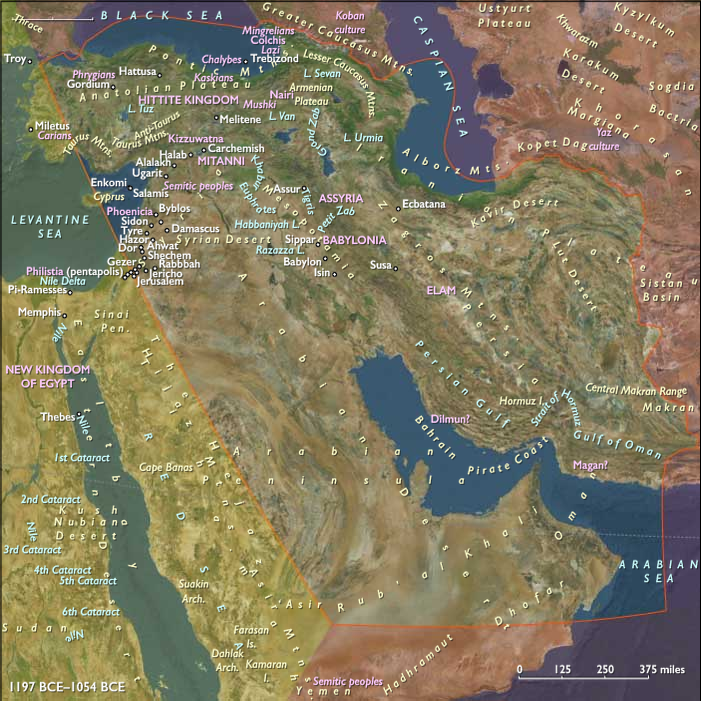
1197 BCE to 1054 BCE
Hattusa’s citadel boasts royal and administrative buildings, five temple complexes, and a massive defensive enclosure wall with its famous lion, sphinx, and so-called king's gates.
Hieroglyphic Luwian, often called Hieroglyphic Hittite (not yet well understood, and its pictographic script not wholly deciphered) probably represents a later stage of development of Cuneiform Luwian.
The language begins to be recorded from 1200 BCE in what are now northern Syria and south central Turkey. (Modern scholars suggest that some of the vocabulary of Hieroglyphic Luwian is preserved as loan words in classical Armenian).
It appears that by the time of the collapse of the Hittite Empire circa 1180 BCE, the Hittite king and the members of the royal family are bilingual in Luwian.
The very last king, Suppiluliuma II, manages to win some victories, including a naval battle against the Sea Peoples off the coast of Cyprus, but these efforts prove too little and too late.
The Sea Peoples have already begun their push down the Mediterranean coastline, starting from the Aegean, and continuing all the way to Philistia—taking Cilicia and Cyprus away from the Hittites en route and cutting off their coveted trade routes.
This leaves the Hittite homelands vulnerable to attack from all directions, Hattusa is burnt to the ground sometime around 1180 BCE following a combined onslaught from Kaskas and Bryges.
The Hittite Kingdom thus vanishes from historical records.
The Eastern Muski appear to have moved into Hatti in the twelfth century, completing the downfall of the collapsing Hittite state, along with various Sea Peoples.
They establish themselves in a post-Hittite kingdom in Cappadocia.
Whether the Muski moved into the core Hittite areas from the east or west has been a matter of some discussion by historians.
Some speculate that they may have originally occupied a territory in the area of Urartu; alternatively, ancient accounts suggest that they first arrived from a homeland in the west, from the region of Troy, or even from as far as Macedonia, as the Bryges.
The historical writings of Herodotus contain the earliest mentions of the Bryges.
He relates them to Phrygians by stating that, according to the Macedonians, the Bryges "changed their name" to Phryges after migrating into Anatolia, a movement that is thought to have happened between 1200 BCE and 800 BCE perhaps due to the Bronze Age collapse, particularly the fall of the Hittite Empire and the resultant power vacuum.
The Kaska, having contributed to the fall of the Hittite empire, then penetrate eastern Anatolia, and continue their thrust southwards, where they encounter the Assyrians.
Together with the Hurrians and Kaskians, the Muski invade the Assyrian provinces of Alzi and Puruhuzzi in about 1160, but they are pushed back and defeated, along with the Kaskas, by Tiglath-Pileser I in 1115 BCE, who until 1110 advances as far as Milid.
The Kaska then disappear from all historical records.
Repulsed by the Assyrians, a subdivision of the Kaska might have passed northeastwards to the Caucasus, where they probably blended with the proto-Colchian or Laz autochthons, forming a polity that was known as the Qulhi to the Urartians and later as the Colchi of the Greeks.
Another branch might have established a polity in Cappadocia that will become a vassal of Assyria in the eighth century BCE.
Locations
Groups
Topics
Commodities
Subjects
Regions
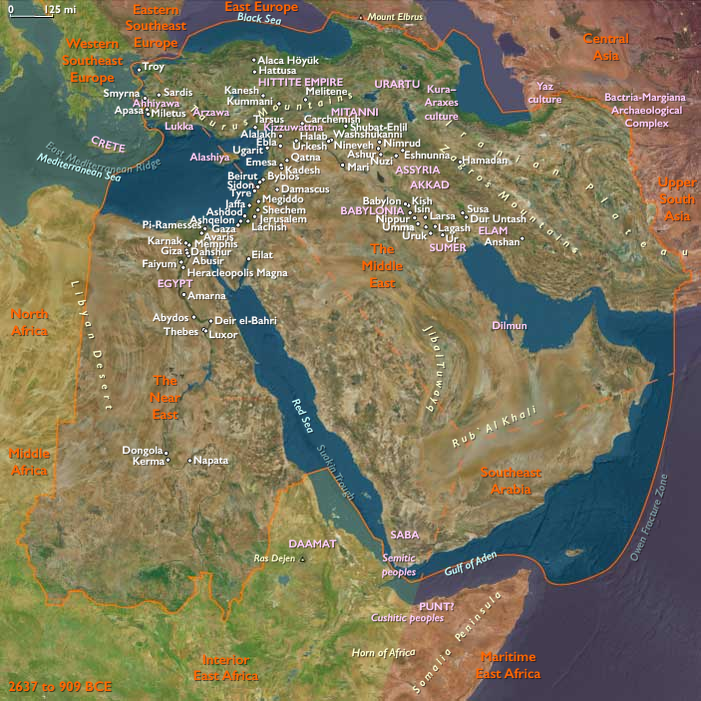
The Near and Middle East
View →Subregions