
Bonaparte sails in May for Alexandria with…
1798 CE
Bonaparte sails in May for Alexandria with over thirty-five thousand troops on three hundred and fifty ships, capturing Malta en route and arriving in Egypt in June having avoided Admiral Horatio Nelson’s British fleet.
Bonaparte occupies Alexandria and Cairo, reorganizes the government and guarantees Islamic Law.
Nelson attacks and destroys the French fleet in the Battle of the Nile at Abukir Bay on August 1.
Bonaparte, unable to leave Egypt, continues to reorganize the nation and helps establish the Institute of Egypt to methodically study ancient Egypt.
People
Subjects
Regions
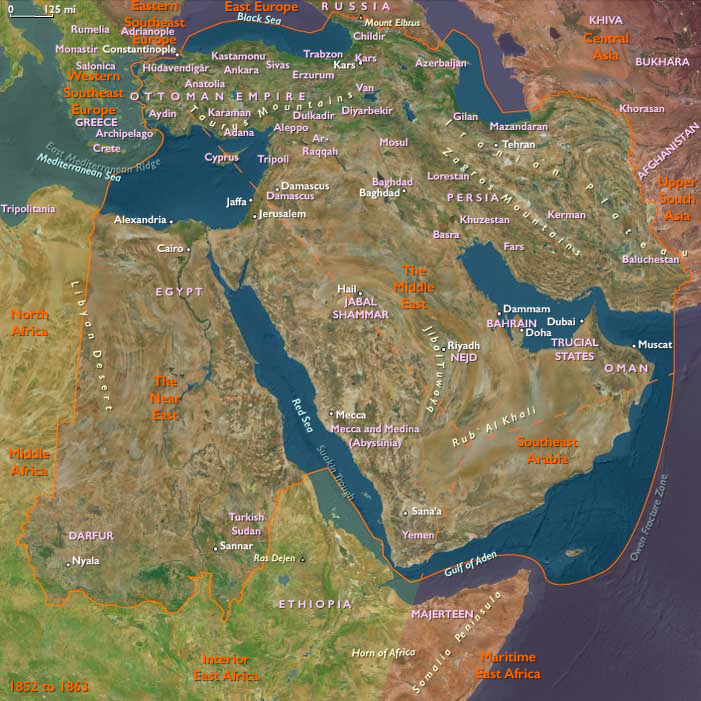
The Near and Middle East
View →Subregions
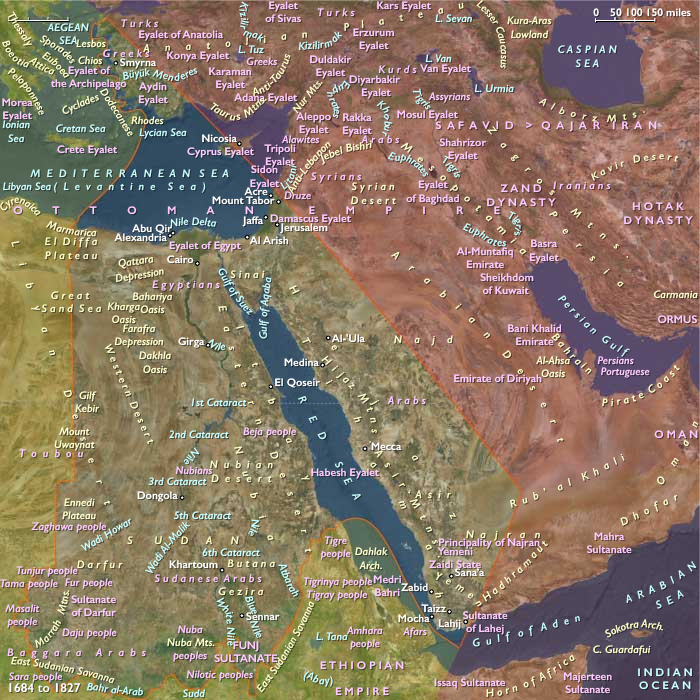
Near East
View →Related Events
No active filters.
Showing 10 events out of 23048 total
According to research, Conrad's find was a gold chunk approximately the size of a shoe and weighing seventeen pounds.
His father John Reed had taken the nugget into Concord to a silversmith, who had informed Reed that the rock did not have any value.
The elder Reed had returned home with it, holding it for three years until a trip in 1802 to Fayetteville, where he sells the "nugget" to a jeweler for $3.50.
Over time John Reed learns that the jeweler had sold the large nugget for several thousand dollars.
Reed returns to Fayetteville insisting on more just compensation.
This discovery and news of the sale spurs the beginning of gold mining in the area.
The policies of Richard Wellesley, known as Earl of Mornington from 1781, conflict with those of the East India Company.
Mornington seems to have caught Pitt's large political spirit in the period 1793 to 1797.
That both had consciously formed the design of acquiring a great empire in India to compensate for the loss of the American colonies is not proved; but the rivalry with France, which in Europe places Britain at the head of coalition after coalition against the French republic and empire, makes Mornington's rule in India an epoch of enormous and rapid extension of British power.
Robert Clive had won and Warren Hastings had consolidated the British ascendancy in India, but Mornington will extend it into an empire.
On the voyage outwards, he forms the design of annihilating French influence in the Deccan.
Soon after his landing, in April 1798, he learns that an alliance is being negotiated between Tipu Sultan and the French republic.
Mornington resolves to anticipate the action of the enemy, and orders preparations for war.
The first step is to effect the disbandment of the French troops entertained by the Nizam of Hyderabad.
A pelt and sketch of the platypus, when the animal is first discovered by Europeans in 1798, are sent back to the United Kingdom by John Hunter.
The fiery revolutionary Rigas Feraios had served a number of Phanariote hospodars in the Danubian principalities, and has spent part of the 1790s in Vienna.
A Hellenized Vlach from Thessaly, in Vienna he has comes under the influence of the French Revolution, as is manifest in a number of revolutionary tracts he has printed, intending to distribute them in an effort to stimulate a Pan-Balkan uprising against the Ottomans.
These tracts include a “Declaration of the Rights of Man” and a “New Political Constitution of the Inhabitants of Rumeli, Asia Minor, the Islands of the Aegean, and the principalities of Moldavia and Wallachia.”
The latter proposes the establishment of what, in essence, would be a revived Byzantine Empire, but an empire in which monarchical institutions would be replaced by republican institutions on the French model.
Rigas' insistence on the cultural predominance of the Greeks, however, and on the use of the Greek language, means that his schemes have little potential interest for the other peoples of the Balkan Peninsula.
In any case, Rigas' ambitious schemes come to naught.
Friedrich von Schlegel founds the journal Athenaum with his elder brother, August Wilhelm von Schlegel, and publishes Geschichte der Poesie der Griechen und Romer (History of the Poetry of the Greeks and Romans) in 1798.
Wahhabi attacks have begun to attract the attention of the Ottoman government, and an Ottoman force invades Al-Hasa in 1798, though Sa'udi forces compel it to withdraw.
He lets them enter Lahore, then encircles them with his army, blocks off all food and supplies, and burns all crops and food sources that could support the Afghan army.
Much of the Afghan army retreats back to Afghanistan.
Neoclassicism in architecture gives way to Greek Revival in America and Classical Revival on the Continent.
The Knights of Malta lose their island to Napoleon Bonaparte in the summer of 1798.
Bonaparte now leads an expedition to Egypt, where his army is trapped and which, after he returns to France, surrenders.
During his absence from Europe, the outbreak of violence in Switzerland meanwhile draws French support against the old Swiss Confederation.
When revolutionaries overthrow the cantonal government in Bern, the French Army of the Alps invades, ostensibly to support the Swiss Republicans.
In northern Italy, Russian general Aleksandr Suvorov wins a string of victories, driving the French under Moreau out of the Po Valley, forcing them back on the French Alps and the coast around Genoa.
However, the Russian armies in the Helvetic Republic are defeated by French commander André Masséna, and Suvorov eventually withdraws.
Ultimately the Russians leave the Coalition when Great Britain insists on the right to search all vessels it stops at sea.
In Germany, Archduke Charles of Austria drives the French under Jean-Baptiste Jourdan back across the Rhine and wins several victories in Switzerland.
Jourdan is replaced by Masséna, who now combines the Armies of the Danube and Helvetia.
Austria, in the wake of defeat by the French, bargains for and receives Istria and Dalmatia from the now-defunct Venetian trading empire.