
Henri Rousseau exhibits his first painting in…
July 1886 CE
Henri Rousseau exhibits his first painting in 1886, not at the official Salon, which would never admit a painter of such naiveté, but at the Salon des Indépendants, an annual exhibition established by young painters to allow themselves and other painters to exhibit and still be free from the narrow official requirements of style and subject matter.
The picture with which the forty-two-year-old Rousseau makes his debut, Carnival Evening (1886, Kunsthalle Tübingen) exhibits an approach to representation that is typical of the naive artist—everything is literally and deliberately drawn; every branch of the trees is traced, the clouds have a curious solidity, and greater attention is paid to the details of costume than to the figures themselves.
What impresses is the painting's design, which is effectively poetic.
Rousseau achieves a striking quality of atmosphere and mood through the accurate and sensitive observation of the colors of the evening and through a literal treatment of trees and clouds that is ultimately unreal and contributes to an air of mystery.
A tinsmith's son and a mediocre student, Rousseau had left the secondary school in Laval without having completed his studies, and soon entered military service, in which he remained for four years.
During his term of service he met soldiers who had survived the French expedition to Mexico (1862-65) in support of Emperor Maximilian, and he lhad istened with fascination to their recollections of the subtropical country.
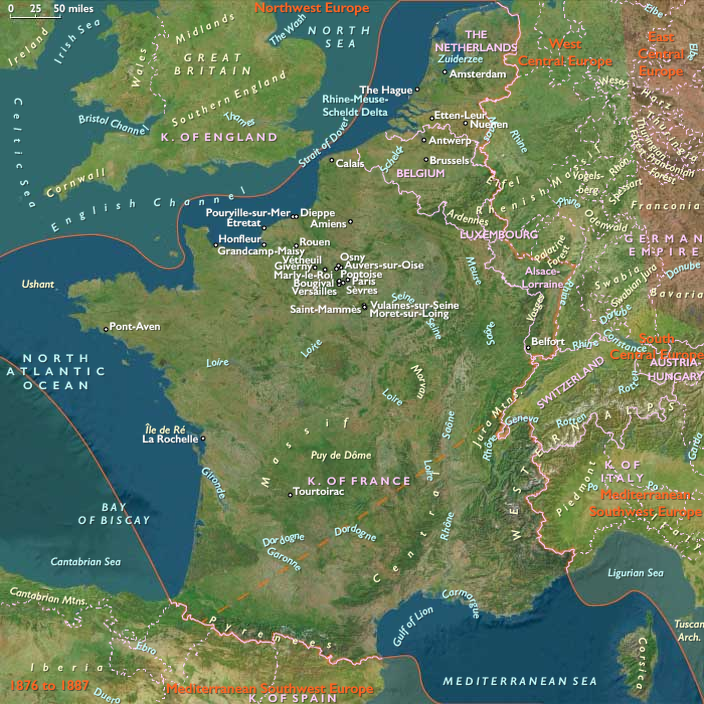
Released from military service upon the death of his father to support his widowed mother, he had settled in 1868 in Paris, and the following year married Clémence Boitard, the daughter of a cabinetmaker.
In Paris he began a career as a petty official, eventually becoming, in 1871, a tax collector in the Paris toll office (from this post comes the name by which in later years he is well known, le douanier, or “customs officer,” in spite of the fact that the toll office had no real customs functions.).
Working as a bureaucrat and busy with family affairs, he has still somehow found time to draw and paint.
He has probably drawn and painted since childhood (although no works remain as evidence) and his stated ambition is to be a painter in the style of the academicians of his day.
In 1884 he had obtained permission to copy paintings at the Louvre.
Images

Henri Rousseau: Carnival Evening (1886); oil on canvas 1,173.99 mm (46.22 ″) x 896.11 mm (35.27 ″) Philadelphia Museum of Art
Locations
People
Subjects
Regions
West Europe
View →Subregions
