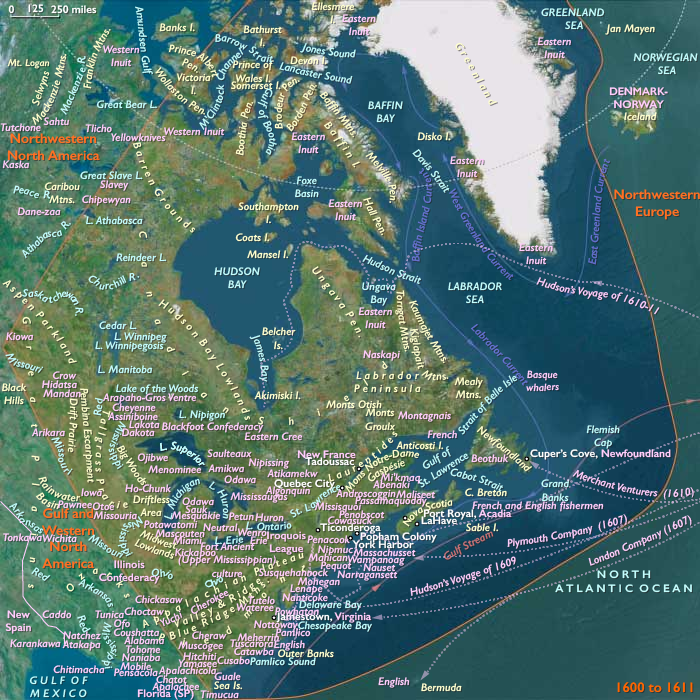
Henry Hudson, chosen by the Dutch East…
July 1609 CE
Henry Hudson, chosen by the Dutch East India Company to find an easterly passage to Asia, has been told to sail through the Arctic Ocean north of Russia, into the Pacific and so to the Far East.
Hudson had departed Amsterdam on April 4, 1609, in command of the Dutch ship Halve Maen.
He could not complete the specified route due to ice like that which had plagued all previous such voyages, and he turned the ship around in mid-May while somewhere east of Norway's North Cape.
At that point, acting entirely outside his instructions, Hudson pointed the ship west to try to find a passage in that direction.
Having heard rumors by way of John Smith of Jamestown and Samuel de Champlain of a passage to the Pacific, he and his crew decided to try to seek a westerly passage through North America.
The natives, who gave the information to Smith and Champlain, were likely referring to what are known today as the Great Lakes (and which could not be reached via any navigable waterways).
They reach the Grand Banks, south of Newfoundland, on the second of July, and in mid-July make landfall near what is now LaHave, Nova Scotia.
Here they encounter natives who are accustomed to trading with the French; they are willing to trade beaver pelts, but apparently no trades occur.
The ship stays in the area about ten days, replacing a broken mast and fishing for food.
A dozen men from the ship, using muskets and small cannon, go ashore on the 25th, and assault the village near their anchorage.
They drive the people from the settlement and take their boat and other property (probably pelts and trade goods).
Locations
People
Groups
Topics
Commodities
Subjects
Regions
Northern North America
View →Subregions