Pre-human remains are found in the Neander…
August 1856 CE
Pre-human remains are found in the Neander Valley in Prussia in 1856.
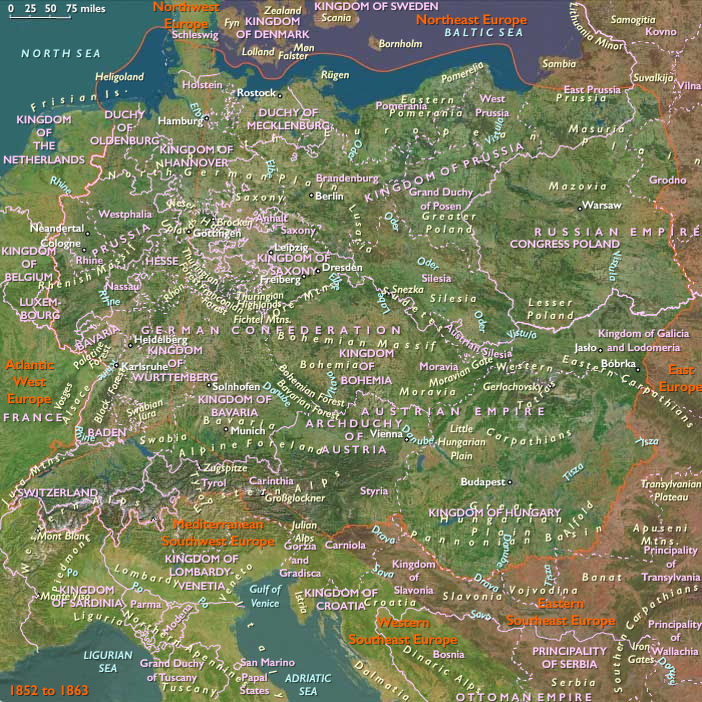
Feldhofer 1, Neanderthal 1 is the scientific name of the forty thousand-year-old type specimen fossil of the species Homo neanderthalensis, found in August 1856 in a German cave, the Kleine Feldhofer Grotte in the Neandertal valley, thirteen kilometers (eight point one miles) east of Düsseldorf.
In 1864 the fossil's description will be first published in a scientific magazine and officially named.
However, the find is not the first Neanderthal fossil discovery.
Rather, the true nature and significance had not been recognized on any of the earlier fossils, and therefore no separate species' name had been assigned.
The discovery is made by limestone quarry miners.
Neanderthal 1 consists of a skullcap, two femora, the three right arm bones, two of the left arm bones, ilium, and fragments of a scapula and ribs.
The fossils are given to Johann Carl Fuhlrott, a local teacher and amateur naturalist.
The first description of the remains will be made by anatomist Hermann Schaaffhausen and the find will be announced jointly in 1857.
In 1997, the specimen will be the first to yield Neanderthal mitochondrial DNA fragments.[5]
In 1999, scientists will announce that recent excavations had led them to some of the sediments of the now-destroyed cave which contained fragments of Neanderthal bones including one that fit exactly to the original femur.[6]
In 2000, the fossil of a second individual from the locality, named Neanderthal 2, will be identified as a Homo neanderthalensis.
The Neanderthal 1 publication represents the beginning of paleoanthropology as a scientific discipline.
The fossil is preserved in the Rheinisches Landesmuseum Bonn since 1877.
As well as the unique historical and scientific importance of this specimen it has continued to play a key role since its discovery.
Locations
People
Groups
Subjects
Regions
Central Europe
View →Subregions