Herod the Great, after annexing the Golan …
Years: 3BCE - 3BCE
Herod the Great, after annexing the Golan in 20 BCE, had erected here a temple of "white marble" in honor of his patron, Augustus.
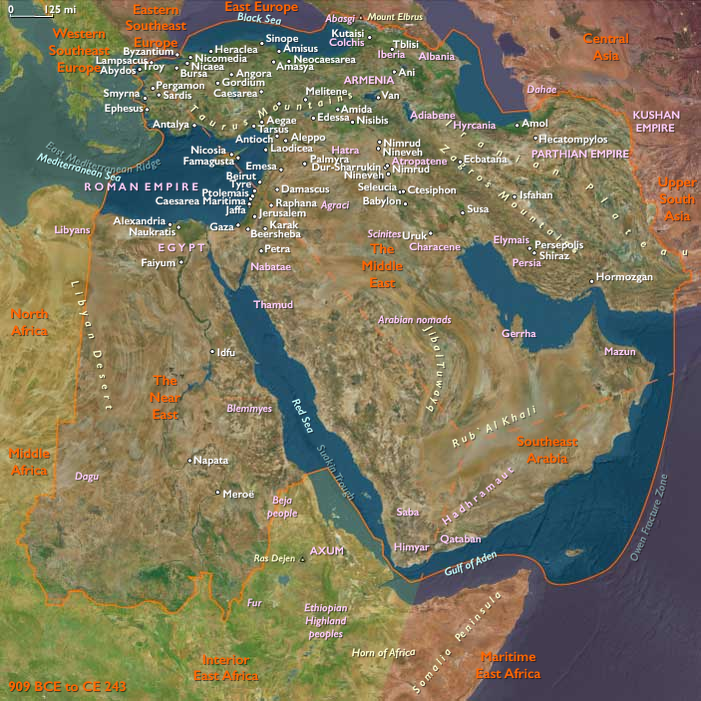
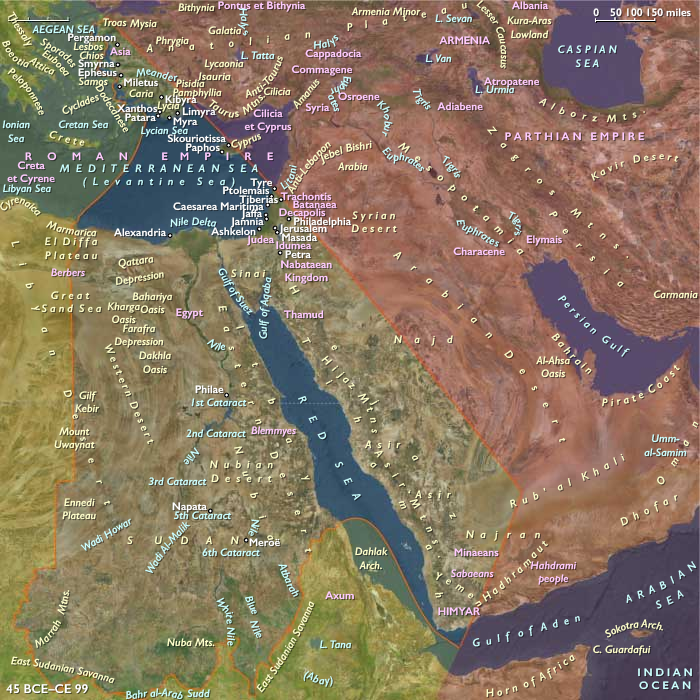
Philip the Tetrarch of Batanaea, which encompasses the Golan and the Hauran, in the year 3 BCE, founds a city at Paneas, which becomes the administrative capital of Philip's large tetrarchy
Flavius Josephus, in The Antiquities of the Jews, refers to the city as Caesarea Paneas; the New Testament as Caesarea Philippi (to distinguish it from Caesarea Maritima on the Mediterranean coast).
Locations
People
Groups
Topics
Commodoties
Subjects
Regions
Subregions
Related Events
Filter results
Showing 10 events out of 62087 total
Publius Quinctilius Varus, whose paternal grandfather was senator Sextus Quinctilius Varus, is a patrician, born to an aristocratic but long-impoverished and unimportant family in the Quinctilia gens.
His mother is a daughter from consul Gaius Claudius Marcellus Minor's first marriage.
His father was Sextus Quinctilius Varus, a senator aligned with the conservative republicans in the civil war against Julius Caesar.
Sextus had survived their defeat, but it is unknown whether he was involved in Caesar's assassination.
He had committed suicide in 42 BCE after the Battle of Philippi.
Varus, despite his father's political allegiances, had become a supporter of Caesar's heir, Octavian, later known as Augustus.
He had in about 14 BCE married Vipsania Marcella, the daughter of Marcus Vipsanius Agrippa and Claudia Marcella Major, and had become a personal friend of both Agrippa and Augustus.
Vipsania Marcella is a grandniece of Augustus; when Agrippa died in 12 BCE, it was Varus who delivered the funeral eulogy.
Thus, his political career was boosted and his cursus honorum finished as early as 13 BCE, when he was elected consul junior partner of Tiberius, Augustus' stepson and future emperor.
Following the consulship, Varus was between 9 and 8 BCE governor of the province of Africa.
He had gone after this to govern Syria, with four legions under his command.
As governor of Syria, Varus is known for his harsh rule and high taxes.
The Jewish historian Josephus mentions the swift action of Varus against a messianic revolt in Judaea after the death in 4 BCE of Rome's client king Herod the Great.
After occupying Jerusalem, he had crucified two thousand Jewish rebels, and may have thus been one of the prime objects of popular anti-Roman sentiment in Judaea, for Josephus, who made every effort to reconcile the Jewish people to Roman rule, felt it necessary to point out how lenient this judicial massacre had been.
Indeed, at precisely this moment, the Jews, nearly en masse, begin a full-scale boycott of Roman pottery (Red Slip Ware).
The archaeological record thus seems to verify mass popular protest against Rome because of Varus' cruelty.
Aretas IV Philopatris, the King of the Nabataeans from roughly 9 BCE and the most powerful neighbor of Judea, frequently takes part in the state affairs of this country, and is to be influential in shaping the destiny of its rulers.
While on not particularly good terms with Rome—as intimated by his surname, "Friend of his People", which is in direct opposition to the prevalent "Friend of the Romans" and "Friend of the Emperor"), and though it was only after great hesitation that Augustus had recognized him as king—had nevertheless taken part in the expedition of Varus against the Jews, and has placed a considerable army at the disposal of the Roman general.
Together with the kidnapped Parthian prince Augustus had given in exchange for the legion standards captured by the Parthians at Carrhae in 53 BCE, he also had given Phraates IV an enslaved Italian girl, "Thea Muse", who has become Queen Musa of Parthia.
To ensure that her child Phraataces will inherit the throne without incident, Musa persuades Phraates IV, whose greatest enemies are his own family, to give his other five sons to Augustus as hostages, thus acknowledging his dependence on Rome.
Again, Augustus uses this as propaganda depicting the submission of Parthia to Rome; he will list it as a great accomplishment in his funerary inscription, Res Gestae Divi Augusti. (The hostages include Tiridates III, whom the Romans will later try to install as a vassal king in CE 35).
He appoints Phraates V successor and in about 2 BCE is murdered by Musa.
Imperial compliments are paid also to Gaius’ younger Lucius in 2 BCE, the year in which their grandfather Augustus receives his climactic title “father of the country” (pater patriae).
As the Augustan building boom continues, many older temples are refaced with marble, and new shrines, such as the Temple of Mars Ultor in the Forum Augusti, are erected at the focal points of forum complexes.
In the battle of Philippi in 42 BCE, in which Augustus and Mark Antony had worked together and avenged Caesar's death, Augustus had vowed to build a temple dedicated to Mars the avenger.
after forty years of construction, the incomplete forum and its Temple of Mars Ultor are inaugurated in 2 BCE as the Forum of Augustus.
The temple consists of a very tall fire wall, and this still distinguishes itself from the neighborhood of Suburra, a notoriously poor district of Rome quite prone to fires.
The tall solid stone wall has been built to protect the marble architecture of the forum from fire, as marble quickly turns to lime once exposed to fire.
The forum consists of a large open space framed by colonnades with semicircular exedrae beyond.
These exedrae honor the founders of Rome, the Julian family, and the leading men of Rome with portrait busts.
In addition to statues of all the Roman triumphatores, which are either made of bronze or marble and are placed along the left side of the Forum and in the left exedrae, the entire right side and right exedrae are full of statues of men in the Julian-Claudian family.
They trace Augustus’s lineage down through the fourteen Alban kings to the founding ancestors Aeneas and Romulus.
According to myth, Rome herself had been born from the god Mars through Romulus.
These figures collectively reinforce the importance of both Roman lineage but also of the prestigious lineage that Augustus himself holds.
By advertising this lineage, he reinforces his power and authorities as a leader.
Also, by placing himself among great figures and heroes, he further portrays himself and his own importance.
He paints himself as one of ‘the greats’ worthy of the power he holds.
The entire decoration of the Forum is tightly connected to the ideology of Augustus.
The open courtyard is dominated by a single octastyle temple, accessible only from the front and with columns on only the front facade.
In addition to Mars Ultor, this temple also honors Venus.
On the left side of the Forum is the Hall of the Colossus, a small room that holds a large cult statue, presumably of Augustus.
The reign of Tigranes IV coincides with the rise of anti-Roman sentiments within Armenian Kingdom.
The Roman Empire apparently did not approve Tigranes IV on the Armenian throne due to the strengthening of Parthia's influence the and pro-Parthian camp in Armenia.
As another major regional power, the Parthian Empire is a strong competitor with Rome over the expansion of imperial influence in the Armenian Kingdom.
Tigranes IV returns to power in Armenia in 2 BCE, likely with the help of the Parthians, but is killed the following year during a war against one of the Caucasian tribes.
The poet Ovid had begun his Amores, written between 10 and 1 BCE, under the influence of his friend Propertius, who wrote about a tormented lover and his irrational, inarticulate passion.
Ovid’s poem portrays a witty lover who refuses to be tormented and instead turns love into a sport.
In Heroides, which also spring from a situation suggested by Propertius, the poet imagines such famous heroines as Ariadne and Dido penning passionate letters to the men who have abandoned them, undertaking an elaborate exploration of the female psyche in fifteen single and three paired letters.
In his Art of Love, written about 1 BCE, he assumes the role of "professor" to instruct men how to seduce Roman women, while in actuality exposing the folly of those who would attempt to turn love into a "science."
NEw event for January 2016
A war threatens to break out between Parthia and Rome about the supremacy in Armenia and Media under the infant Phraates V.
However, when Augustus sends his adopted son Gaius Caesar into the east with proconsular powers in 1 BCE for a mission to Ariobarzanes, ruler of the Roman client kingdom of Armenia, which the Parthians have invaded, the Parthians eventually prefer to conclude a treaty in CE 1, signed on an island in the river Euphrates, by which once again Armenia is recognized as in the Roman sphere, with Ariobarzanes II of Media Atropene as client king.
The year CE 1, alternately known as 1 AD, is popularly taken to be the birth-year in which Jesus of Nazareth is born, although modern scholarship places the event at about 5 or 4 BCE.
The Gospel of Matthew, in its Nativity account, associates the birth of Jesus with the reign of Herod the Great, who is generally believed to have died around 4 BC/BCE.
Matthew 2:1 states that: "Jesus was born in Bethlehem of Judaea in the days of Herod the king" and Luke 1:5 mentions the reign of Herod shortly before the birth of Jesus.
Matthew also suggests that Jesus may have been as much as two years old at the time of the visit of the Magi and hence even older at the time of Herod's death, but the author of Luke also describes the birth as taking place during the first census of the Roman provinces of Syria and Iudaea, which is generally believed to have occurred in 6 AD/CE.
Most scholars generally assume a date of birth between 6 and 4 BC/BCE.
Other scholars assume that Jesus was born sometime between 7 and 2 BC/BCE.
The year of birth of Jesus has also been estimated in a manner that is independent of the Nativity accounts, by using information in the Gospel of John to work backwards from the statement in Luke 3:23 that Jesus was "about 30 years of age" at the start of his ministry.
By combining information from John 2:13 and John 2:20 with the writings of Flavius Josephus, it has been estimated that around 27-29 AD/CE, Jesus was "about thirty years of age".
Some scholars thus estimate the year 28 AD/CE to be roughly the thirty-second birthday of Jesus and the birth year of Jesus to be around 6-4 BC/BCE.
However, the common Gregorian calendar method for numbering years, in which the current year is 2012, is based on the decision of a monk Dionysius in the sixth century, to count the years from a point of reference (namely, Jesus’ birth) which he placed sometime between 2 BC and 1 AD.
Although Christian feasts related to the Nativity have had specific dates (e.g. December 25 for Christmas) there is no historical evidence for the exact day or month of the birth of Jesus.
Christian tradition, based on the Gospels of Saints Mark, Matthew, Luke, and John, has Mary, his mother, being told by an angel that God had miraculously impregnated her.
She and her husband Joseph reportedly traveled to be counted in a census ordered by Augustus, stopping in the town of Bethlehem, the ancestral city of David, to give birth.
The birth of her son, Jesus, is reportedly accompanied by signs and prophecies pointing to his importance as the fulfillment of the hopes of Israel and of God's redemptive purpose for the world.
Jesus is traditionally considered a descendant of Abraham, the father of the Jewish people, and David, their most illustrious king.
Reportedly present at the birth are three "wise men from the East" who follow a star to Bethlehem to worship the infant Jesus, presenting him with gifts of frankincense, gold, and myrrh.
In a Biblical event paralleling the account in Exodus of Pharaoh's massacre of Jewish male babies at the time of Moses' birth, Herod the Great, who died between 4 and 1 BC, had allegedly tried to kill the infant males of Bethlehem, forcing Mary and Joseph to take Jesus to Egypt for safety.
Although Herod is certainly guilty of many brutal acts, including the killing of his wife and two of his sons, the historical accuracy of this event has been questioned, since no other document from the period makes any reference to such a massacre.
Bethlehem is at this time a small rural town, and the number of male children under the age of two would probably not exceed twenty; the number of children actually killed, if any, may have been as few as five or six.
This may be the reason for the lack of other sources for this history, although Herod's order in Matthew 2:16 includes those children in Bethlehem's vicinity making the massacre larger numerically and geographically.
Modern biographers of Herod tend to doubt the event took place; most recent biographies of Herod the Great deny it entirely. (Paul L. Maier, "Herod and the Infants of Bethlehem", in Chronos, Kairos, Christos II, Mercer University Press [1998], p.170.)

The Chinese census shows nearly one million people living in Vietnam.
The population China's of China in its first known nationwide census, taken in 2 CE, is registered as having 57,671,400 individuals in 12,366,470 households.
Wang Mang, an official of China’s Han dynasty, had been born in a distinguished family, but his father had died when he was young and he had held minor posts until being made a marquess in 16 BCE.
His father's half sister is the powerful Grand Empress Dowager Wang Zhengjun, who had been the consort of Emperor Yuan and mother of Emperor Cheng.
Wang Zhengjun (71 BCE–13 CE) was first empress, then empress dowager, and finally grand empress dowager during the reigns of the Emperors Yuan (r. 49–33 BCE), Cheng (r. 33–7 BCE), and Ai (r. 7–1 BCE), respectively.
During this time, a succession of her male relatives have held the title of regent.
In 8 BCE, Wang Mang had been appointed regent for Emperor Cheng, but Cheng had died in 7 BC or 6 BCE and been succeeded by Emperor Ai, who is not related to Empress Dowager Wang.
Wang Mang thus resigned.
After Ai died childless in the year 1 BCE, the throne had been passed to his cousin Emperor Ping - then a child of 9 years old.
Wang Mang had been appointed regent by the Grand Empress Dowager Wang.
Dissatisfied with his father's dictatorial regency, in 3, Wang's son Wang Yu conspires with Emperor Ping's maternal uncles of the Wei clan against Wang, but after they are discovered, Wang has not only Wang Yu and the Weis (except Consort Wei) put to death, but also uses this opportunity to accuse many actual or potential political enemies as being part of the conspiracy and to execute or exile them.
From this time forward, the Han Dynasty exists only in name.
Furthermore, Wang Mang also designates his daughter as the empress consort to Emperor Ping to codify his legitimacy to power.