
The first great indigenous empire to spread…
388 CE to 531 CE
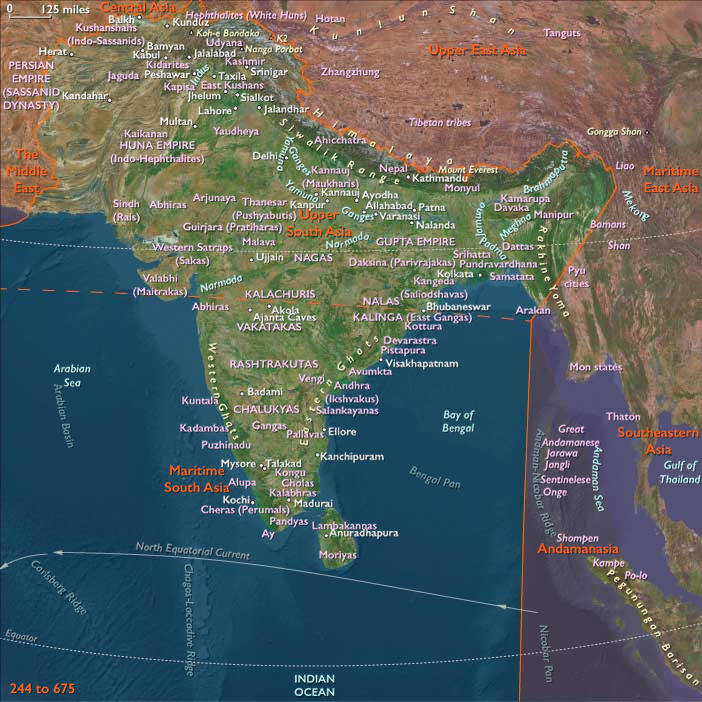
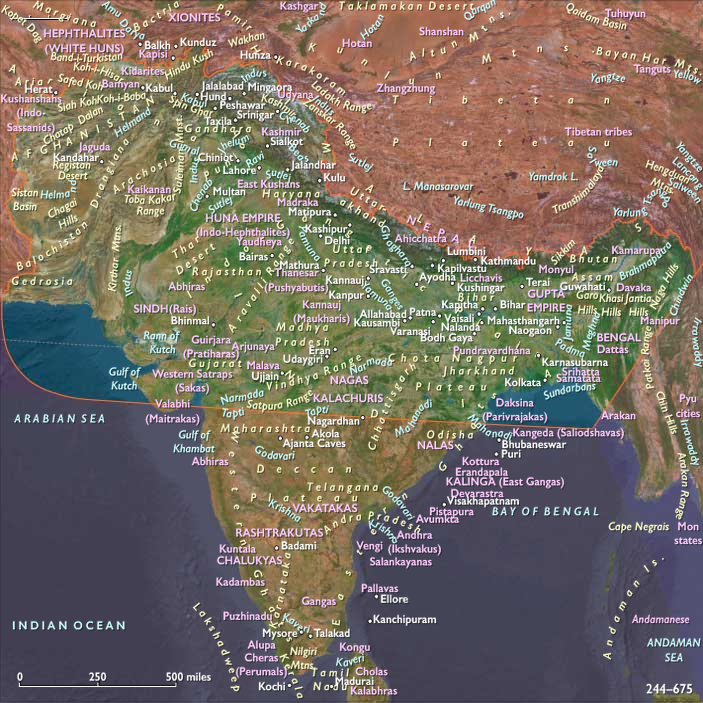
The first great indigenous empire to spread over most of present-day India, Pakistan, and Bangladesh was the Mauryan Empire (ca. 320-180 BCE), whose most famous ruler was Asoka (ca. 273-232 BCE).
Although the empire was well administered and politically integrated, little is known of any reciprocal benefits between it and eastern Bengal.
The western part of Bengal, however, achieves some importance during the Mauryan period because ships sail from its ports to Sri Lanka and Southeast Asia.
During the time of the Mauryan Empire, Buddhism comes to Bengal, and it is from here that Asoka's son, Mahinda, carries the message of the Enlightened One to Sri Lanka.
After the decline of the Mauryan Empire the eastern portion of Bengal becomes the kingdom of Samatata; although politically independent, it is a tributary state of the Indian Gupta Empire (CE ca. 319-ca. 540).
Groups
Topics
Regions
South Asia
View →Subregions
Upper South Asia
View →Related Events
Showing 10 events out of 102 total
Maritime East Asia (388–531 CE): Consolidation of States, Cultural Flourishing, and Technological Advancements
Between 388 CE and 531 CE, Maritime East Asia—comprising lower Primorsky Krai, the Korean Peninsula, the Japanese Archipelago below northern Hokkaido, Taiwan, and southern, central, and northeastern China—witnesses the consolidation of major kingdoms, cultural flourishing, and important technological innovations.
Consolidation and Expansion in Korea: Silla, Baekje, and Goguryeo
Silla, evolving from the walled town of Saro, is consolidated under King Naemul (r. 356–402), establishing a hereditary monarchy east of the Naktong River. By the early sixth century, Silla significantly advances agricultural productivity through oxen plowing and extensive irrigation, enabling greater political stability and cultural development. In 520 CE, an administrative code is adopted, followed by Buddhism becoming the state religion around 535 CE. The bone-rank system emerges, codifying an aristocratic social hierarchy where status and lineage are paramount.
Baekje, after successfully repelling an attack from the Chinese-held region of Lelang in 246 CE, maintains its influential aristocratic state structure, integrating Buddhism officially as the state religion in 384 CE under royal patronage.
Goguryeo, a formidable northern power, continues expansion into Lelang and the broader Korean Peninsula. Its geographic position, marked by harsh climates and mountainous terrain, strengthens its distinct cultural identity, later emphasized in North Korean historiography.
The Gaya Confederacy, consisting of states along the south-central peninsula, maintains close ties with Japan but is eventually absorbed by Silla, despite Japanese military intervention on Gaya’s behalf in 399 CE.
The Yamato Polity and Aristocratic Transformation in Japan
In Japan, the Yamato polity emerges prominently in the mid-Kofun period, defined by influential great clans. Clan patriarchs perform sacred rites to ensure welfare, with a hereditary aristocracy beginning to replace tribal leadership structures. Aristocratic status increasingly determines political influence, shifting power dynamics away from purely clan-based hierarchies.
Political Fragmentation and Cultural Flourishing in China
China experiences continued political fragmentation during the Sixteen Kingdoms (304–439 CE) and the subsequent Southern and Northern Dynasties period (420–589 CE). Despite persistent warfare and instability, this era is culturally vibrant, characterized by advancements in art, science, and religion.
Significant technological innovations include the widespread adoption of the stirrup by 477 CE, enhancing military effectiveness. Additionally, Chinese architecture evolves distinctly, with the development of the pagoda, derived from Buddhist stupa traditions, becoming prominent for housing Buddhist scriptures.
Buddhism and Cultural Exchange
Buddhism spreads widely across China, notably through the influential translations by Kumarajiva, facilitating its integration into Chinese society. By the late fifth century, the distinct Ch’an (Zen) Buddhism emerges prominently, attributed to the teachings of Bodhidharma, emphasizing contemplative meditation as a pathway to enlightenment.
Artistic and Architectural Achievements
Monumental stone sculpture flourishes, exemplified by the Yungang Grottoes near Pingcheng (modern-day Datong). Under imperial patronage of the Northern Wei Dynasty, the caves house immense rock-cut Buddha sculptures, showcasing Central Asian artistic influences. This monumental art form persists through imperial and private support until political upheavals halt further construction by 525 CE.
Legacy of the Age: State Consolidation and Cultural Innovation
Thus, the age from 388 to 531 CE is marked by significant state consolidation, particularly in Korea and Japan, combined with cultural and technological innovations across East Asia. These developments lay foundational structures influencing political, social, and cultural trajectories well into subsequent centuries.
The Sixteen Kingdoms, or less commonly the Sixteen States, are a collection of numerous short-lived sovereign states in China proper and its neighboring areas from 304 to 439 after the retreat of the Jin Dynasty (265-420) to South China and before the establishment of the Northern Dynasties.
The Southern and Northern Dynasties period, which follows the Jin Dynasty and precedes the Sui Dynasty in China, is an age of civil war and political disunity.
It is, however, also a time of flourishing in the arts and culture, advancement in technology, and the spread of foreign Mahayana Buddhism and native Taoism.
Distinctive Chinese Buddhism also matures during this time, shaped by the northern and southern dynasties alike.
China’s northern territory, including the site where Beijing now stands, is largely under the control of invading nomads for nearly three centuries (from the end of the Xi [Western] Jin dynasty in 316/317 to the beginning of the Sui dynasty in 581).
The process of sinicization accelerates during this period among the non-Chinese arrivals in the North and among the aboriginal tribesmen in the South.
Many northern Chinese immigrate to the South.
This process is accompanied by the increasing popularity of Buddhism (introduced into China in the first century CE) in both north and south China, along with Taoism gaining influence from the outline of Buddhist scriptures (with two essential Taoist canons written during this period).
Multiple story towers such as guard towers and residential apartments had existed in previous periods of China.
The distinct Chinese pagoda tower (for storing Buddhist scriptures) evolves during this period from the stupa, the latter originating from Buddhist traditions of protecting sutras in ancient India.
The Three Kingdoms period in China’s history, part of an era of disunity called the Six Dynasties immediately following the loss of de facto power of the Han dynasty emperors, refers in a strict academic sense to the period between the foundation of the Wu in 222 and the conquest of the Shu by the Kingdom of Wei in 263.
Although the three kingdoms had been reunited temporarily in 278 by the Jin Dynasty founded in 265 by the Sima family, the contemporary non-Han Chinese Wu Hu ethnic groups had controlled much of the country in the early fourth century and provoked large-scale Han Chinese migrations to south of the Chang Jiang.
The Di people had rebelled in 303 and later captured Chengdu, establishing the state of Cheng Han.
Under Liu Yuan, the Xiongnu had rebelled near today's Linfen County and established the state of Han Zhao.
His successor Liu Cong had captured and executed the last two Western Jin emperors.
The Sixteen Kingdoms, or less commonly the Sixteen States, are a collection of numerous short-lived sovereign states that have coalesced in China proper and its neighboring areas from 304 after the retreat of the Jin Dynasty to South China in 317.
Almost all rulers of the kingdoms are part of the Wu Hu ethnicity and claim to be the emperors and wangs (kings).
Many nomadic ethnic groups are involved, including ancestors of the Turks, Mongolians, and Tibetans, most of which peoples had to some extent been "Sinicized" long before their ascent to power.
Some of them, notably the Qiang and the Xiongnu, had already been allowed to live in the frontier regions within the Great Wall since late Han times.
The Han Chinese have founded Former Liang and the state of Wei.
Six Chinese rulers of the Former Liang remained titularly under the government of the Jin Dynasty, whose emperors, who are of Chinese stock, now rule southern China from Nanjing.
The Tuoba seizure of China’s northern border areas in 386 has little affected the Chinese heartland, which boasts a large population and a well-integrated social and economic system organized along Confucianist and Buddhist principles.
By the close of the fourth century, a series of sixteen nomadic kingdoms have ruled North China since the erection of the first Xiongnu kingdom in the century’s first decade.
Emperors of Chinese stock rule southern China from Nanjing.
Prominent figure painter Gu Kaizhi, who flourishes in the latter half of the fourth century, is the putative creator of a hand scroll (the earliest surviving example) entitled Admonitions of the Instructress of the Ladies of the Palace.
Such scrolls typically portray human figures as edifying exemplars of good character.
The creator of Admonitions, employing a needle-fine brush point, brings a keen psychological sense to the delineation of his subjects, embodying them by their clothes, rather than by their flesh.
The Admonition Scroll, dated between the sixth and eighth century CE—probably an early Tang dynasty copy —illustrates nine stories from a political satire about Empress Jia Nanfeng written by Zhang Hua, who lived from about 232 to 302.
Beginning in the eighth century, many collectors and emperors left seals, poems, and comments on the scroll.
The Admonition Scroll will be stored in the emperor's treasure until it is looted by the British army in the Boxer Uprising in 1900.
It is today in the British Museum collection, missing the first three scenes.
There is another surviving copy of this painting, made during the Song Dynasty and is now held in the Palace Museum in Beijing.
The Song version is complete in twelve scenes.
Baekje, its influence not limited to the Korean peninsula, had become a dominant power in East Asia, after defeating Goguryeo in 371.
This state's King Geunchogo (r. 346-375) had seized several coastal cities of China, notably in Liaoxi and Shandong, to retain its superiority over Goguryeo and a variety of southern Chinese dynasties, which had arisen within the context of extended civil wars caused by the fall of the Han Dynasty in 220 CE and the concomitant invasions of foreign tribes, including but not limited to the Xiongnu and Xianbei (Wu Hu).
Baekje under Geunchogo's leadership also seems to have had a close relationship with parts of Japan and has established good relations with that archipelago's natives.
Xie Xuan, the Jin Dynasty general who is best known for repelling the Former Qin army at the Battle of Fei River, thus preventing the Former Qin emperor Fu Jiān from destroying Jin and uniting China, had after 386 apparently suffered a series of illnesses that had made it impossible for him to conduct any further campaigns and which also made him to repeatedly try to resign his command.
Eventually, he was made the governor of Kuaiji prefecture (roughly modern Shaoxing, Zhejiang)—an important, but almost entirely civilian, post.
He dies in 388 while still serving as the governor of Kuaiji.
Zhai Liao, a leader of the Gaoche, or Dinglings, had previously vacillatied between being a vassal of Later Yan, Western Yan, or Jin Dynasty.
In spring 388, he sends his subordinate Sui Qiong to apologize to Later Yan's emperor Murong Chui, but Murong Chui no longer believes him, and kills Sui to show that he is not interested.
Zhai Liao then declares an independent Wei state and declares himself the Heavenly Prince.
He also changes the era name and establishes an imperial government.
He now moves his capital to Huatai (in modern Anyang, Henan).
Qifu Guoren had been a Xianbei tribal chief in the modern southern/southwestern Gansu region and founded the Chinese/Xianbei state Western Qin in 385.
(The Western Qin is entirely distinct from the ancient Qin Dynasty, the Former Qin, and the Later Qin.)
Dividing his domain into twelve prefectures, he had established his capital at Yongshicheng (in modern Lanzhou, Gansu).
Over the next two years, he had gradually drawn the Xianbei and other ethnic groups into his state.
In 387, however, contrary to his prior stance against Former Qin, Qifu Guoren had accepted the title of Prince Xuanlie of Wanchuan bestowed on him by the Former Qin emperor Fu Deng and nominally become a Former Qin vassal again, although he does not use the Former Qin era name.
Qifu Guoren dies in summer 388 and as his son Qifu Gongfu is still young, his subordinates support his brother Qifu Gangui to succeed him.
Yao Chang had been had been a powerful general and Qiang chieftain under the Later Zhao emperor Shi Hu, but after Later Zhao's collapse after Shi Hu's death, Yao Chang's older brother Yao Xiang had attempted to start an independent state but was defeated and killed by Former Qin forces.
Yao Chang became a Former Qin general, but after an incident in 384 after the Former Qin emperor Fu Jiān's defeat at the Battle of Fei River, Yao Chang feared that Fu Jiān would kill him and therefore rebelled.
He subsequently captured and killed Fu Jiān, who had saved his life when Yao Xiang was defeated, causing many historians to view him as a traitor and murderer.
Western Yan forces, under its emperor Murong Chong, had then occupied Chang'an, and Western Yan and Later Qin had battled on-and-off.
However, the Western Yan people were unhappy that Murong Chong was not leading them back to their homeland in the east, and, in 386, Murong Chong had been assassinated in a coup and replaced with Deng Sui, who was then assassinated and replaced with Murong Yi, under whom the Western Yan people abandoned Chang'an and headed east.
Briefly, Chang'an was held by the Xiongnu chief Hao Nu, but Yao Chang then advanced on Chang'an, and Hao surrendered.
Yao Chang had made Chang'an his capital and claimed the title of emperor of Later Qin.
He had created his wife Lady She as empress and his son Yao Xing as crown prince.
For the next few years, Yao Chang has not been able to attain complete control over the region, as many Di, Qiang, Xiongnu, and Han generals remain semi-independent throughout the region.
Further, in 386, a distant member of Former Qin's imperial Fu clan, Fu Deng, had risen in modern eastern Gansu to oppose him, and after the death of Fu Jiān's son Fu Pi that year, had claimed imperial title and became the main adversary for Yao Chang.
Fu Deng has used Yao Chang's killing of Fu Jiān to good propaganda effect, and for several years has been quite successful in battles against Yao Chang, although the battles have generally been inconclusive in their impact, with neither Fu Deng nor Yao Chang being able to decisively defeat the other.
However, Yao Chang has been able to gradually subdue the other Former Qin generals of the region, taking advantage of Fu Deng's cautiousness.
In 387, for example, after the Former Qin general Fu Zuan had been killed by his brother Fu Shinu, Yao Chang had taken the opportunity to quickly advance against Fu Shinu and defeat him, seizing his troops.
He also, at the same time, seized the remaining cities held by Western Yan west of the Yellow River.
In 389, after losing several battles to Former Qin, Yao Chang becomes apprehensive and thinks that it is Fu Jiān's spirit aiding Former Qin, so he, following Fu Deng's lead, makes an image of Fu Jiān and worships it, claiming to it that he had killed Fu Jiān only to avenge Yao Xiang and asking for forgiveness.
The image does not help Yao Chang, and he eventually cuts off its head and sends it to Fu Deng.
Later that year, as Fu Deng is pressuring Yao Chang, however, Yao Chang makes a surprise attack at night, around Fu Deng's army, against Fu Deng’s logistics base.
Dajie (in modern Xianyang, Shaanxi), capturing it and Fu Deng's wife Empress Mao and killing his sons Fu Bian and Fu Shang.
He initially wants to make Empress Mao his concubine, but after she curses him, he executes her.
While Former Qin and Later Qin will continue to stalemate for the next few years, Fu Deng will be unable to again threaten Later Qin's existence from this point on.
Zhai Liao captures Jin's Yingyang prefecture (roughly modern Zhengzhou, Henan) in 389.
He also sends his general Gu Ti to pretend to surrender to the Later Yan Prince of Lelang, Murong Wen, and assassinate Murong Wen, although that maneuver yields him no territory, as Gu's forces are quickly destroyed by Murong Nong.
Jin general Liu Laozhi attacks Zhai Liao in autumn 390, capturing Juancheng (in modern Puyang, Henan), forcing Zhai Liao's son Zhai Zhao, who is in charge of the city, to flee, and next …