Jung Bahadur Kunwar's early career parallels that…
1840 CE to 1851 CE
Jung Bahadur's great-grandfather had been an important military leader under Prithvi Narayan Shah in the eighteenth century, and during the war with China (1791-92) his grandfather was also a military leader, who became one of the four chief administrators (kaji) of the Gorkha-Nepalese state.
His father, Bala Narasimha Kunwar, was in court the day Rana Bahadur Shah was murdered and killed the murderer on the spot.
For this action, he had been rewarded with the position of kaji, which has been made hereditary in his family.
Jung Bahadur joined the military service in 1832-33 at the age of sixteen.
As maternal grandson of Bhimsen Thapa, he lost his job and his property when the latter fell.
After wandering in northern India for several years, he returned to Nepal as a captain in the artillery in 1840.
In November 1841, he is asked by the king to join his bodyguard, and in January 1842 he begins work as kaji in the palace.
When Mathbar Singh returns to power, Jung Bahadur rises with him but Mathbar Singh dislikes his ambition and has him removed to a lesser position on the staff of the heir apparent.
When Fateh Jang Chautaria comes to power, Jung Bahadur becomes fourth in the hierarchy of the coalition government and takes pains to flatter the queen while showing no signs of ambition to Gagan Singh.
A career opportunist, he is ready and waiting when the time comes to act at the Kot Massacre.
Locations
People
Groups
Regions
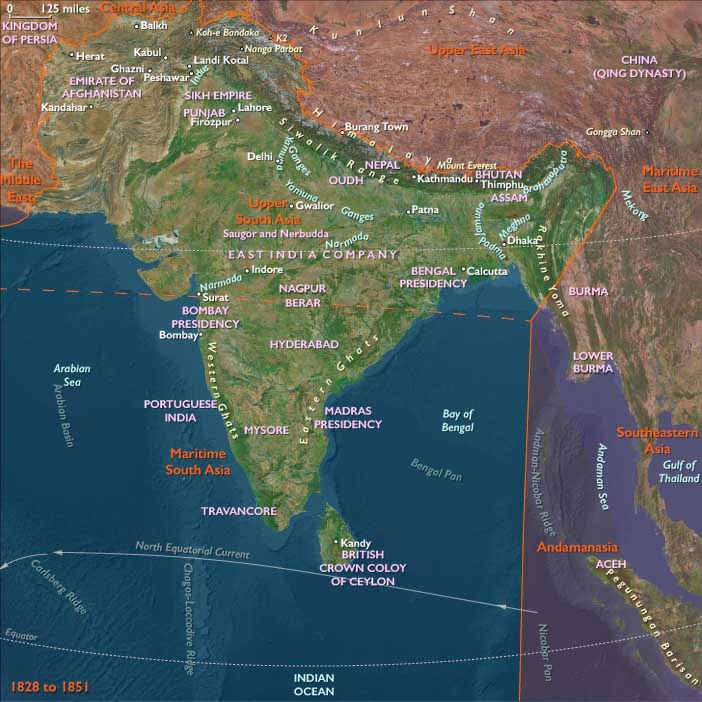
South Asia
View →Subregions