George II is blind in one eye…
October 1760 CE
On the morning of 25 October, he rises as usual at 6:00 am, drinks a cup of hot chocolate, and goes to his close stool, alone.
After a few minutes, his valet hears a loud crash.
He enters the room to find the king on the floor.
The king is lifted into his bed, and Princess Amelia is sent for, but before she reaches him, he is dead.
At the age of nearly 77, he has lived longer than any of his English or British predecessors.
A post-mortem reveals that the right ventricle of the king's heart had ruptured as the result of an incipient aortic aneurysm.
George II is succeeded by his grandson George III, and is buried on November 11 in Westminster Abbey.
He had left instructions for the sides of his and his wife's coffins to be removed so that their remains can mingle.
He is the most recent monarch to be buried in Westminster Abbey.
During George II's reign British interests had expanded throughout the world, the Jacobite challenge to the Hanoverian dynasty had been extinguished, and the power of ministers and Parliament in Britain had become well-established.
Nevertheless, in the memoirs of contemporaries such as Lord Hervey and Horace Walpole, George is depicted as a weak buffoon, governed by his wife and ministers.
Biographies of George written during the nineteenth and first part of the twentieth century relied on these biased accounts.
Since the last quarter of the twentieth century, scholarly analysis of surviving correspondence has indicated that George was not as ineffective as previously thought.
Letters from ministers are annotated by George with pertinent remarks and demonstrate that he had a grasp of and interest in foreign policy in particular.
He was often able to prevent the appointment of ministers or commanders he disliked, or sideline them into lesser offices.
This academic reassessment of George II, however, has not totally eliminated the popular perception of him as a "faintly ludicrous king".
His parsimony, for example, may have opened him to ridicule, but his biographers observe that parsimony is preferable to extravagance.
Locations
Subjects
Regions
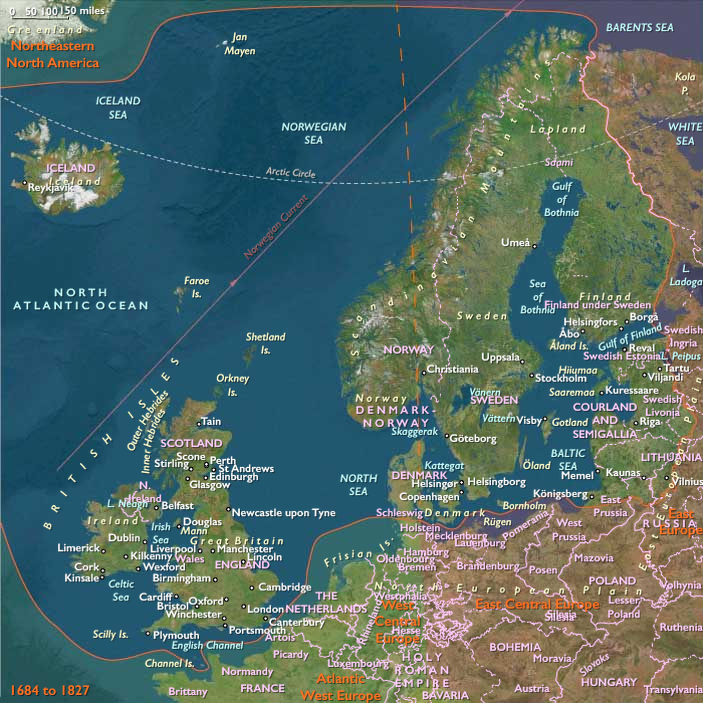
North Europe
View →Subregions