
Hugh's power in Italy is damaged but …
Years: 933 - 933
Hugh's power in Italy is damaged but not destroyed by the events in Rome and Provence.
To strengthen his hand in the affairs of Milan, he tonsures his younger illegitimate son, Tebald, to groom him for the position of Archbishop of Milan; unfortunately the ancient cleric, Arderic, whom he has installed pro tem will live another twenty-two years.
He continues to organize the fight against the Magyars and the Andalusian pirates based at Fraxinet in Provence.
Active, if sometimes dubious, diplomacy pays off.
He concludes a treaty with Rudolph in 933 by which Rudolf abandons his claims to Italy in return for being handed Provence over the heads of the heirs of Louis the Blind and the marriage of Rudolph's daughter Adelaide to Hugh's son Lothair.
Locations
People
- Adelaide of Italy
- Alberic II of Spoleto
- Boso
- Charles-Constantine of Vienne
- Guy
- Hugh of Italy
- Lothair II of Italy
- Marozia
- Pope John XI
Groups
- Christianity, Chalcedonian
- Saracens
- Papal States (Republic of St. Peter)
- Italy, Carolingian Kingdom of
- Francia Occidentalis (West Francia, or France), Kingdom of
- Tuscany, Margravate of
- Burgundy, Lower, Kingdom of
- Hungary, Principality of
Topics
Commodoties
Subjects
Regions
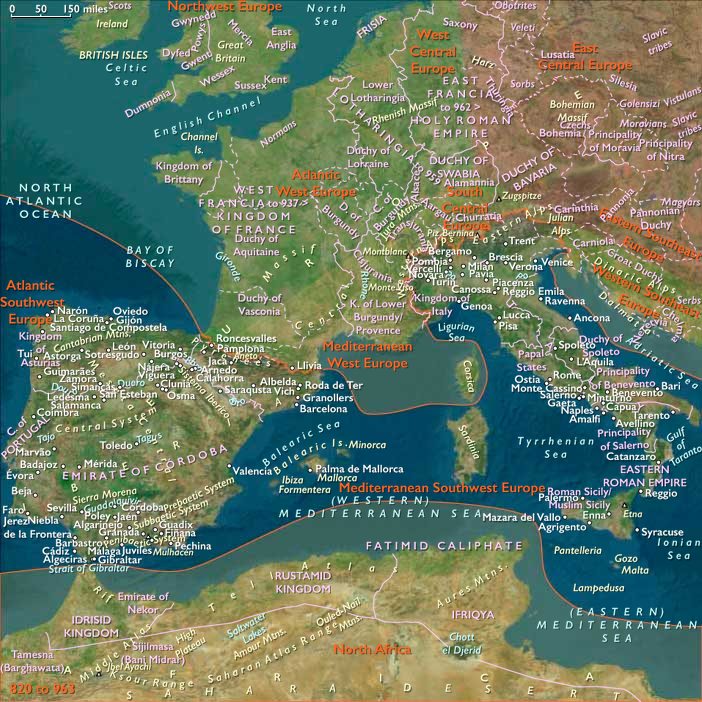
Subregions
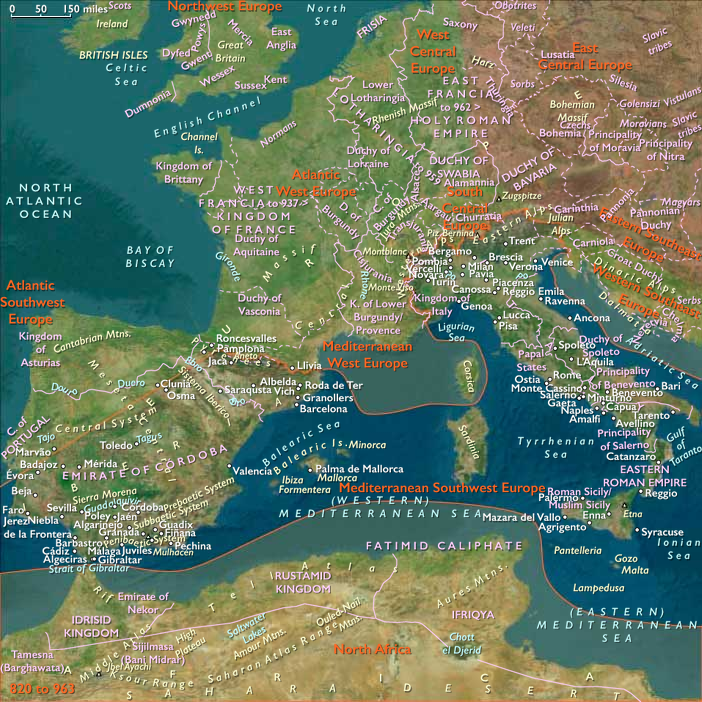
Related Events
Filter results
Showing 10 events out of 53156 total
The Magyars (Hungarians), Eurasian nomads who had originally served as mercenaries under Emperor Arnulf, after his death in 899 had begun to campaign in the Kingdom of Italy and East Francia.
In 906, they had broken up Great Moravia and one year later destroyed a Bavarian army under Margrave Luitpold at the Battle of Pressburg.
A Magyar army invading the German duchy of Saxony in 924 had defeated King Henry I in the field, but an Árpád prince—possibly Zoltán—captured near Pfalz Werla had allowed Henry to negotiate for terms.
A truce of nine years, during which annual tribute was required of the Germans, had been declared in 926.
During the truce, Henry has reorganized the defenses of his Saxonian duchy and subdued the Polabian Slavs in the east.
At an 926 assembly, Henry had secured the construction of new castles and the authorization of a new form of garrison duty: the soldiery are organized into groups of nine agrarii milites (farmer-soldiers), one of which is doing guard duty at any given time while the other eight work the fields.
In time of invasion, all nine can man the castles.
Once he believed the necessary reforms had been made, Henry had secured the support of the church in reneging on tribute payments in 932.
Allegedly he had a dead dog thrown down in front of the Magyar negotiators, which amounts to a declaration of war.
In preparation for the campaign, Henry has levied mounted contingents from every region and stem duchy of the German kingdom, though only French chronicler Flodoard of Reims records the Bavarian presence.
The Magyars had besieged an unknown town but attempted to withdraw in the night because Henry and his army have camped in the neighborhood at Riade.
Henry sends forward a small contingent of foot soldiers with a few cavalrymen as a screen for his main army.
The king had learned what to expect from the preceding struggles, where the rapidity of the Magyar light cavalry and archers had brought them success.
He confronts their onset with lightly armored combatants at first, followed by a massed heavy cavalry attack.
According to Widukind of Corvey, the Magyar forces readily fled at the coming of Henry's horsemen and the victorious German troops declared Henry emperor on the battlefield.
The exact location of the battle is unknown and several municipalities in Central Germany claim to be the site of the combat, among them Kalbsrieth, at the confluence of Unstrut and Helme, and the Hunnenfeld near Riethgen.
However the place of Riade rendered by Widukind denotes the army camp of King Henry, probably not identical with the battlefield.
The Magyars, who will not dare to make a further raid on East Francia in Henry's lifetime, will again invade Germany in 954 during a rebellion instigated by Duke Liudolf of Swabia; they will be finally defeated the following year by Henry's son and successor King Otto I at the Battle of Lechfeld.
Some of the earliest accounts concerning the island of Comoros are derived from the works of Al-Masudi, which mention the importance of the Comoro Islands, like other coastal areas in the region, along early Islamic trade routes and how the islands are frequently visited by Muslims including Persian and Arab merchants and sailors from Basra in search of coral, ylang-ylang, ivory, beads, spices, gold.
They also bring Islam to the people of the Zanj, including Comoros.
Al-Masudi in the year 933 mentions Muslim sailors who call the Comoros islands: "the Perfume Islands" and sing of waves that break rhythmically along broad, pearl-sand beaches, the light breezes scented with vanilla and ylang-ylang, a component in many perfumes.
Meinrad’s kinsmen, Abbots Hatto and Erlebald, had run the abbey school on Reichenau Island, in Lake Constance, where Meinrad had been educated, became a monk and been ordained a priest.
After some years at Reichenau, and at a dependent priory on Lake Zurich, he had embraced an eremitical life and established his hermitage on the slopes of Etzel Mountain.
Meinrad died on January 21, 861, at the hands of two robbers who thought that the hermit had some precious treasures, but during the past eighty years the place has never been without one or more hermits emulating his example.
One of them, named Eberhard, previously Provost of Strassburg, erects in 934 a monastery and church here, of which he becomes first abbot.
Hugh makes peace in 933 with Rudolph of Upper Burgundy by giving him the Kingdom of Lower Burgundy, and the two the Transjurane and Cisjurane sections of Burgundy are combined into a single Kingdom of Burgundy (later called Arles).
Rudolph, in turn, relinquishes all his rights to Italy.
Verona has long been the ordinary residence of the kings of Italy.
The government of the city has become hereditary in the family of Count Milo, progenitor of the counts of San Bonifacio.
Ratherius was born about 887 into a noble family which lived in the territory of Liège.
While still a boy, he had been sent as an oblate to the Benedictine Abbey of Lobbes in Hainaut, where he was a diligent student, acquired much learning, and became a monk of the abbey.
At an early age he displayed a restless nature, a disposition difficult to get along with, great ambition and harsh zeal.
Consequently, notwithstanding his strict orthodoxy, wide learning and sobriety of conduct, he has met with great difficulties in every position he assumed, and has nowhere attained permanent success.
When Abbot Hilduin of Lobbes went in 926 to Italy, where his cousin, Hugh of Provence, is king, he had taken Ratherius with him as companion.
After many difficulties, Ratherius had received from the king the Diocese of Verona in 931.
Upset about the good relations between the city and its Jewish inhabitants, he had badgered the town elders until they agreed to temporarily expel the Jewish community, present in Verona since Roman times.
Yet he only rules his see for two years, soon falling into a quarrel with both the members of his diocese and with the king, so that the latter sends him to prison and has him brought to Como.
The Idrisids of Fés had been ousted in 927 by the Fatimid Caliphate and their Miknasa Berber allies.
After the Miknasa broke off relations with the Fatimids in 932 and formed an alliance with the Spain-based Umayyad Caliphate, the Fatimids mount a failed attempt in 933 to seize the Maghreb al-Aqsa (nowadays Morocco).
William Longsword Faces a Norman Rebellion (c. 927–933)
After succeeding his father Rollo as ruler of Normandy in 927, William Longsword quickly faces resistance from within his own ranks. Many of his Norse followers, particularly the more traditionalist Viking leaders, believe he has become too Gallicized and too lenient in his rule. This early rebellion, led by Riouf of Évreux, threatens William’s authority in the duchy.
The Norman Rebellion: A Reaction to William’s Frankish Influence
- William Longsword continues his father’s policies, adopting Frankish customs, language, and governance, which alienates some of the Viking nobility.
- Many Normans still view themselves as independent Norse warriors, resisting full assimilation into the Frankish feudal system.
- Riouf of Évreux leads a faction of discontented Norman nobles in rebellion against William’s rule, attempting to challenge his leadership.
William Secures His Heir: The Birth of Richard I (933)
- During the rebellion, William sends his pregnant wife, Sprota, to Fécamp, a safer location away from the conflict.
- Their son, Richard I, is born in 933 at Fécamp, ensuring the continuation of the dynasty founded by Rollo.
- Sprota, a Breton noblewoman, plays a crucial role in Norman politics as the mother of William’s successor.
Outcome of the Rebellion and William’s Rule
- William ultimately crushes the rebellion, securing his rule over Normandy.
- However, the uprising demonstrates the fragile balance of power in early Norman society, where Viking traditions still clashed with Frankish influences.
- William’s success ensures that Normandy continues to integrate into the West Frankish kingdom, but it also shows that his rule is not uncontested.
Conclusion: A Turning Point in Norman Identity
The rebellion against William Longsword (927–933) highlights the ongoing cultural transformation in Normandy, as Norse rulers gradually adopt Frankish customs. Though he defeats the insurgents, the tensions between Norman warriors and feudalized Frankish-Norman aristocrats will continue to shape the region’s political landscape for generations. Meanwhile, the birth of Richard I in 933 ensures that the dynasty of Rollo remains intact, setting the stage for the continued rise of Norman power in medieval Europe.
William Longsword Recognizes King Rudolph and Gains Breton Territories (933)
In 933, William Longsword, the ruler of Normandy, formally recognizes King Rudolph (Raoul) of West Francia, who is struggling to assert his authority in northern France. In return, Rudolph grants William lordship over much of the Breton lands, significantly expanding Norman control beyond the Seine Valley.
Rudolph’s Need for Norman Support
- By 933, King Rudolph of Burgundy (Raoul) is still contesting his rule against the Carolingian claimant, Charles the Simple, and dealing with internal noble resistance.
- Northern France remains unstable, with regional lords like Herbert II of Vermandois, Hugh the Great, and Arnulf of Flanders holding considerable autonomy.
- Rudolph seeks William Longsword’s allegiance as the Duke of Normandy to help secure his northern frontier, particularly against Viking and noble threats.
The Expansion of Normandy: Avranches and the Cotentin
- In exchange for William’s recognition of his kingship, Rudolph grants him lordship over key Breton lands:
- Avranches → A strategic coastal town that helps secure Norman access to the Channel.
- Cotentin Peninsula → A highly fortified region with Viking settlements, making it a natural extension of Normandy.
- These territories had previously been part of Brittany, but with Breton power weakened by Viking invasions, they are transferred to Norman control.
Significance of the 933 Agreement
-
Normandy Expands Westward
- The incorporation of Avranches and Cotentin doubles the size of Norman-controlled lands, further establishing the duchy as a dominant power in northern France.
-
Weakened Breton Independence
- Brittany, already devastated by Viking raids and the loss of Nantes to Norse control, is now further dismembered, making a Breton resurgence unlikely for decades.
-
Rudolph Strengthens His Hold Over Northern France
- By securing William Longsword’s loyalty, Rudolph gains a powerful northern ally to counter both Carolingian loyalists and the rebellious Frankish nobility.
Conclusion: The Rise of Norman Influence in the West
The 933 recognition of King Rudolph by William Longsword is a turning point in the consolidation of Norman power in France. With control over parts of Brittany, the Normans now expand beyond their original grant in the Seine Valley, reinforcing their military and political dominance in northern Francia. This expansion westward lays the foundation for Normandy’s growing strength, which will later culminate in its role in the Norman Conquest of England in 1066.
The Breton Resistance to Norman Expansion and the Flight of Alan II Wrybeard (933–935)
As William Longsword of Normandy expands his domain westward into Brittany in 933, Breton leaders, particularly Alan II Wrybeard, Duke of Brittany, and Judicael Berenger, Count of Rennes, lead a resistance movement against Norman rule. However, their efforts are short-lived, ending with Alan fleeing to England and Judicael Berenger seeking reconciliation with the Normans.
Breton Resistance Against the Normans (933–935)
- The Norman annexation of Avranches and the Cotentin in 933 under William Longsword severely weakens Brittany, which had already suffered from decades of Viking incursions and noble infighting.
- Alan II Wrybeard (son of Count Mathuedoï of Poher) and Judicael Berenger of Rennes attempt to mobilize Breton forces against the Norman advance.
- The Bretons engage in skirmishes with the Normans, but their forces lack the strength and unity to mount an effective resistance.
The Collapse of the Breton Resistance (c. 935)
- The Normans, better organized and supported by West Francia, quickly overpower the Breton resistance.
- Alan II Wrybeard, seeing no path to victory, flees to England, seeking refuge with King Æthelstan, who had supported previous Breton exiles during Viking invasions of Brittany.
- Judicael Berenger of Rennes, realizing continued resistance is futile, seeks reconciliation with William Longsword, effectively submitting to Norman rule in order to retain his lands and influence.
Consequences of the Breton Defeat
-
Normandy Strengthens Its Hold Over Western Francia
- William Longsword further consolidates Norman rule in the west, making Normandy the dominant power in northern France.
-
Brittany Remains in Disarray
- With Alan II in exile and Judicael Berenger submitting to the Normans, Brittany loses its independence, becoming a fragmented and weakened region.
- Viking influence in Brittany remains strong, with Norman control extending deeper into Breton lands.
-
The Beginning of Norman-Breton Rivalry
- Although Brittany is temporarily subdued, Breton leaders will later return to reclaim their homeland, setting the stage for future conflicts between Brittany and Normandy.
Conclusion: Brittany Falls, but Resistance Will Continue
The defeat of the Breton resistance (c. 935) marks the temporary end of an independent Brittany, as Normandy extends its reach westward. However, Alan II Wrybeard’s flight to England ensures that Breton leadership survives in exile, setting the stage for his eventual return and the restoration of Brittany in later years.
The Channel Islands, which lie within thirty miles (forty-eight kilometers) of the French coast, become part of the county of Normandy in 933.
Years: 933 - 933
Locations
People
- Adelaide of Italy
- Alberic II of Spoleto
- Boso
- Charles-Constantine of Vienne
- Guy
- Hugh of Italy
- Lothair II of Italy
- Marozia
- Pope John XI
Groups
- Christianity, Chalcedonian
- Saracens
- Papal States (Republic of St. Peter)
- Italy, Carolingian Kingdom of
- Francia Occidentalis (West Francia, or France), Kingdom of
- Tuscany, Margravate of
- Burgundy, Lower, Kingdom of
- Hungary, Principality of
