
Austria had ended absolutist rule in 1860,…
1864 CE to 1875 CE
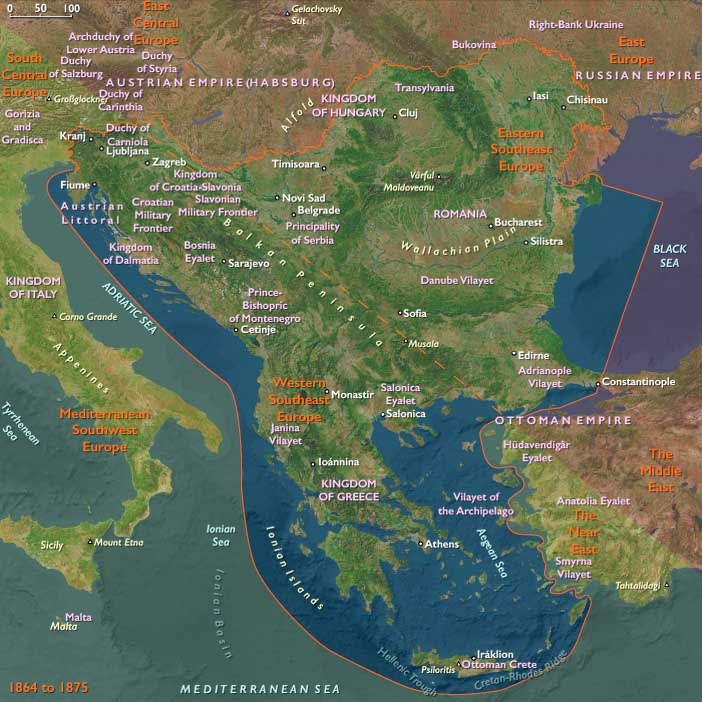
Austria had ended absolutist rule in 1860, and a military defeat in 1866 brings the empire to the brink of collapse.
In 1867 Emperor Franz Joseph enters the Dual Monarchy with Hungary, uniting the two states under a single crown.
Conflicting interests keep Austria-Hungary from uniting the South Slavs: Croatia and Slavonia fall under Hungarian control, while Austria retains Dalmatia.
In 1868 a Sabor dominated by pro-Hungarian deputies adopts the Nagodba, or compromise, which affirms that Hungary and Croatia constitute distinct political units within the empire.
Croatia obtain sautonomy in internal matters, but finance and other Croatian-Hungarian or Austro-Hungarian concerns require approval from Budapest and Vienna.
Hungarian leaders consider that the Nagodba provides ample home rule for Croatia, but Croatia opposes it strongly.
A subsequent election law guarantees pro-Hungarian landowners and officials a majority in the Sabor and increases Croatian hatred for Hungarian domination.
Croatian members of the Hungarian assembly now resort to obstructionism to enhance their meager influence.
Locations
Groups
Regions
Southeast Europe
View →Subregions
