
Hungary’s King Andrew II dies on September…
1235 CE
Hungary’s King Andrew II dies on September 21, 1235; his son succeeds as Béla IV to a weakened monarchy.
Subjects
Regions
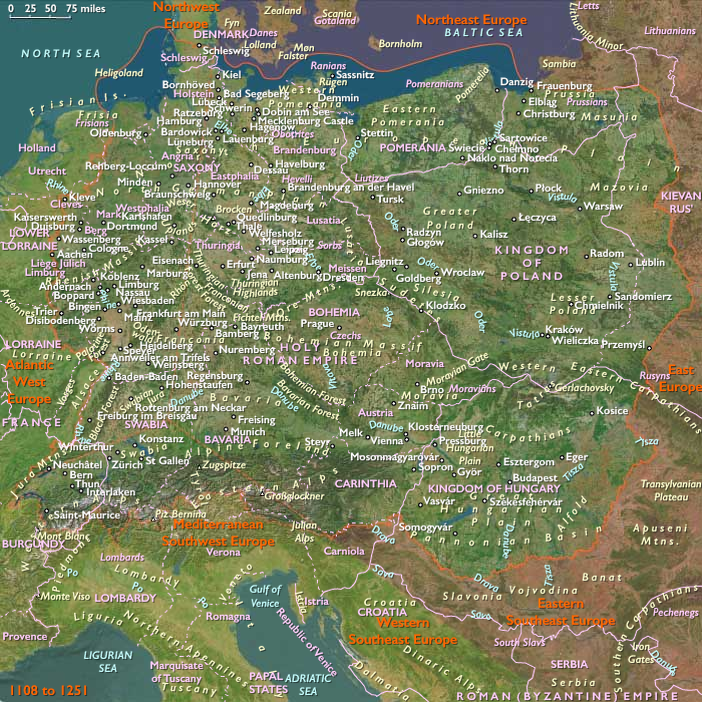
Central Europe
View →Subregions
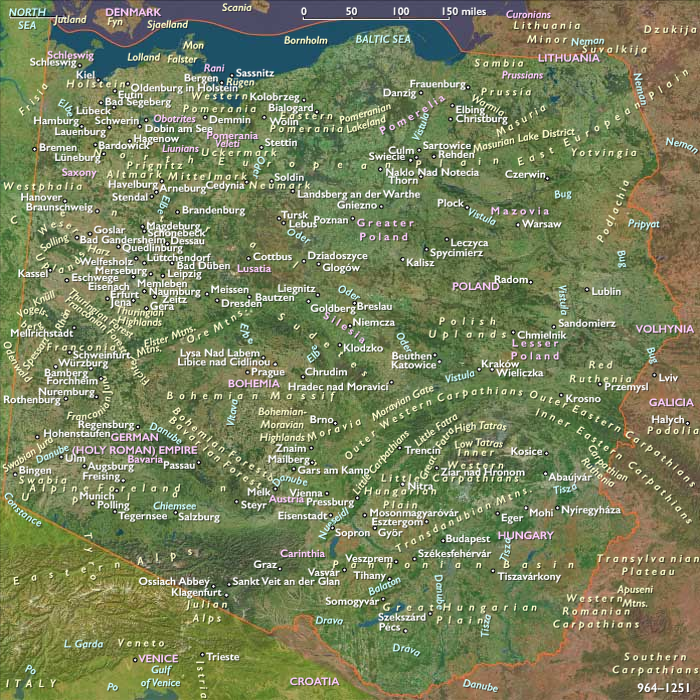
East Central Europe
View →Related Events
No active filters.
Showing 10 events out of 46999 total
Ögödei, on the refusal by the fugitive Goryean monarch of an order to appear at the Mongol capital of Karakorum, in 1235 sends a punitive expedition to Korea to reestablish control.
The Jin dynasty has been extinguished and the surviving Jurchens have been driven north.
Song generals field their armies to occupy the old capitals of the Song in 1235, but they are completely repelled by the Mongol garrisons under Tachir, a descendant of Boorchu, who had been a famed companion of Genghis Khan.
Thus the Mongol troops, headed by sons of Ögedei Khan, start their slow but steady invasion of the south.
The fierce resistance of the Song forces results in the Mongols having to fight the most difficult war in all of the conquests they have made.
The Song Chinese offer the fiercest resistance among all the nations that the Mongols have fought, the Mongols requiring every advantage they can gain in order to prevail.
Ögedei distributes lands in Shanxi, China to Batu and the family of Jochi in the 1230s, but they appoint their officials under the supervision of the Imperial governor in Khorasan.
Genghis Khan’s four principal sons at his death in 1227 had divided his empire.
The Mongols after two years without a Great Khan had accepted his chosen heir, the even-tempered Ögödei.
Ögödei has finished off the Jin, declared war on China’s Southern Song empire, and inaugurated new campaigns across western Asia.
After having defeating the Jin in 1234, Ögödei has retired from combat and has begun the transformation of his father’s simple base camp, which is little more than a yurt town, into what will become the magnificent walled city of Karakorum.
Holy Roman Emperor Frederick II grants the Welfs a new ducal title in 1235, enabling them to create the duchy of Brunswick on their territorial base in Saxony’s central zone around Braunschweig and …
…Lüneburg.
The second Bulgarian empire, with its center at Turnovo, reaches its height during Ivan’s reign.
Bulgaria is now the leading power in the Balkans, holding sway over Albania, Epirus, Macedonia, and Western Thrace.
During this period, the first Bulgarian coinage appears, and the head of the Bulgarian church receives the title of patriarch in 1235.
Invasions by the Greeks under the emperor John III at Nicaea and by the Bulgarians under Tsar Ivan Asen II have substantially reduced the territory of the Latin empire, leaving only the area around Constantinople to the Latins.
Theodore's defeat has given John the chance to extend his own empire into Europe, to ally with the Bulgarians, and so to encircle Constantinople, which he besieges in 1235.
Conflict in Frankish Palestine continues, as Filangieri remains in control of Jerusalem and Tyre, and has the support of Bohemond IV of Antioch, the Teutonic Knights, the Knights Hospitaller, and the Pisan merchants.
John, for his part, is supported by his nobles on Cyprus, and in his continental holdings in Beirut, Caesarea, and Arsuf, as well as by the Knights Templar and the Genoese merchant community.
Neither side can make any headway, and in 1234 Pope Gregory IX had excommunicated John and his supporters.
This is partly revoked in 1235, but still no peace can be made.
Pope Gregory canonizes the pious Elizabeth of Hungary in 1235.
A canon lawyer, theologian, defender of papal prerogatives, and founder of the papal Inquisition, Gregory condemns the excesses of the Fifth Crusade in its violence against the Jews.