
The Al Khalifa and the Al Jalahima…
1756 CE to 1767 CE
The Al Khalifa and the Al Jalahima sections of the Utub tribe migrate from Kuwait to Qatar's northwest coast in 1766 and establish a settlement at the new town of Az Zubarah.
The Bani Utub maintain important trading connections with Kuwait and are close to the rich oyster banks; therefore, Az Zubarah becomes a thriving center of trade and pearling, despite hostilities between the Al Khalifa and the Al Jalahima.
The exact origins of the Al Thani clan, the leading family from another tribe that, like the Bani Utub, had recently moved into the area, are unknown, but they are already in Qatar when the Al Khalifa arrive.
Muhammad ibn Abd al Wahhab's reformist ideas have proved popular among many of the peninsula tribes, including the Al Thani clan.
As a consequence, Wahhabi beliefs motivate Al Thani efforts to resist the attempt of the Al Khalifa, who reject Wahhabism, to gain control of the peninsula.
Locations
Groups
Regions
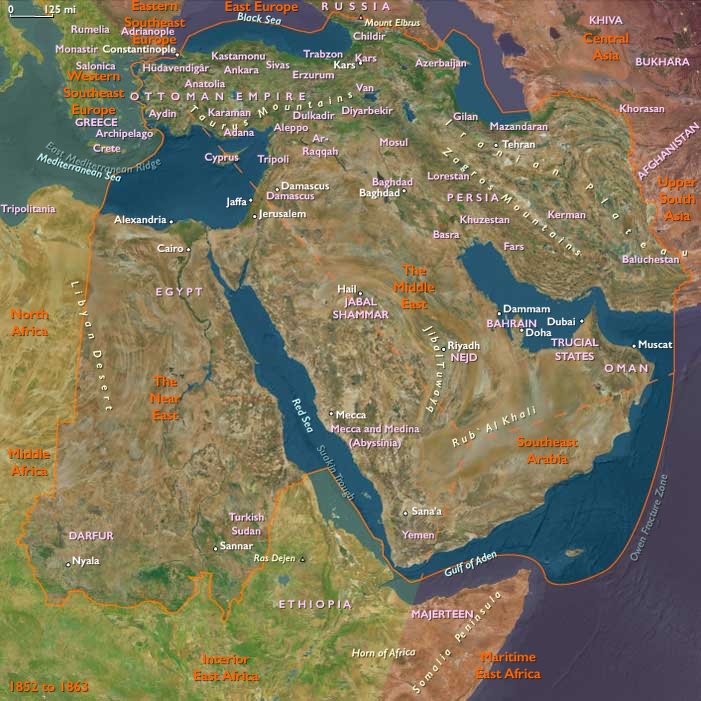
The Near and Middle East
View →Subregions
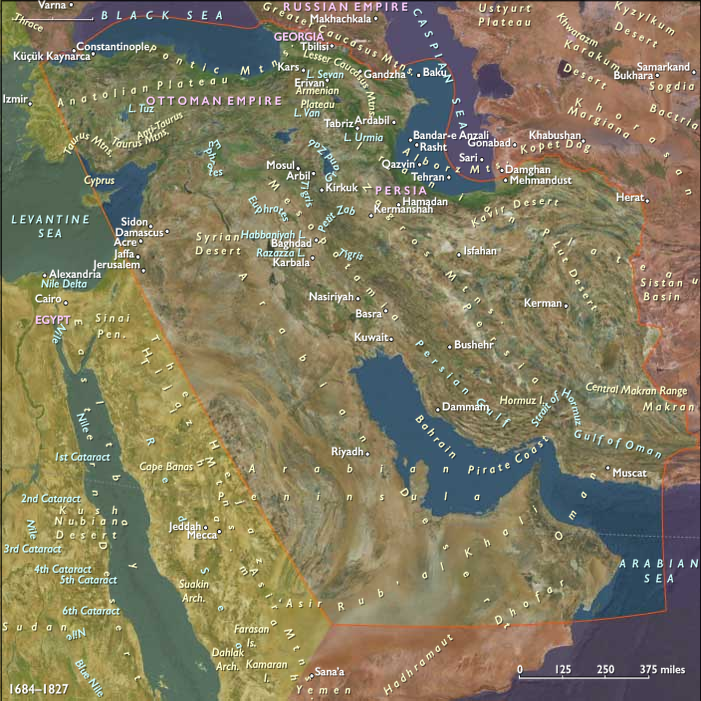
Middle East
View →Related Events
No active filters.
Showing 10 events out of 26815 total
The Presbyterian Synods in Philadelphia and New York City create the Corporation for Relief of Poor and Distressed Widows and Children of Presbyterian Ministers in 1759.
The Presbyterian Synods in Philadelphia and New York City create the Corporation for Relief of Poor and Distressed Widows and Children of Presbyterian Ministers in 1759.
The Presbyterian Synods in Philadelphia and New York City create the Corporation for Relief of Poor and Distressed Widows and Children of Presbyterian Ministers in 1759.
The Presbyterian Synods in Philadelphia and New York City create the Corporation for Relief of Poor and Distressed Widows and Children of Presbyterian Ministers in 1759.
Northeast Asia (1756–1767 CE)
Russian Expansion, Indigenous Encounters, and Economic Consolidation
From 1756 to 1767, the Russian presence in Northeast Asia continued to expand significantly, driven primarily by the maritime fur trade and further exploration. The profitability of the fur industry encouraged intensified Russian efforts in the region, notably along the Aleutian Islands and throughout the Kamchatka Peninsula.
The Russian settlement of Okhotsk, despite its challenging location and poor harbor conditions, remained the essential maritime gateway connecting inland Siberia with the North Pacific fur trade. Russian traders continued to gather substantial quantities of pelts—primarily sea otter, arctic fox, and fur seal—which were then transported inland and sold in the Chinese markets via the Mongolian border town of Kyakhta.
This era saw increased interaction—often exploitative or conflictual—with local indigenous communities, including the Koryaks, Chukchi, and Itelmens. Indigenous peoples faced demands for yasak (tribute) and were frequently coerced or violently compelled into participating in the fur trade, resulting in significant cultural disruptions and ecological consequences due to overhunting.
In response to escalating competition and logistical challenges, Russian authorities and private traders improved maritime infrastructure, fortified coastal settlements, and enhanced local resource extraction methods. However, Okhotsk’s limitations—scarce arable land, a short growing season, and severe weather—continued to impose substantial difficulties, necessitating the importation of supplies and provisions.
Despite these persistent hardships, the period from 1756 to 1767 consolidated Russia’s territorial claims in Northeast Asia, established firmer administrative control, and deepened its involvement in lucrative trans-Pacific commerce. These developments would shape the geopolitical and economic landscapes of Northeast Asia well into subsequent periods.
Russian fur companies expand into North America along the Aleutian Islands in the early 1760s reaching the Fox Islands and ...
...the Alaska Peninsula in the early 1760s.
British shipping dominates the opium trade out of Calcutta to China.
The annual amount of Indian-grown opium imported into China is about 1,000 chests in 1767.
The Company does not carry the opium itself but, because of the Chinese ban, farms it out to country traders, private traders licensed by the company to take goods from India to China.
The country traders sell the opium to smugglers along the Chinese coast.
The gold and silver the traders receive from these sales are then turned over to the Company.
In China, the company uses the gold and silver it receives to purchase goods that can be sold profitably in England.
Amursana has rejected the Qing arrangement and rebelled because he wants to be leader of a united Dzungar nation.
The enraged Qianlong Emperor issues orders for the eradication of the entire Dzungar nation and name.
Mongol banners and Manchus will receive Dzungar women and children as slaves; the remaining Dzungars are to be killed.
The Mongol Khalkha Prince Chingünjav had conspired with Amursana to revolt against the Qing in 1755.
Chingünjav starts his own rebellion in Outer Mongolia against the Qing in 1756, but it is crushed by the Qing in 1757.
Chingünjav and his entire family are executed by the Qing after the rebellion is put down.
The Manchu Eight Banners are now ordered by the Qianlong Emperor to conquer the Dzungars.
The Qianlong Emperor issues the following orders, as translated by Peter C. Perdue:
Show no mercy at all to these rebels. Only the old and weak should be saved. Our previous military campaigns were too lenient. If we act as before, our troops will withdraw, and further trouble will occur.
If a rebel is captured and his followers wish to surrender, he must personally come to the garrison, prostrate himself before the commander, and request surrender. If he only send someone to request submission, it is undoubtedly a trick. Tell Tsengünjav to massacre these crafty Zunghars. Do not believe what they say.
Qianlong issues his orders multiple times as some of his officers are reluctant to carry them out.
Some are punished for sparing Dzungars and allowing them to flee, such as Agui and Hadada, while others who participate in the slaughter are rewarded like Tangkelu and Zhaohui (Jaohui).
Young Dzungar men are especially singled out by the Emperor.
Loyalist Khalkhas receive Dzungar Khoit women as slaves from Chebudengzhabu, and orders to deprive the starving Dzungars of food are issued.
Manchu Bannermen and loyalist Mongols receive Dzungars women, children, and old men as bondservants, and their Dzungar identity is wiped out.
Orders are given to "completely exterminate" the Dzungar tribes, and the genocide leaves Dzungaria mostly depopulated.
The Emperor sees no conflict between his order of extermination and upholding the peaceful principles of Confucianism.
He supports his position by portraying the Dzungars as barbarians and subhuman.
The Qianlong Emperor proclaims that "to sweep away barbarians is the way to bring stability to the interior", that the Dzungars had "turned their back on civilization", and "Heaven supports the emperor," in their destruction.
The Qianlong Emperor commemorates the Qing conquest of the Dzungars as having added new territory in Xinjiang to "China", defining China as a multi ethnic state, and rejecting the idea that China only meant Han areas in "China proper".
The Qing expounded on their ideology that they are bringing together the "outer" non-Han Chinese (like the Inner Mongols, Eastern Mongols, Oirat Mongols, and Tibetans together with the "inner" Han Chinese) into "one family" united in the Qing state, showing that the diverse subjects of the Qing are all part of one family.
People of Xinjiang are not allowed to be called foreigners (yi) under the Qing.