
Lord Byron, Mary Wollstonecraft Godwin, Percy Bysshe…
July 1816 CE
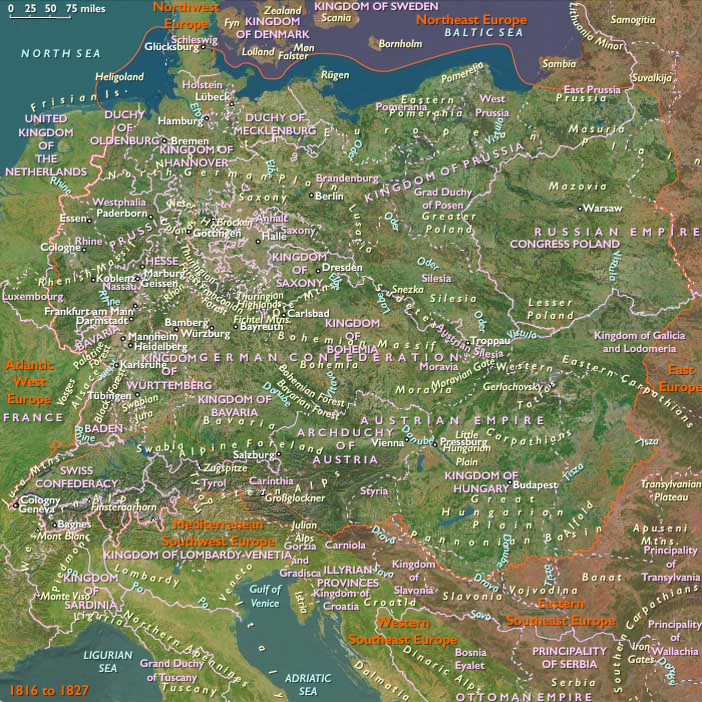
Lord Byron, Mary Wollstonecraft Godwin, Percy Bysshe Shelley and John William Polidori, gather at the Villa Diodati by Lake Geneva in a rainy July in Switzerland, tell each other tales.
This gives rise to two classic Gothic narratives: Mary Shelley's Frankenstein, and Polidori's The Vampyre.
George Gordon, Lord Byron had embarked in 1812 on a well publicized affair with the married Lady Caroline Lamb that had shocked the British public.
She had spurned the attention of the poet on their first meeting, subsequently giving Byron what became his lasting epitaph when she famously described him as "mad, bad and dangerous to know".
This hadn't prevented him from pursuing her.
Byron eventually broke off the relationship and moved swiftly on to others (such as that with Lady Oxford), but Lamb never entirely recovered, pursuing him even after he tired of her.
She was emotionally disturbed, and lost so much weight that Byron cruelly commented to her mother-in-law, his friend Lady Melbourne, that he was "haunted by a skeleton".
She began to call on him at home, sometimes dressed in disguise as a page boy, at a time when such an act could ruin both of them socially.
One day, during such a visit, she wrote on a book at his desk, "Remember me!"
As a retort, Byron wrote a poem entitled Remember Thee! Remember Thee! which concludes with the line "Thou false to him, thou fiend to me".
As a child, Byron had seen little of his half-sister Augusta Leigh; in adulthood, he has formed a close relationship with her that has been interpreted by some as incestuous, and by others as innocent.
Augusta (who is married) had given birth on April 15, 1814 to her third daughter, Elizabeth Medora Leigh.
Eventually Byron had begun to court Lady Caroline's cousin Anne Isabella Milbanke ("Annabella"), who had refused his first proposal of marriage but later accepted him.
Milbanke is a highly moral woman, intelligent and mathematically gifted; she is also an heiress.
They had married at Seaham Hall, County Durham, on January 2, 1815.
The marriage has proved unhappy; he treats her poorly.
They have a daughter (Augusta Ada).
Lady Byron leaves him on January 16, 1816, taking Ada with her.
Byron on April 21 had signed the Deed of Separation.
Rumors of marital violence, adultery with actresses, incest with Augusta Leigh, and sodomy are circulated, assisted by a jealous Lady Caroline.
Augusta, in a letter, quotes him as saying: "Even to have such a thing said is utter destruction and ruin to a man from which he can never recover."
Byron, after this breakup of his domestic life, had again left England; as it turns out, it will be forever.
He had passed through Belgium and continued up the Rhine River.
Locations
People
Subjects
Regions
Central Europe
View →Subregions
