
Rama II accepts Portuguese trade representative Carlos…
1818 CE
Rama II accepts Portuguese trade representative Carlos Manoel Silveira in 1818 as resident consul in Bangkok.
Subjects
Regions
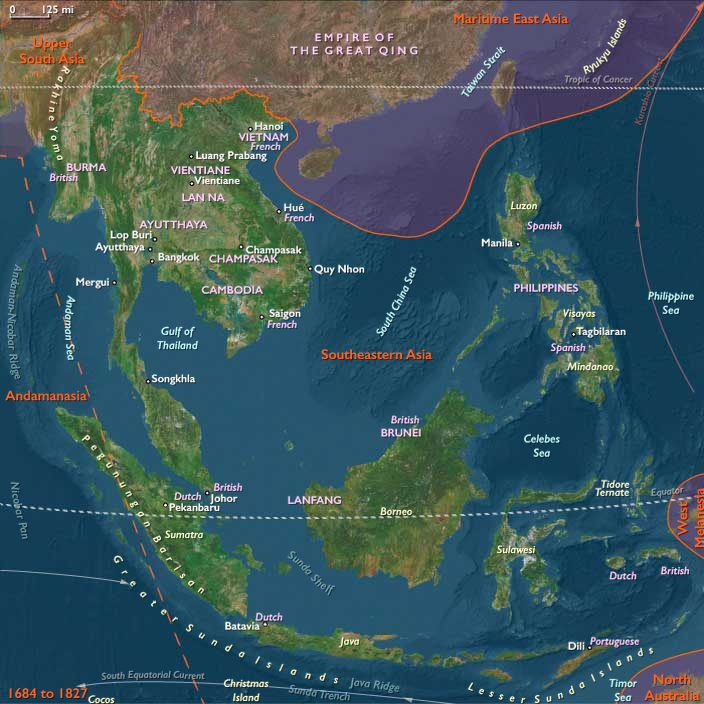
Southeast Asia
View →Subregions
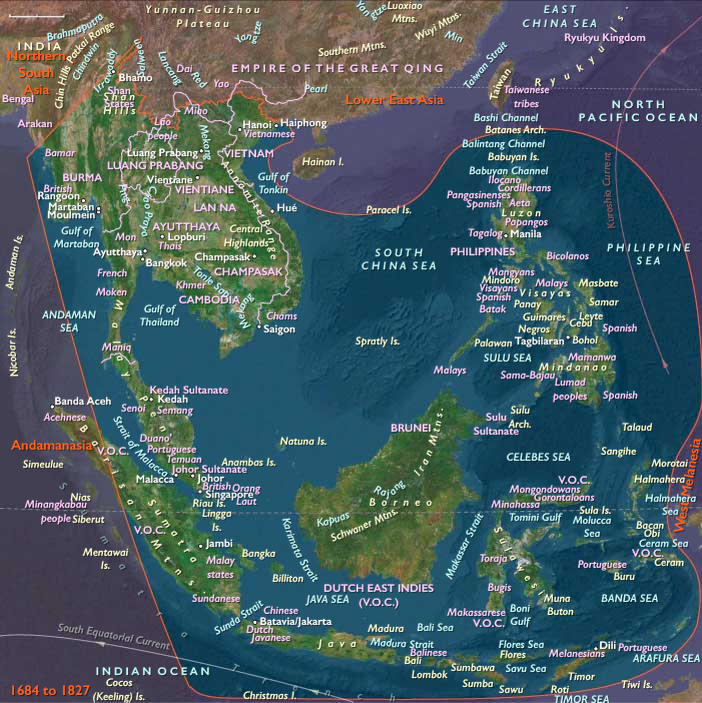
Southeastern Asia
View →Related Events
No active filters.
Showing 10 events out of 20573 total
Hongi Hika had studied European military and agricultural techniques while in Australia, and had purchased muskets and ammunition.
From 1818, he introduces European agricultural implements and the potato, using slave labor to produce crops for trade.
Hongi has married the famous Turikatuku, who is completely blind for much of her adult life, and who is an important military advisor for him.
He later takes her youngest sister Tangiwhare as an additional wife.
Both bear at least one son and daughter by him.
It is uncertain if he had other wives.
He is crowned Charles XIV of Sweden–Norway on May 11, and crowned Carl III of Norway, in Trondheim.
Swedish chemist Jöns Jacob Berzelius first recognizes selenium as an element in 1818 and prepares the red and 'metallic' forms.
The element is named for Greek Selene, “the Moon”.
Georg Wilhelm Hegel, having received offers of a post from the Universities of Erlangen, Berlin and Heidelberg, had chosen Heidelberg, where he had moved in 1816.
Soon after, his illegitimate son Ludwig Fischer (now ten years old) joined the Hegel household in April 1817, having thus far spent his childhood in an orphanage, as his mother had died in the meantime.
Hegel philosopher had published The Encyclopedia of the Philosophical Sciences in Outline (1817) as a summary of his idealist philosophy for students attending his lectures at Heidelberg.
In 1818, Hegel accepts the renewed offer of the chair of philosophy at the University of Berlin, which had remained vacant since Johann Gottlieb Fichte's death in 1814.
The Prussian customs union, heeding such free-trade advocates as economist Friedrich List, abolishes all internal duties in 1818.
Christian Gmelin observes in 1818 that salts of lithium color flames bright red.
Neither Gmelin nor Johan August Arfwedson, in attempting reductions by heating the oxide with iron or carbon, succeed in isolating the element itself from its salts.
Chemist William Thomas Brande and electrochemist Sir Humphry Davy later isolate the metal in pure form, producing a minute quantity by the electrolysis of lithium oxide (or lithium carbonate?).
Dost Mohammad, younger brother of Fatteh Khan, advancing from Kashmir in 1818, takes Peshawar and ...
...Kabul and drives Shah Mahmud and Kamran from all their possessions ...
...except Herat, where they will maintain a precarious footing for a few years.
Ghazna and ...