Humphry Davy and fellow British scientist William…
1825 CE
Humphry Davy and fellow British scientist William Hyde Wollaston had tried but failed to design an electric motor in 1821, soon after the Danish physicist and chemist Hans Christian Ørsted had discovered the phenomenon of electromagnetism,
Davy’s assistant Michael Faraday, having discussed the problem with the two men, has gone on to build two devices to produce what he calls "electromagnetic rotation".
One of these, now known as the homopolar motor, causes a continuous circular motion that is engendered by the circular magnetic force around a wire that extends into a pool of mercury wherein is placed a magnet; the wire then rotates around the magnet if supplied with current from a chemical battery.
These experiments and inventions form he foundation of modern electromagnetic technology.
In his excitement, Faraday has published results without acknowledging his work with either Wollaston or Davy.
The resulting controversy within the Royal Society has strained his mentor relationship with Davy and may well have contributed to Faraday’s assignment to other activities, which consequently prevent his involvement in electromagnetic research for several years.
From his initial discovery in 1821, Faraday has continued his laboratory work, exploring electromagnetic properties of materials and developing requisite experience.
In 1824, Faraday had briefly sets up a circuit to study whether a magnetic field could regulate the flow of a current in an adjacent wire, but he found no such relationship.
This experiment follows similar work conducted with light and magnets three years earlier that yielded identical results.
Faraday isolates benzene in 1825, the year in which he is appointed director of the laboratory of the Royal Institution in London.
Locations
People
Regions
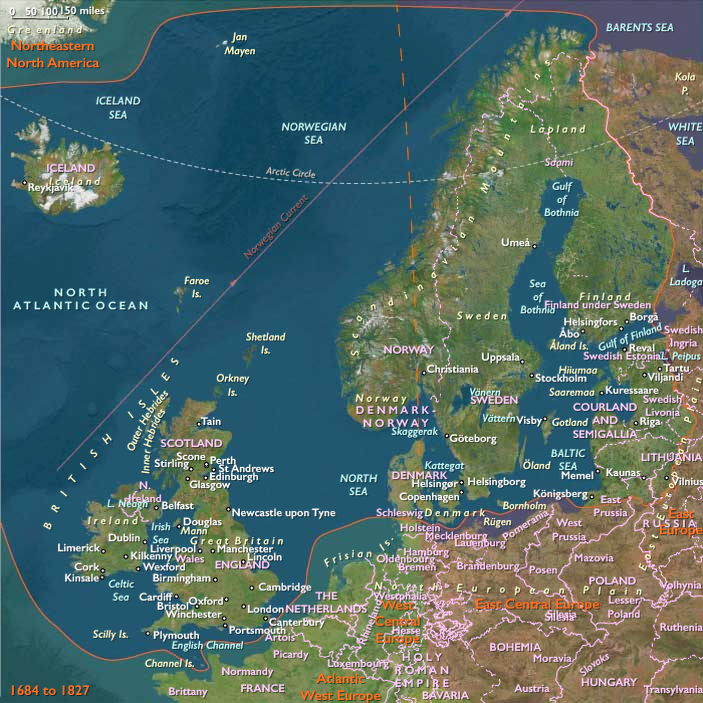
North Europe
View →Subregions