
The cholera pandemic reaches Quebec, Ontario, Nova…
1833 CE
Groups
Subjects
Regions
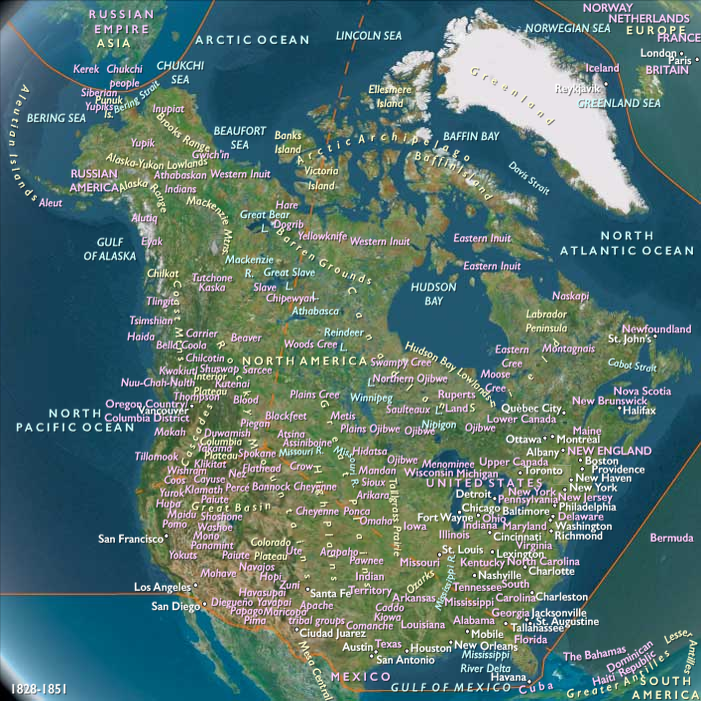
Northern North America
View →Subregions

Northeastern North America
View →Related Events
No active filters.
Showing 10 events out of 18757 total
As many as ninety percent of the Kalapuya may have died as a result of an epidemic of "fever and ague" that hit the Willamette Valley between 1830 and 1833.
The Hudson's Bay Company controls the fur trade in the Willamette Valley and the rest of Oregon Country in the 1820s and 1830s from its Columbia District headquarters at Fort Vancouver.
The Willamette Valley is largely inhabited by bands of the native Kalapuya tribe throughout the nineteenth century.
Britain accelerates the immigration of free settlers to Australia, having claimed the entire Australian continent by 1830.
Their numbers now beginning to swell, the settlers drive the aboriginal population farther off into the marginal lands—when not slaughtering them wholesale (as they have done in Van Diemen’s Land and will do in that portion of New South Wales that will eventually be known as Queensland. The settlers, having perpetrated total genocide in Van Diemen’s Land, will nearly annihilate the Queensland aborigines.)
By the early 1830s, the search for additional sheep-grazing land has caused settlers to spill over from Van Diemen’s Land to the mainland, where they establish the free settlement of Portland, on the west coast of what is now Victoria.
The Thais welcome American missionary and trade interests, and in 1833 sign a treaty (similar to that concluded with Britain) with U.S. envoy Edmund Roberts, marking the first U.S. treaty with an Eastern nation.
In particular, Minh Mạng has prosecuted Lê Văn Duyệt, a former faithful general of Emperor Gia Long, who had opposed his enthronement.
Since Lê Văn Duyệt had already died in July 1832, his tomb is profaned and inscribed with the words "This is the place where the infamous Lê Văn Duyệt was punished".
Prince Mongkut, the son of King Rama II, founds the Dhammayuttika Nikaya, or simply Thammayut, an order of Theravada Buddhist monks in Thailand, as a reform movement in 1833; it is to become one of the two denominations of Buddhism in modern Thailand.
Mongkut has studied Latin, English, and astronomy with missionaries and sailors, and will spend the following twenty-seven years discovering Western knowledge.
Aleksander Griboyedov’s The Misfortune of Being Clever sees posthumous publication in 1833. (Several lines from the play will enter Russian speech as common expressions.)
The Last Day of Pompeii, a large history painting by Karl Bryullov produced in 1830–1833 on the subject of the eruption of Mount Vesuvius in CE 79, is notable for its positioning between Neoclassicism, the predominant style in Russia at this time, and Romanticism as increasingly practiced in France.
The painting is received to near universal acclaim and makes Bryullov the first Russian painter to have an international reputation.
In Russia it is seen as proving that Russian art is as good as art practiced in the rest of Europe.
Critics in France and Russia both note, however, that the perfection of the classically modeled bodies seems to be out of keeping with their desperate plight and the overall theme of the painting, which is a Romantic one of the sublime power of nature to destroy man's creations.
Vissarion Belinsky establishes his reputation in 1834 with his Literary Reveries, a survey of the previous two centuries of Russian literature.
The twenty-two-year-old Belinsky, expelled from Moscow University as a radical, had taken up literary criticism and journalism in 1833.
Cerium metal is obtained in a very impure state by Swedish chemist Carl Gustaf Mosander and, working independently, German chemist Friedrich Wöhler, around 1833.