
The realm of the Danish king in…
January 1864 CE
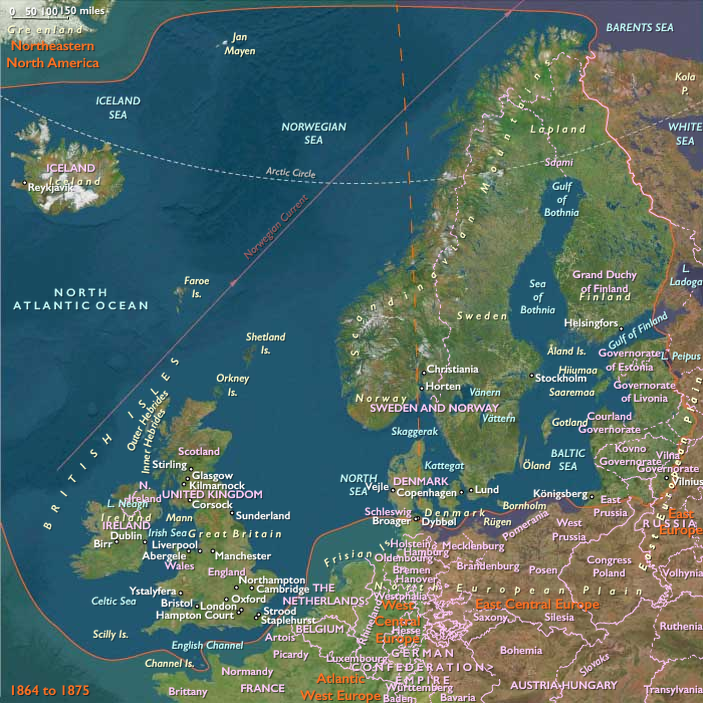
The realm of the Danish king in 1845 had still consisted of the islands, the northern half of the Jutland peninsula, and the Duchy of Schleswig in real union with the Duchy of Holstein.
The islands and Jutland together constituted the kingdom, whereas the monarch holds the duchies in personal union with the kingdom.
The duchy of Schleswig constitutes a Danish fief, while the Duchy of Holstein remains a part of the German Confederation.
Since the early eighteenth century, and even more so from the early nineteenth century, the Danes had become used to viewing the duchies and the kingdom as increasingly unified in one state.
This view, however, had clashed with that of the German majority in the duchies, also enthused by liberal and national trends, which had led to a movement known as Schleswig-Holsteinism.
Schleswig-Holsteinists aim for independence from Denmark.
The First Schleswig War (1848–1851) had broken out after constitutional change in 1849 and had ended with the status quo only, thanks to the intervention of Britain and other Great Powers.
On November 18, 1863, King Christian IX of Denmark had signed the so-called "November constitution" establishing a shared law of succession and a common parliament for both Schleswig and Denmark.
This is seen by the German Confederation as a violation of the 1852 London Protocol.
In response, on December 24, 1863, Saxon and Hanoverian troops had marched into Holstein on behalf of the Confederation (as part as the federal execution (Bundesexekution) against Holstein).
Supported by the German soldiers and by loyal Holsteiners, Frederick VIII, Duke of Schleswig-Holstein, had taken control of the government of Holstein.
National-Liberals demand permanent ties between Schleswig and Denmark, but state that Holstein can do as it pleased.
However, international events overtake domestic Danish politics, and Denmark faces war against both Prussia and Austria in what becomes known as the Second Schleswig War.
Groups
Commodities
Regions
North Europe
View →Subregions
