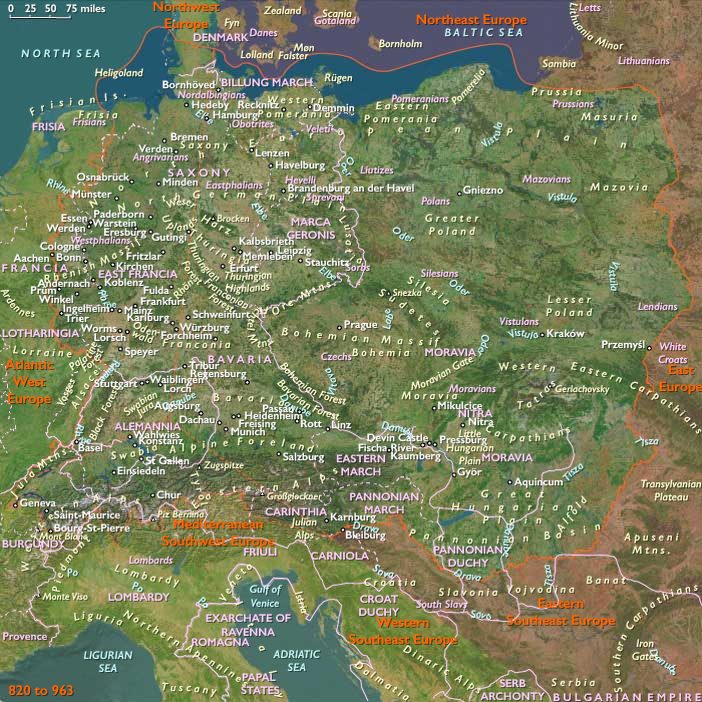
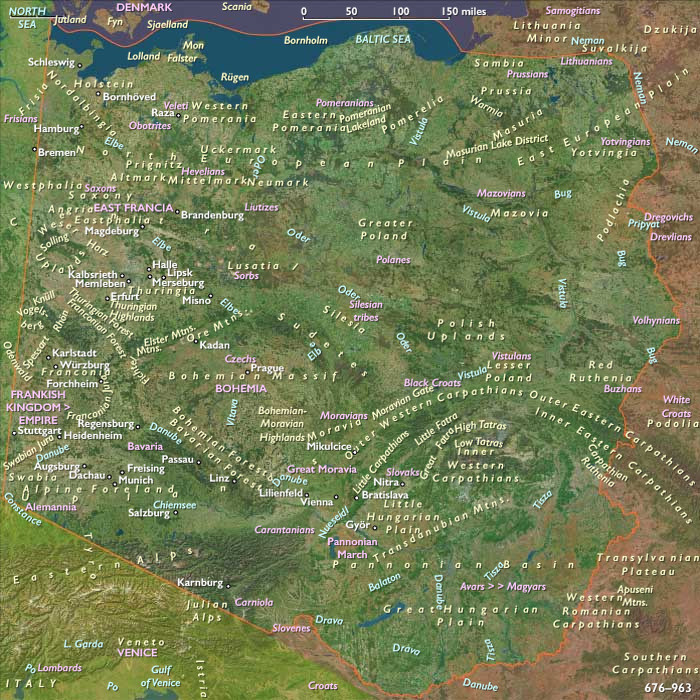
...attaches the Nitra region (the western part …
Years: 833 - 833
...attaches the Nitra region (the western part of modern Slovakia) to his domain in about 833 , ousting the ruling prince Pribina
Both principalities are united into the Empire of Great Moravia.
Locations
People
Groups
- Franks
- Wends, or Sorbs (West Slavs)
- Francia (Carolingians)
- Frankish, or Carolingian (Roman) Empire
- Moravia, Great, Kingdom of
Commodoties
Subjects
Regions
Subregions
Related Events
Filter results
Showing 10 events out of 54321 total
Moravian princes enjoy independence from the Franks and often have warred against Charlemagne and his successors, Louis I the Pious and Louis the German.
Moravia has by the first half of the ninth century become a united kingdom under Prince Mojmír I, who …
Malamir had become ruler of Bulgaria in 831 on the death of his father Omurtag, because his older brother Enravota (Voin) had forfeited his right to the succession by becoming a Christian.
It is possible that Malamir was young and inexperienced at the time of his accession, and that affairs of state were managed by his kavhan (kaukhanos) Isbul.
About 833, Malamir executes Enravota for refusing to renounce Christianity.
Caliph al-Ma'mun, having brought the ‘Abbasid caliphate to its greatest heights, had kept up the pressure on the Empire in 832, with his army capturing the strategically important fortress of Loulon, and in late 832 the Caliph had begun gathering a huge army and announced that he intends to conquer and colonize Anatolia step by step, and finally subjugate the Empire by capturing Constantinople itself.
Consequently, on May 833, Abbas with the advance force marches into imperial territory and begins creating a military base at the site of Tyana.
The site has been fortified and awaits the arrival of the Caliph's army, which in early July crosses into Anatolia.
At his juncture, however, luck intervenes for Constantinople, as Ma'mun falls ill and dies on October 10, although some modern scholars speculate that his death may have been the result of a coup.
Although Abbas is Ma'mun's only son, the Caliph apparently had named his brother Abu Ishak al-Mu’tasim, a younger son of the late Harun ar-Rashid, as his heir shortly before his death.
Abbas swiftly swears allegiance to Mu'tasim, but this turn of events is not popular among the assembled army, which tries to proclaim Abbas caliph.
Abbas refuses, and manages to assuage the troops' anger.
Nevertheless, Mu'tasim's hold on the throne is still shaky, and he abandons Ma'mun's campaign; the new base at Tyana is razed, and the army returns to the Caliphate.
Al-Mu'tasim, having succeeded his brother to become the eighth 'Abbasid caliph, concludes an indeterminate peace with Emperor Theophilos.
Al-Mu'tasim is the first caliph to employ the non-Muslim Berber, Slav, and especially Turkish mercenaries (who will later come to dominate the Abbasid dynasty).
To strengthen himself against the troublesome Khorasanians, Al-Mu'tasim inaugurates a policy of importing enslaved Turkish men and mercenaries to form a special military corps.
The Field of Lies (833): The Betrayal and Humiliation of Louis the Pious
By 833, Emperor Louis the Pious faces his most devastating defeat, not on the battlefield, but through betrayal and political maneuvering by his own sons, leading to his temporary deposition.
Lothair Joins the Rebellion
- Lothair I, King of Italy, joins his brothers Louis the German and Pepin I of Aquitaine in open rebellion against their father.
- Their coalition attracts widespread support, including leading clerics who had grown disillusioned with Louis' rule.
The "Field of Lies" (June 30, 833)
- Louis the Pious meets Lothair near Colmar, Alsace, at a site later called the "Field of Lies" (Lügenfeld).
- Ostensibly, the meeting is meant to negotiate peace, but Louis soon finds himself facing:
- A fully united coalition of his three eldest sons and their noble supporters.
- Pope Gregory IV, who had been invited by Lothair under the pretext of acting as a mediator but ultimately sides with the rebels.
- Leading clerics, including Agobard of Lyon and Ebbo of Reims—the latter, ironically, had been Louis' childhood companion.
The Deposition and Humiliation of Louis the Pious
- In a humiliating public ceremony, the rebel clergy demand Louis' abdication, accusing him of misgovernance and violating his imperial duties.
- Louis is forced to acknowledge his "crimes", removing his imperial regalia before his sons and the assembled nobles.
- He is sentenced to perpetual penance, a politically charged punishment meant to prevent him from regaining the throne.
The Aftermath: A Short-Lived Victory for the Rebels
- Lothair takes control of the empire, but his rule quickly alienates many Frankish nobles.
- By 834, the political tide shifts once again, and Louis is restored to power, though his authority is permanently weakened.
Significance of the Field of Lies
- Breakdown of Carolingian Unity → This event marks the deepening divisions among Charlemagne’s heirs, accelerating the empire’s fragmentation.
- Clerical Involvement in Secular Politics → The role of Pope Gregory IV and the Frankish clergy in deposing an emperor foreshadows the increasing power of the Church in European politics.
- A Turning Point for Louis the Pious → Though he regains the throne, his credibility is shattered, and his sons continue to challenge his authority until his death in 840.
The Field of Lies stands as one of the most infamous episodes in Carolingian history, symbolizing betrayal, political instability, and the irreversible decline of imperial authority.
The Restoration of Louis the Pious (834): A Reversal of Fortune
Following his humiliating deposition at the Field of Lies (833), Emperor Louis the Pious finds unexpected support as public sentiment turns against his rebellious sons. His orchestrated return to power in 834 is driven by three key factors:
- Widespread Outrage at His Mistreatment → The forced abdication of an anointed emperor, compounded by his public humiliation, alienates many Frankish nobles and clergy who still respect the concept of sacral kingship.
- Renewed Infighting Between the Brothers → The rebellion fractures as Lothair I, the leading instigator, attempts to consolidate power at the expense of his brothers Pepin of Aquitaine and Louis the German, leading to internal conflicts.
- Escalating Violence and Disorder → The rebellion creates widespread unrest, as noble factions take sides, resulting in an unstable empire, prompting many to reconsider supporting Louis the Pious’ return as a stabilizing force.
The Restoration of Imperial Authority
By 834, a counter-revolt gathers momentum:
- Supporters of Louis the Pious mobilize to free him from confinement.
- Once released, he is restored to power, marking an astonishing reversal of fortune.
- His weapons, wife (Empress Judith), and youngest son (Charles the Bald) are returned to him, symbolizing his full restoration as emperor.
Aftermath: A Weakened but Reinstated Emperor
Though Louis regains his throne, his authority is permanently weakened:
- Lothair I flees, but remains a persistent challenger to imperial unity.
- Pepin and Louis the German, though involved in the rebellion, are gradually reconciled with their father.
- The empire remains divided, with regional rulers continuing to assert their own interests.
Louis’ final years are marked by continued instability, and his death in 840 immediately reignites the civil war, culminating in the Treaty of Verdun (843) and the permanent partition of the Carolingian Empire.
The Oseberg burial mound will be found to contain numerous grave goods and two female human skeletons.
The ship's interment into its burial mound dates from 834, but parts of the ship date from around 800, and the ship itself is thought to be older.
It was excavated by Norwegian archaeologist Haakon Shetelig and Swedish archaeologist Gabriel Gustafson in 1904-1905.
This ship is widely celebrated and has been called one of the finest finds to have survived the Viking Age.
The ship and some of its contents are displayed at the Viking Ship Museum, in Bygdøy.
The ship is a clinker built 'karv' ship built almost entirely of oak.
It is 21.58 meters long and 5.10 meters broad, with a mast of approximately nine to ten meters.
With a sail of about ninety square meters, the ship could achieve a speed up to ten knots.
The ship has fifteen pairs of oar holes, which means that thirty people could row the ship.
Other fittings include a broad steering oar, iron anchor, gangplank, and a bailer.
The bow and stern of the ship are elaborately decorated with complex woodcarvings in the characteristic "gripping beast" style, also known as the Oseberg style.
Although seaworthy, the ship is relatively frail, and it is thought to have been used only for coastal voyages.
The skeletons of two women were found in the grave with the ship.
One, probably aged sixty to seventy, suffered badly from arthritis and other maladies.
The second was initially believed to be aged twenty-five to thirty, but analysis of tooth-root translucency suggests she was older (aged fifty to fifty-five).
It is not clear which one was the more important in life or whether one was sacrificed to accompany the other in death.
The younger woman had a broken collarbone, initially thought to be evidence that she was a human sacrifice, but closer examination showed that the bone had been healing for several weeks.
The opulence of the burial rite and the grave-goods suggests that this was a burial of very high status.
One woman wore a very fine red wool dress with a lozenge twill pattern (a luxury commodity) and a fine white linen veil in a gauze weave, while the other wore a plainer blue wool dress with a wool veil, possibly showing some stratification in their social status.
Neither woman wore anything entirely made of silk, although small silk strips were appliquéed onto a tunic worn under the red dress.
Dendrochronological analysis of timbers in the grave chamber dates the burial to the autumn of 834.
Although the high-ranking woman's identity is unknown, it has been suggested that she is Queen Åsa of the Yngling clan, mother of Halfdan the Black and grandmother of Harald Fairhair.
Recent tests of the women's remains suggest that they lived in Agder in Norway, as had Queen Åsa.
This theory has been challenged, however, and some think that she may have been a völva.
There were also the skeletal remains of 14 horses, an ox, and three dogs found on the ship.

Some of the work of Al-Khwārizmī’ is based on Persian and Babylonian astronomy, Indian numbers, and Greek mathematics.
He also writes on mechanical devices like the astrolabe and sundial.
He assists a project to determine the circumference of the Earth and in making a world map for al-Ma'mun, overseeing seventy geographers while systematizing and correcting Ptolemy's data for Africa and the Middle East.
Another major book is Kitab surat al-ard ("The Image of the Earth"; translated as Geography), presenting the coordinates of places based on those in the Geography of Ptolemy but with improved values for the Mediterranean Sea, Asia, and Africa.
Al-Khwārizmī's contributions to mathematics, geography, astronomy, and cartography establish the foundation for innovation in algebra and trigonometry.
His systematic approach to solving linear and quadratic equations leads to algebra, a word derived from the title of his 830 book on the subject, "The Compendious Book on Calculation by Completion and Balancing".
He accomplishes most of his work in the period between 813 and 833.
Aleppo's Central Synagogue, also known as the Great Synagogue, (parts of which, including the original inscriptions, still exist) is completed in 834.
According to tradition, the foundation for the Great Synagogue in Aleppo was constructed by King David's General, Joab ben Zeruiah, (circa 950 BCE), after his conquest of the city (See 2 Sam 8:3-8); it is still sometimes referred to as Joab's Synagogue.
The oldest surviving inscription is from the year 834 CE.
Pepin of Aquitaine's Reconciliation and the Restoration of Louis the Pious (834)
By 834, the rebellion that had deposed Louis the Pious in 833 at the Field of Lies begins to fracture, as Lothair I's ambitions alienate his allies, particularly his brother Pepin of Aquitaine.
Pepin Turns Against Lothair
- Initially, Pepin had joined Lothair and Louis the German in rebellion against their father.
- However, Lothair’s growing power and apparent disregard for his brothers’ interests leads Pepin to abandon the coalition.
- Seeing an opportunity for reconciliation, Pepin shifts his allegiance back to Louis the Pious and joins him in his restoration campaign.
The Restoration of Louis the Pious (March 1, 834)
- With support from Pepin of Aquitaine and other loyalists, Louis the Pious is reinstated as emperor on March 1, 834.
- Pepin is fully restored to his former status, reaffirming his control over Aquitaine.
- Lothair I, now isolated, is forced to flee as the empire momentarily returns to stability.
Aftermath and the Continued Struggle for the Carolingian Empire
Although Pepin and Louis the Pious are reconciled, the empire remains fragile, with tensions between the emperor’s sons continuing:
- Lothair retreats but remains a threat, particularly after Louis' death in 840.
- The division of the empire is now inevitable, culminating in the Treaty of Verdun (843), which permanently splits Charlemagne’s empire among his grandsons.
Pepin’s temporary realignment with his father in 834 highlights the shifting alliances that characterize the later Carolingian period, as dynastic rivalries reshape medieval Europe.
Years: 833 - 833
Locations
People
Groups
- Franks
- Wends, or Sorbs (West Slavs)
- Francia (Carolingians)
- Frankish, or Carolingian (Roman) Empire
- Moravia, Great, Kingdom of