
Some of the work of Al-Khwārizmī’ is…
834 CE
Some of the work of Al-Khwārizmī’ is based on Persian and Babylonian astronomy, Indian numbers, and Greek mathematics.
He also writes on mechanical devices like the astrolabe and sundial.
He assists a project to determine the circumference of the Earth and in making a world map for al-Ma'mun, overseeing seventy geographers while systematizing and correcting Ptolemy's data for Africa and the Middle East.
Another major book is Kitab surat al-ard ("The Image of the Earth"; translated as Geography), presenting the coordinates of places based on those in the Geography of Ptolemy but with improved values for the Mediterranean Sea, Asia, and Africa.
Al-Khwārizmī's contributions to mathematics, geography, astronomy, and cartography establish the foundation for innovation in algebra and trigonometry.
His systematic approach to solving linear and quadratic equations leads to algebra, a word derived from the title of his 830 book on the subject, "The Compendious Book on Calculation by Completion and Balancing".
He accomplishes most of his work in the period between 813 and 833.
Locations
Topics
Subjects
Regions
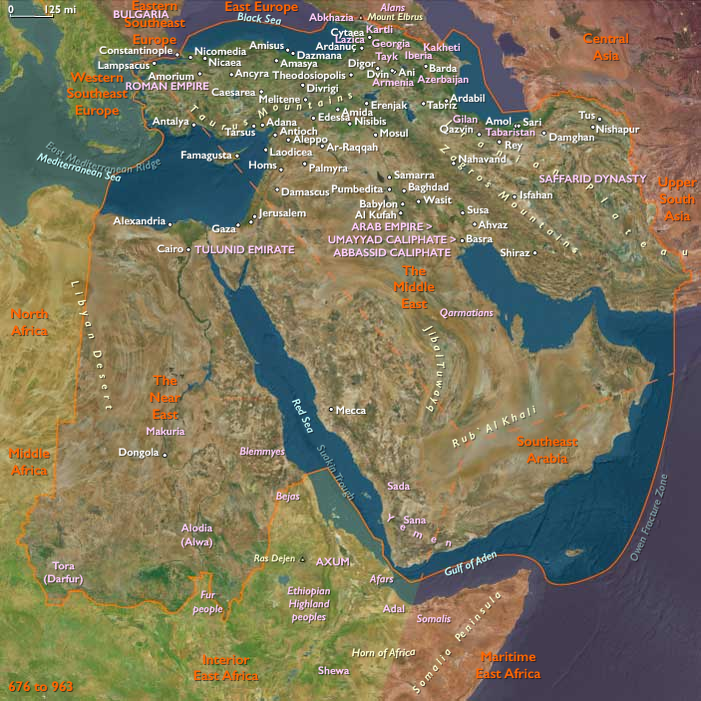
The Near and Middle East
View →Subregions
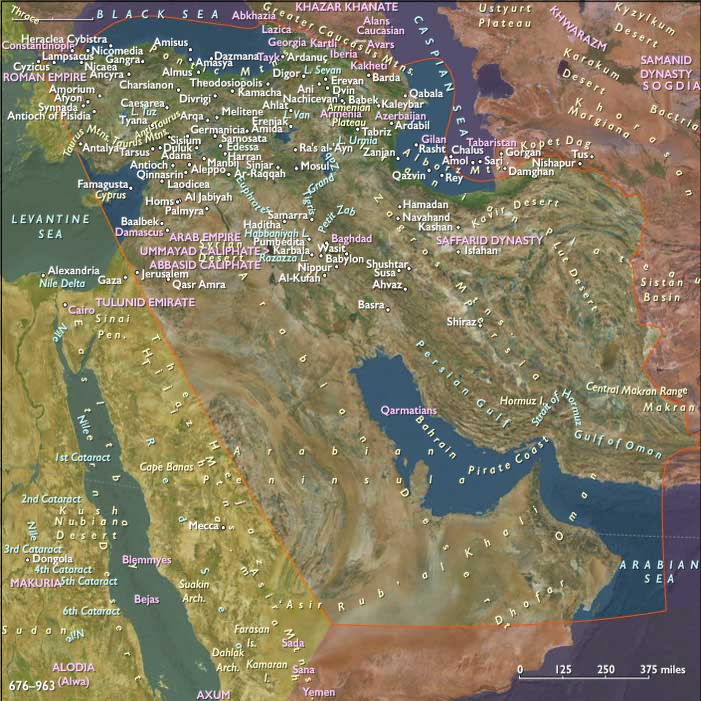
Middle East
View →Related Events
No active filters.
Showing 10 events out of 54327 total
The Oseberg burial mound will be found to contain numerous grave goods and two female human skeletons.
The ship's interment into its burial mound dates from 834, but parts of the ship date from around 800, and the ship itself is thought to be older.
It was excavated by Norwegian archaeologist Haakon Shetelig and Swedish archaeologist Gabriel Gustafson in 1904-1905.
This ship is widely celebrated and has been called one of the finest finds to have survived the Viking Age.
The ship and some of its contents are displayed at the Viking Ship Museum, in Bygdøy.
The ship is a clinker built 'karv' ship built almost entirely of oak.
It is 21.58 meters long and 5.10 meters broad, with a mast of approximately nine to ten meters.
With a sail of about ninety square meters, the ship could achieve a speed up to ten knots.
The ship has fifteen pairs of oar holes, which means that thirty people could row the ship.
Other fittings include a broad steering oar, iron anchor, gangplank, and a bailer.
The bow and stern of the ship are elaborately decorated with complex woodcarvings in the characteristic "gripping beast" style, also known as the Oseberg style.
Although seaworthy, the ship is relatively frail, and it is thought to have been used only for coastal voyages.
The skeletons of two women were found in the grave with the ship.
One, probably aged sixty to seventy, suffered badly from arthritis and other maladies.
The second was initially believed to be aged twenty-five to thirty, but analysis of tooth-root translucency suggests she was older (aged fifty to fifty-five).
It is not clear which one was the more important in life or whether one was sacrificed to accompany the other in death.
The younger woman had a broken collarbone, initially thought to be evidence that she was a human sacrifice, but closer examination showed that the bone had been healing for several weeks.
The opulence of the burial rite and the grave-goods suggests that this was a burial of very high status.
One woman wore a very fine red wool dress with a lozenge twill pattern (a luxury commodity) and a fine white linen veil in a gauze weave, while the other wore a plainer blue wool dress with a wool veil, possibly showing some stratification in their social status.
Neither woman wore anything entirely made of silk, although small silk strips were appliquéed onto a tunic worn under the red dress.
Dendrochronological analysis of timbers in the grave chamber dates the burial to the autumn of 834.
Although the high-ranking woman's identity is unknown, it has been suggested that she is Queen Åsa of the Yngling clan, mother of Halfdan the Black and grandmother of Harald Fairhair.
Recent tests of the women's remains suggest that they lived in Agder in Norway, as had Queen Åsa.
This theory has been challenged, however, and some think that she may have been a völva.
There were also the skeletal remains of 14 horses, an ox, and three dogs found on the ship.
Aleppo's Central Synagogue, also known as the Great Synagogue, (parts of which, including the original inscriptions, still exist) is completed in 834.
According to tradition, the foundation for the Great Synagogue in Aleppo was constructed by King David's General, Joab ben Zeruiah, (circa 950 BCE), after his conquest of the city (See 2 Sam 8:3-8); it is still sometimes referred to as Joab's Synagogue.
The oldest surviving inscription is from the year 834 CE.
Pepin of Aquitaine's Reconciliation and the Restoration of Louis the Pious (834)
By 834, the rebellion that had deposed Louis the Pious in 833 at the Field of Lies begins to fracture, as Lothair I's ambitions alienate his allies, particularly his brother Pepin of Aquitaine.
Pepin Turns Against Lothair
- Initially, Pepin had joined Lothair and Louis the German in rebellion against their father.
- However, Lothair’s growing power and apparent disregard for his brothers’ interests leads Pepin to abandon the coalition.
- Seeing an opportunity for reconciliation, Pepin shifts his allegiance back to Louis the Pious and joins him in his restoration campaign.
The Restoration of Louis the Pious (March 1, 834)
- With support from Pepin of Aquitaine and other loyalists, Louis the Pious is reinstated as emperor on March 1, 834.
- Pepin is fully restored to his former status, reaffirming his control over Aquitaine.
- Lothair I, now isolated, is forced to flee as the empire momentarily returns to stability.
Aftermath and the Continued Struggle for the Carolingian Empire
Although Pepin and Louis the Pious are reconciled, the empire remains fragile, with tensions between the emperor’s sons continuing:
- Lothair retreats but remains a threat, particularly after Louis' death in 840.
- The division of the empire is now inevitable, culminating in the Treaty of Verdun (843), which permanently splits Charlemagne’s empire among his grandsons.
Pepin’s temporary realignment with his father in 834 highlights the shifting alliances that characterize the later Carolingian period, as dynastic rivalries reshape medieval Europe.
Danish Vikings Establish Beachheads in Frisia (834): The Beginning of Large-Scale Norse Raids
In 834, Danish Viking raiders make their first recorded appearance in Frisia, particularly targeting Dorestad, a wealthy Carolingian trading hub. This marks the beginning of a sustained Norse presence in the weakened Frankish Empire, as Vikings exploit political instability to establish beachheads along the North Sea coast.
Why Frisia and Dorestad?
- Dorestad is one of the most prosperous trade centers in the Carolingian world, making it a prime target for plunder.
- The Frankish kingdom, weakened by dynastic conflicts following the deposition and restoration of Louis the Pious (833–834), is less capable of mounting a defense.
- The Frisian coastline, with its inlets and riverways, provides ideal Viking landing sites for raids and eventual settlement.
Viking Strategy: From Raiding to Occupation
- The Vikings initially raid and withdraw, seizing silver, goods, and captives for ransom or sale.
- Over time, they begin to overwinter in Frisia, establishing semi-permanent bases from which to launch further inland incursions.
- The Franks, unable to consistently defend their coastlines, resort to paying tribute (Danegeld) or granting land in exchange for Viking loyalty—a tactic that will later be repeated in England and Normandy.
Impact on the Frankish Empire
- The Norse raids destabilize Frankish trade, leading to the decline of Dorestad as a commercial center.
- Viking incursions contribute to the weakening of Carolingian authority, particularly in Frisia and Lower Lotharingia.
- The Norse presence in Frisia paves the way for later Viking-controlled territories, culminating in figures like Rorik of Dorestad (850s), who will rule Frisia as a Frankish vassal.
The Start of a Century-Long Conflict
The 834 raids on Frisia mark the beginning of nearly a century of Viking attacks on the Carolingian Empire, culminating in:
- The sacking of Paris (845, 885–886).
- Further incursions along the Rhine, Loire, and Seine Rivers.
- The eventual integration of Viking leaders into Frankish nobility, as seen in the granting of Normandy to Rollo in 911.
The Viking incursions into Frisia and Dorestad in 834 represent a turning point in Norse expansion, as they transition from raiders to rulers, exploiting the Carolingian Empire’s fragmentation to establish their first permanent footholds in Western Europe.
The chancellor Li Xun had failed to slaughter the powerful eunuchs, whose troops on December 14 slaughter many court officials and Li Xun's associates in the northeast sector of the Chinese capital Chang'an, in what is known as the Ganlu Inciden.
The 834–835 Conflict Between Louis the Pious and Lothair I
By 834, tensions between Emperor Louis the Pious and his eldest son, Lothair I, reignite over the issue of inheritance, particularly regarding Charles the Bald, Louis' son from his second marriage to Judith of Bavaria. This renewed dynastic struggle leads to yet another period of civil war within the Carolingian Empire.
Lothair’s Defeat and Withdrawal to Italy (835)
- Lothair had previously led the rebellion against his father, culminating in the Field of Lies (833) and Louis’ temporary deposition.
- However, support shifts back to Louis in 834, and Lothair is forced into retreat.
- In 835, after suffering military defeats and losing the support of the nobility, Lothair withdraws to Italy, where he dedicates himself solely to governing his Italian lands.
- He never again directly challenges his father’s authority, focusing instead on strengthening his rule in the Kingdom of Italy.
Aftermath: A Brief Restoration of Stability
- Louis the Pious fully regains control of the empire, seemingly securing the succession of Charles the Bald alongside his other sons, Louis the German and Pepin of Aquitaine.
- A general reconciliation ceremony is held in 835, where former rebels, including key bishops, are restored to favor.
- However, dynastic tensions persist, and following Louis’ death in 840, Lothair will once again assert his claim to imperial overlordship, leading to the Battle of Fontenay (841) and the eventual Treaty of Verdun (843), which permanently divides the Carolingian Empire.
Lothair’s defeat in 835 marks the end of his immediate challenge to Louis the Pious, but it is only a temporary resolution—the empire remains fragile, with underlying tensions that will lead to its ultimate partition after Louis’ death.
The celebration of All Saints is fixed at November 1 and made an obligation throughout the Frankish Empire.
Danish Vikings raid the Thames island of Sheppey in 835.
Presian, who succeeds Malamir in 836 as Khan of Bulgaria, may have been young and inexperienced at the time of his accession, and state affairs may have been dominated by the minister (Kavkhan) Isbul, as under Presian's uncle Malamir.
Caliph al-Mu'tasim, in response to the problems caused by the Abbasids’ Khorasanian troops and their commanders in their treatment of the populace, transfers the capital in 836 from Baghdad to …