In Chagall's My Fiancée with Black Gloves …
Years: 1909 - 1909
In Chagall's My Fiancée with Black Gloves (1909), a portrait becomes an occasion for experimenting with an arrangement in black and white.
Locations
Topics
Subjects
Regions
Subregions
Related Events
Filter results
Showing 10 events out of 8123 total
In 1909, Siam cedes Kedah, Perlis, Kelantan and Trenganu to Britain, who turn them into protectorates.
A meeting of the 13-nation International Opium Commission, held in Shanghai on February 1, 1909, results in recommendations that form the basis of the first opium convention, to be held at The Hague in 1912.
(Source: The Politics of Heroin: CIA Complicity in the Global Drug Trade)
A meeting of the 13-nation International Opium Commission, held in Shanghai on February 1, 1909, results in recommendations that form the basis of the first opium convention, to be held at The Hague in 1912.
(Source: The Politics of Heroin: CIA Complicity in the Global Drug Trade)
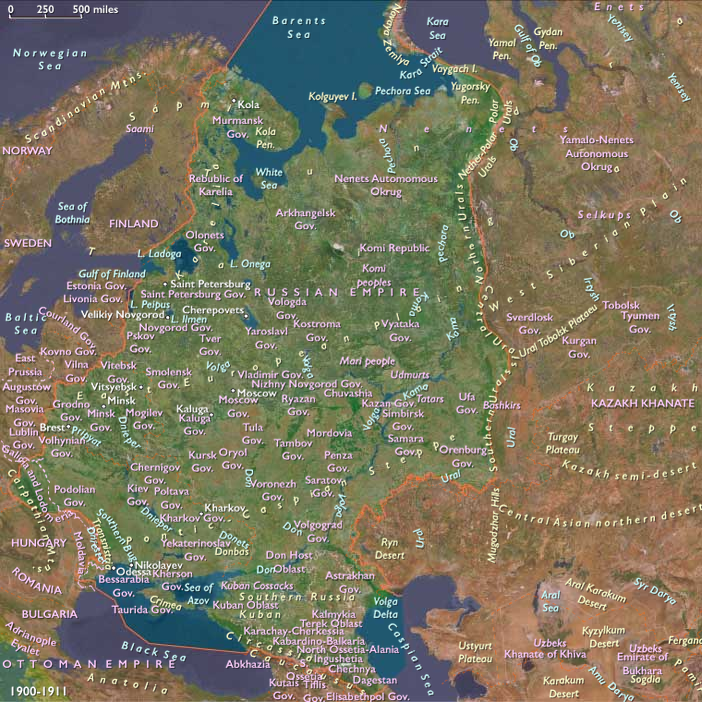
A "Jew hunt" (one of many) is organized in 1909 in the western Russian city of Smolensk to find Jews living outside the Pale of Settlement.
Ten are found in the city and seventy-four more in the neighboring woods.
All are forced back into the Pale.
A boycott of Jewish goods is organized in Poland in 1909 under the guise of nationalism.
Lehmbruck's life-sized Mankind (1909) is a monumental work in the style of Rodin.
Klee's caricatures are rejected as too idiosyncratic, and for many years his small family—increased to three in 1907 by the birth of their only child, Felix—is supported largely by Lily's piano lessons.
Between 1906 and 1909 he has become successively acquainted with the work of van Gogh, Cézanne and Ensor.
He also begins to explore the expressive possibilities of children's drawings.
These varied influences impart to his work a freedom of expression and a willfulness of style equaled by few other artists of the era.
Franz Marc had painted his early works in a self-consciously academic style, but his stolid naturalism was lightened in 1903 by his exposure to French Impressionist painting and later to the sensuous, curvilinear art of Munich's Jugendstil movement.
The twenty-nine-year-old Marc in 1909 joins a group of Expressionist artists known as the Neue Künstlervereinigung (New Artists' Association).
Here he meets August Macke, whose idiosyncratic use of broad areas of rich color leads Marc to experiment with similar techniques.
Macke, thirty-one, had been influenced, particularly in his earlier work, by his teacher Lovis Corinth, as well as by the Cubists and the Impressionists.
A lyrical temperament, however, is revealed in his works, which avoid the often-violent style and subject matter of his fellow Expressionists.
His art combines the tradition of French painting—;its sense of the grace of movement and atmosphere in landscape painting—with the cosmic sentiment of German art.

Kokoschka seeks to express through his colors the inner sensibility of the observer viewing a scene.
This aim is exemplified in one of his earliest paintings, Dent du Midi (1909), a snowscape in which the colors are warm, reflecting the response of the observer to the scene, rather than cool, evoking the actual light that must have emanated from the snow.
Egon Schiele, as a student at the Vienna Academy of Fine Arts (190709), has been strongly influenced by the Jugendstil movement, the German Art Nouveau.
He meets Klimt, leader of the Vienna Sezession group, and the linearity and subtlety of Schiele's work owe much to Klimt's decorative elegance.
Schiele, however, emphasizes expression over decoration, heightening the emotive power of line with a feverish tension.
He concentrates from the beginning on the human figure, and his candid, agitated treatment of erotic themes causes a sensation.
In 1909, the 19-year-old Schiele helps found the Neukunstgruppe (New Art Group) in Vienna.
The series of riots and demonstrations in Bulgaria between 1905 and 1908, inspired by the 1905 uprisings in Russia, have been a reaction by workers, the poor, and some of the intelligentsia to several issues: domestic repression, government corruption, and the handling of the Macedonian issue.
The strikes and demonstrations remain isolated and have little practical effect, so Ferdinand remains in firm control.
The Armenian populace remaining in the Ottoman Empire after the 1895 massacre has supported the 1908 revolution of the Young Turks, who have promised liberal treatment of ethnic minorities.
The Young Turk government, its revolution a success, now plots elimination of the Armenians, who are a significant obstacle to the regime's evolving nationalist agenda.