Étienne Montgolfier, in collaboration with the successful…
September 1783 CE
Étienne Montgolfier, in collaboration with the successful wallpaper manufacturer Jean-Baptiste Réveillon, constructs a 37,500-cubic-foot (1,060 square meters) envelope of taffeta coated with a varnish of alum (which has fireproofing properties).
The balloon is sky blue and decorated with golden flourishes, signs of the zodiac, and suns.
The design shows the intervention of Réveillon.
The next test is on the 11th of September from the grounds of la Folie Titon, close to Réveillon's house.
There is some concern about the effects of flight into the upper atmosphere on living creatures.
The king had proposed to launch two criminals, but it is most likely that the inventors decided to send a sheep, a duck, and a rooster aloft first.
On September 19, 1783, the Aérostat Réveillon is flown with the first living beings in a basket attached to the balloon: a sheep called Montauciel ("Climb-to-the-sky"), a duck and a rooster.
The sheep is believed to have a reasonable approximation of human physiology.
The duck, which is expected to be unharmed by being lifted aloft, is included as a control for effects created by the aircraft rather than the altitude.
The rooster is included as a further control, as it is a bird that does not fly at high altitudes.
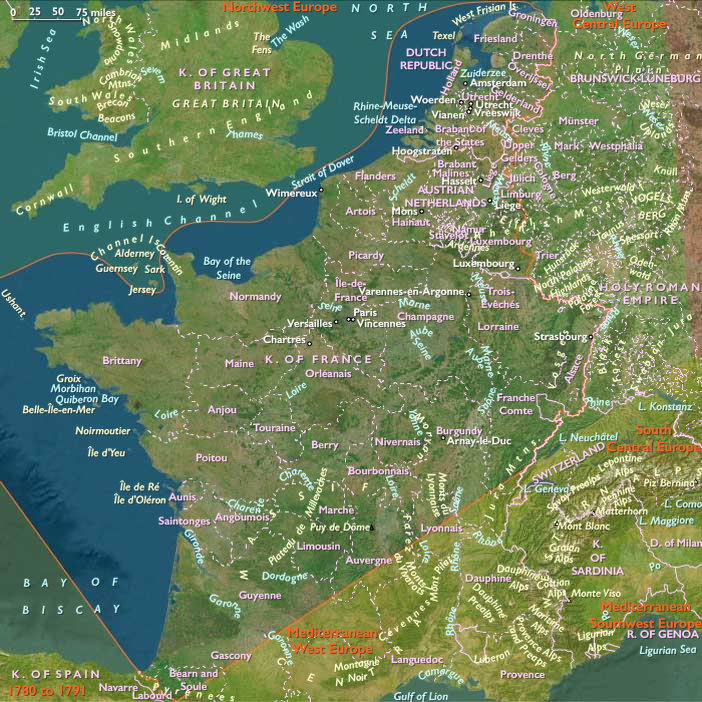
This demonstration is performed before a crowd at the royal palace in Versailles, before King Louis XVI of France and Queen Marie Antoinette.
The flight lasts approximately eight minutes, covers two miles (three kilometers), and obtains an altitude of about fifteen hundred feet (four hundred and sixty meters).
The craft lands safely after flying.
Images

A model of the Montgolfier brothers' balloon at the London Science Museum
Locations
People
Commodities
Regions

West Europe
View →Subregions