
The 1783 Great Meteor is an unusually…
1783 CE
The meteor will the subject of much discussion in the Philosophical Transactions of the Royal Society and the subject of a detailed study by Charles Blagden.
The event occurred between 21:15 and 21:30 on a clear, dry night.
Analysis of observations has indicated that the meteor entered the Earth's atmosphere over the North Sea, before passing over the east coast of Scotland and England and the English Channel; it finally broke up, after a passage within the atmosphere of around a thousand miles (sixteen hundred and ten kilometers), over south-western France or northern Italy
Subjects
Regions
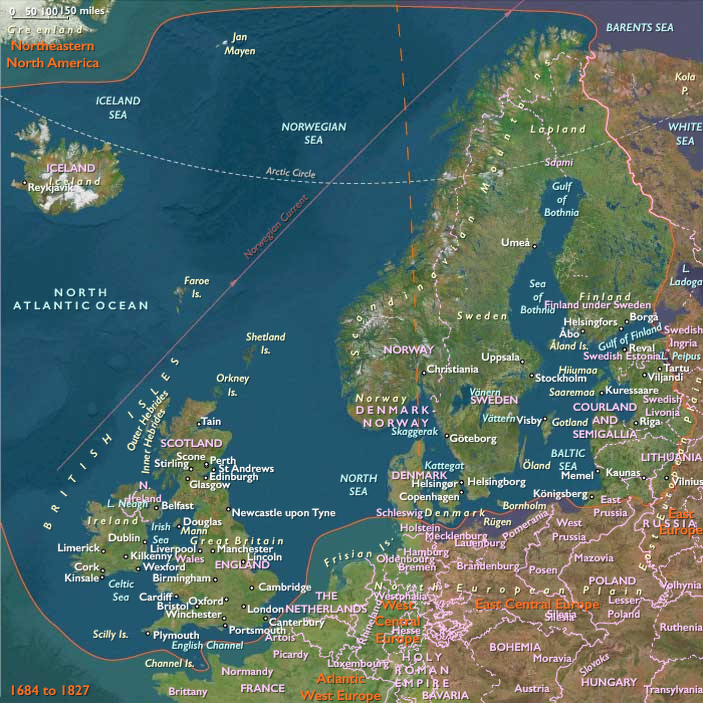
North Europe
View →Subregions
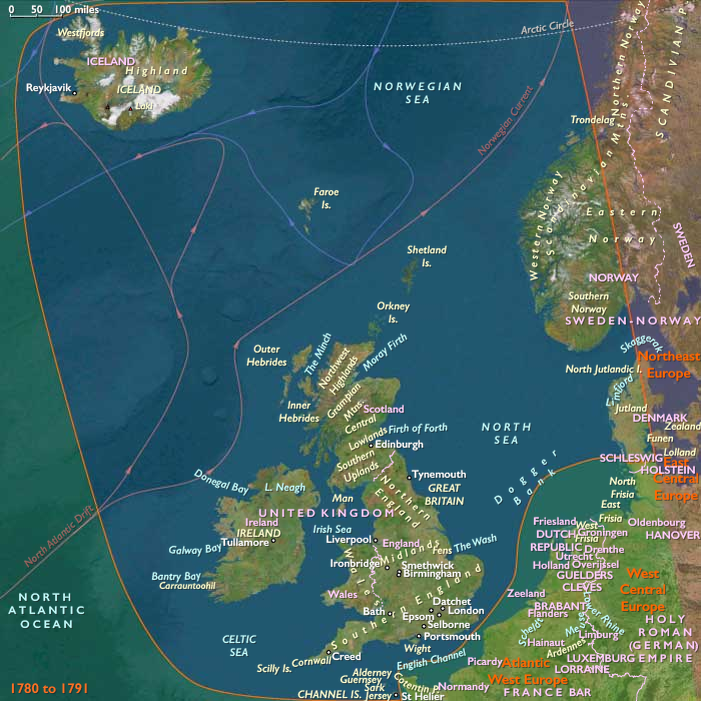
Northwest Europe
View →Related Events
No active filters.
Showing 10 events out of 24766 total
The Laki eruption and its aftermath cause a drop in global temperatures, as one hundred and twenty million tons of sulfur dioxide is spewed into the Northern Hemisphere.
This causes crop failures in Europe and may have caused droughts in North Africa and India.
The poisonous cloud drifts to Bergen in Denmark–Norway, then spreads to Prague in the Kingdom of Bohemia (now the Czech Republic) by June 17, Berlin by June 18, Paris by June 29, Le Havre by June 22, and Great Britain by June 23.
The fog is so thick that boats stay in port, unable to navigate, and the sun is described as blood colored.
Mount Asama erupts in 1783 (Tenmei 3), causing widespread damage.
The three-month-long plinian eruption that begin on May 9, 1783, produces andesitic pumice falls, pyroclastic flows, lava flows, and enlarges the cone.
The climactic eruption begins on August 4 and lasts for fifteen hours, and contains pumice falls and pyroclastic flows.
The complex features of this eruption are explained by rapid deposits of coarse pyroclastic ash near the vent and the subsequent flows of lava; and these events, which are accompanied by a high eruption plume that generates further injections of pumice into the air.
The volcano's devastation exacerbates what is already known as the "Great Tenmei Famine".
Much of the agriculturally productive land in Shinano and Kōzuke provinces will remain fallow or under-producing for the next four or five years.
The effects of this eruption are made worse because, after years of near or actual famine, neither the authorities nor the people have any remaining reserves.
The August4 eruption kills up to fourteen hundred people, with an additional twenty thousand more deaths caused by the famine.
Russia’s Catherine II has by 1783 conquered the region of the lower Dnieper and annexed the last Mongol stronghold in the Crimea, an Ottoman vassal state, where the inhabitants, long intermarried with local Turks, are known as Tartars.
The rule of the last Crimean, khan Şahin Giray, is marked with increasing Russian influence and outbursts of violence from the khan administration towards internal opposition.
On April 8, 1783, in violation of the treaty (some parts of which had been already violated by Crimeans and Ottomans), Catherine II intervenes in the civil war, de facto annexing the whole peninsula as the Taurida Governorate.
In 1787, Şahin Giray takes refuge in the Ottoman Empire and is eventually executed, on Rhodes, by the Ottoman authorities for betrayal.
The royal Giray family survives to this day.
Breaking with tradition, Catherine incorporates Cossack units into the regular army regiments as a measure against future Cossack revolts.
The Bani Utub of Kuwait and Qatar, as well as some local Qatari tribes, capture Bahrain in 1783 in response to attacks on Az Zubarah by an Omani shaykh who rules nearby Bahrain from Bushehr in Iran.
The Al Khalifahs claim sovereignty over Bahrain and will rule it for several years from Az Zubarah.
Schisms within Oman's ruling family had appeared before Ahmad ibn Sa'id's death in 1783.
His son, Sa'id ibn Ahmad Al Sa'id, is elected to the imamate after him.
The succession is unchallenged, and Said takes possession of the capital, Rustaq.
His brothers Saif and Sultan bin Ahmad call on Sheikh Sakar of the Shemal tribal group to help them gain the throne.
The Sheikh takes the towns of Hamra, Shargah, Rams and Khor Fakan.
Said fights back, but is unable to regain these towns.
However, Saif and Sultan feel it is too dangerous for them to stay in Oman.
Saif sails for East Africa, intending to set himself up as a ruler there.
He dies there soon after.
Sultan escapes to Gwadar on the Makran coast of Balochistan.
A sequence of five earthquakes strikes Calabria, Italy (February 5–7, March 1 and 28), leaving fifty thousand dead.