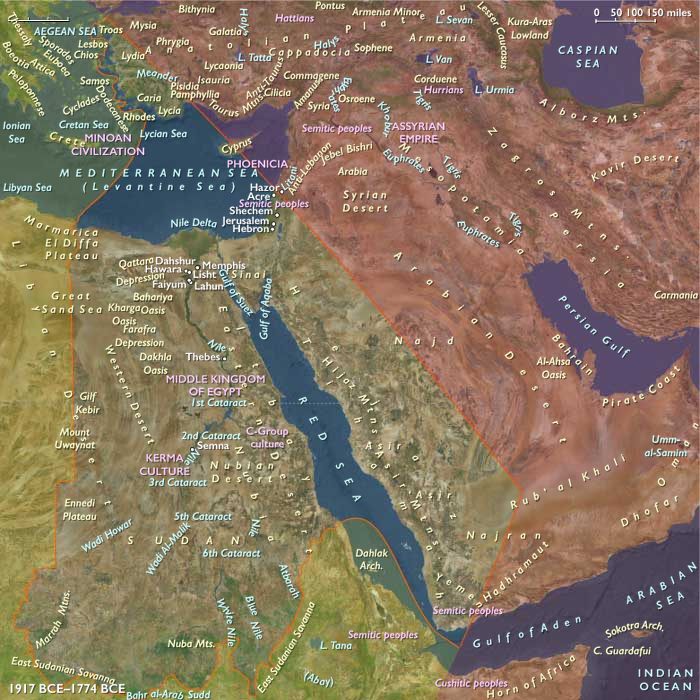
The capital and court of the pharaoh…
1917 BCE to 1774 BCE
The capital and court of the pharaoh had moved to Thebes in the south in the beginning of the Middle Kingdom, leaving Memphis in the shade for a time.
Despite the seat of political power having been shifted, Memphis remains perhaps the most important commercial and artistic center, as evidenced by the discovery of handicrafts districts and cemeteries, located west of the temple of Ptah.
Found also will be vestiges attesting to the architectural focus of this time.
A large granite offering table on behalf of Amenemhat I mentions the erection by the king of a shrine to the god Ptah, master of Truth.
Other blocks registered in the name of Amenemhat II are used as foundations for large monoliths preceding the pylons of Ramesses II.
These kings are also known to have ordered mining expeditions, raids or military campaigns beyond the borders, erecting monuments or statues to the consecration of deities, evinced by a panel recording official acts of the royal court during this time.
In the ruins of the Temple of Ptah, a block in the name of Senusret II bears an inscription indicating an architectural commission as a gift to the gods of Memphis.
Moreover, many statues found at the site, later restored by the New Kingdom pharaohs, are attributed to pharaohs of the Twelfth Dynasty.
Examples include the two stone giants that have been recovered amid the temple ruins, which will later be restored under the name of Ramesses II.
Finally, according to the tradition recorded by Herodotus and Diodorus, Amenemhat III builds the northern gate of the Temple of Ptah.
The Nile is dammed near Memphis for flood control.
Locations
Topics
Subjects
Regions
The Near and Middle East
View →Subregions