
Spain's colonies in the New World are, …
Years: 1540 - 1683
Spain's colonies in the New World are, legally, the personal patrimony of the king, and he holds absolute control over all matters in Ecuador.
Colonial administration at all levels is carried out in the name of the monarch.
The king's chief agency in Madrid is the Council of the Indies, which devotes most of its energies to formulating legislation designed to regulate virtually every aspect of colonial life.
The House of Trade, seated in Seville, is placed in charge of governing commerce between Spain and the colonies.
In America, the king's major administrative agents are the viceroyalty, the audiencia (court), and the municipal council (cabildo).
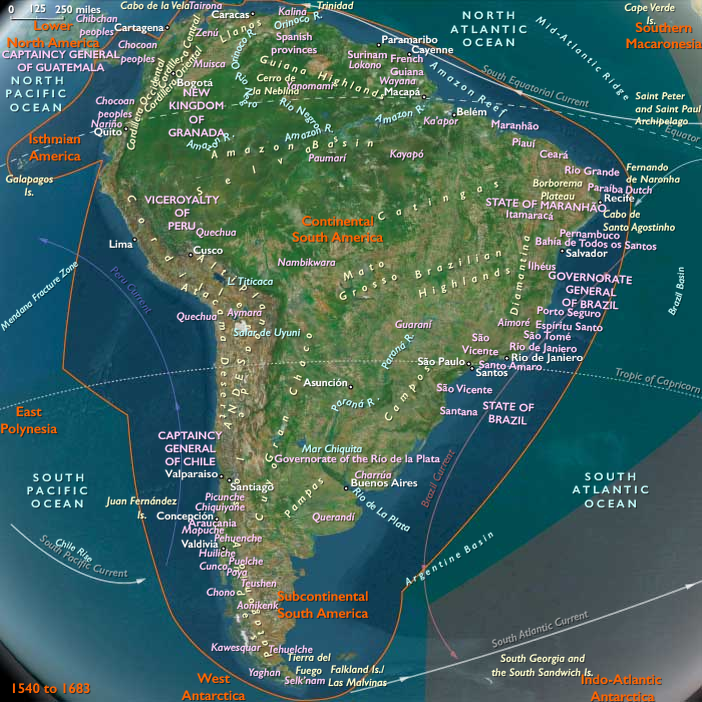
Between 1544 and 1563, Ecuador is an integral part of the Viceroyalty of Peru, having no administrative status independent of Lima.
It remains a part of the Viceroyalty of Peru until 1720, when it joins the newly created Viceroyalty of Nueva Granada; within the viceroyalty, however, Ecuador is awarded its own audiencia in 1563, allowing it to deal directly with Madrid on certain matters.
The Quito audiencia, which is both a court of justice and an advisory body to the viceroy, consists of a president and several judges (pidores).
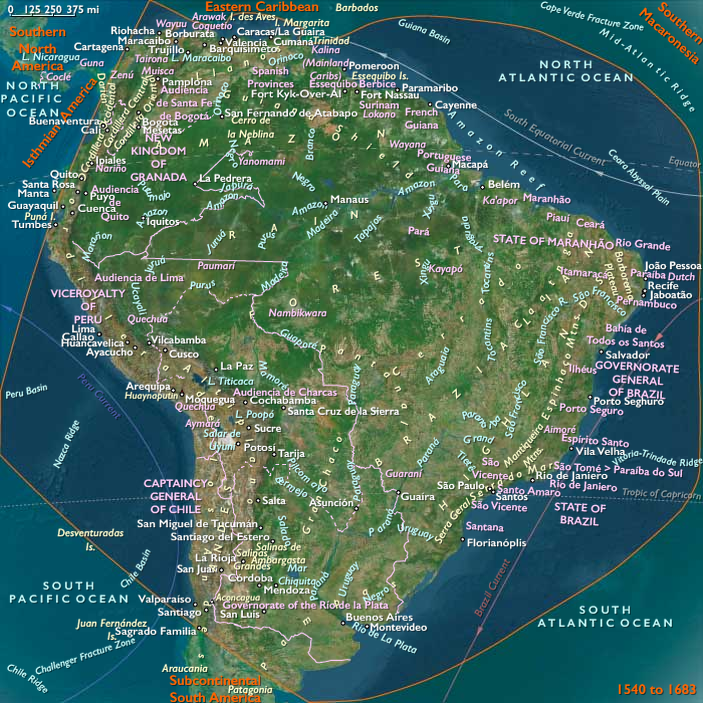
The territory under the jurisdiction of Quito considerably exceeds that of present-day Ecuador, extending southward to the port of Paita in the north of present-day Peru, northward to the port of Buenaventura and the city of Cali in the south of present-day Colombia, and well out into the Amazon River Basin in the east.
Quito is also the site of the first (founded in 1547) and most important municipal council within the area comprising modern-day Ecuador. It consists of several councilmen (regidores) whose extensive responsibilities include the maintenance of public order and the distribution of land in the vicinity of the local community.
The borders of the audiencia (or kingdom as it is also known) of Quito are poorly defined, and a great deal of its territory remains either unexplored or untamed throughout much of the colonial era.
Only in the Sierra, and there only after a series of battles that rage throughout the mid-sixteenth century, will the native population be fully subjugated by the Spanish.
The jungle lowlands in both the Oriente and the coastal region of Esmeraldas are, in contrast, refuges for an estimated one-quarter of the total native population that remain recalcitrant and unconquered throughout most or all of the sixteenth and seventeenth centuries.
Despite Orellana's harrowing journey of discovery, the Oriente remains terra incognita to the Spanish until its settlement by Jesuit missionaries beginning in the mid-seventeenth century, and it will continue to be largely inaccessible throughout the remainder of the colonial period.
Locations
People
Groups
- Christians, Roman Catholic
- Spain, Habsburg Kingdom of
- Spaniards (Latins)
- Jesuits, or Order of the Society of Jesus
- Peru, Viceroyalty of
- Quito, Real Audiencia of
- Bogotá, Audiencia de Santa Fe de (Captaincy General of New Granada)
Topics
Commodoties
Subjects
Regions
Subregions
Years: 1540 - 1683
Locations
People
Groups
- Christians, Roman Catholic
- Spain, Habsburg Kingdom of
- Spaniards (Latins)
- Jesuits, or Order of the Society of Jesus
- Peru, Viceroyalty of
- Quito, Real Audiencia of
- Bogotá, Audiencia de Santa Fe de (Captaincy General of New Granada)
Topics
Commodoties
Subjects
Regions
Subregions