
A great-grandson of Alexander I of Macedon…
393 BCE to 382 BCE
A great-grandson of Alexander I of Macedon finally takes the throne as Amyntas III in 393/392.
Although his reign is filled with anarchy and intrigue, he successfully brings unity to the troubled country.
Locations
People
Subjects
Regions
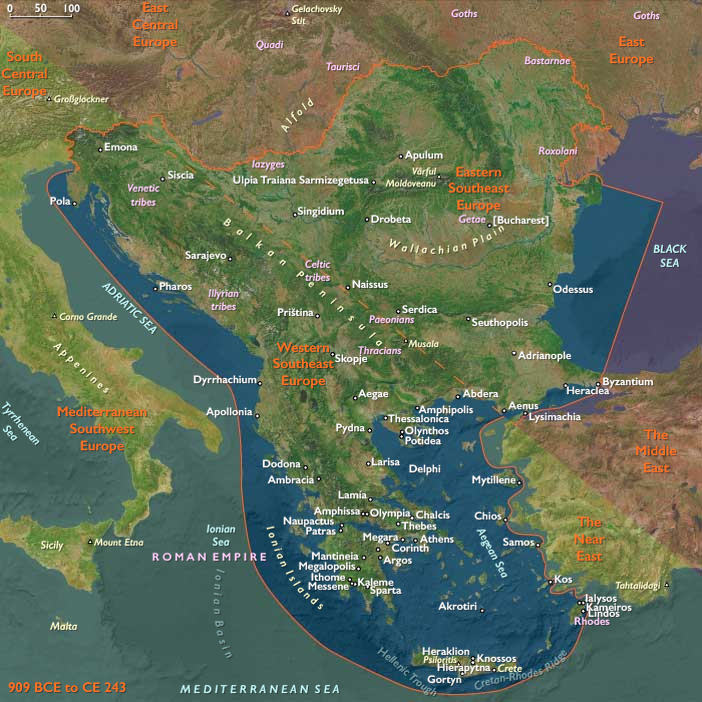
Southeast Europe
View →Subregions
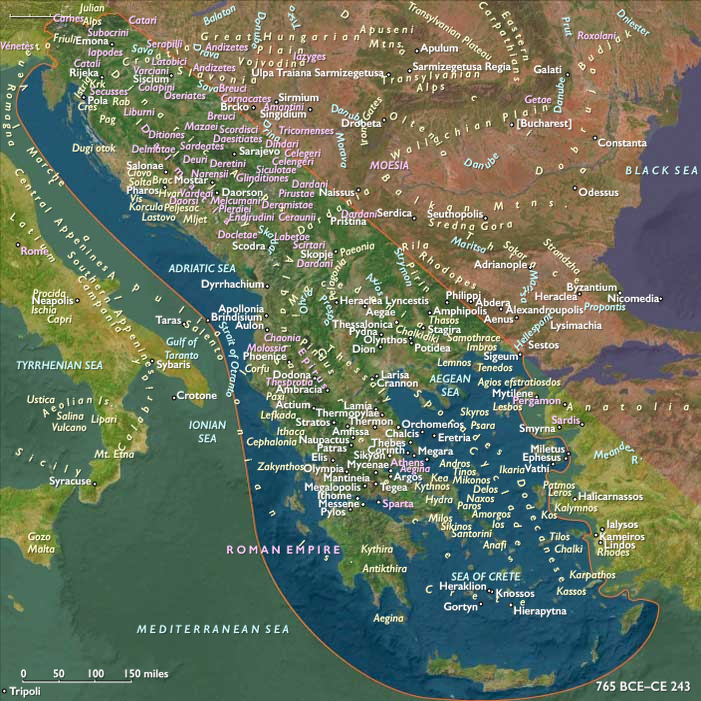
Western Southeast Europe
View →Related Events
No active filters.
Showing 10 events out of 64932 total
Leukon, ruler of the Bosporan Kingdom from 387 BCE, is noted in antiquity as a strategist and a disciplinarian.
In the writings of Aeneas Tacticus, How to Survive under Siege, he dismissed his guards who owed gambling debts, because their loyalty could be doubted during a city siege.
He continues the war of his father against Theodosia and Chersonesus with the goal of annexing all the Greek colonies in the Bosporus.
He also makes Sindike his vassal, and in an inscription from Nymphaion he is described as "archon of the Bosporus, Theodosia, all Sindike".
Chersonesus (Heracleotic Chersonese), prosperous from the fourth century BCE through trade with Athens and cities on the Pontic coast, maintains a free constitution of the Greek type.
The city-state fights for its continued independence against the Scythians of southern Russia, against the native Tauri of the southern Crimea, and against the Bosporan kingdom in the west.
Theodosia (modern Feodosiya) is situated on the southern coast of the Crimean Peninsula on the western shores of Feodosiya Bay.
Originally called Ardabda by its natives, terra cottas show it to have been inhabited in the sixth century BCE, but it is first heard of in history as resisting the attacks of Satyrus, ruler of the Bosporan kingdom, or Cimmerian Bosporus, about 390 BCE.
His successor Leukon, who succeeds to the throne in 387 BCE, transforms it into a great port for shipping wheat to Greece, especially to Athens.
Celts, having begun to push south and east into the Mediterranean lands, are already in northern Italy; the archaeological record shows them also moving farther south in the Iberian peninsula.
Celts have begun to push into eastern Europe also by about 390 BCE.
The archaeological record shows them moving east into present-day Poland and Ukraine, and taking over Illyrian and Thracian lands in the Balkans.
The Middle East: 393–382 BCE
Evagoras of Salamis and Persian Conflict
Evagoras, ruler of Salamis in Cyprus, initially maintains amicable relations with the Persian Empire under Artaxerxes II, notably securing Persian support for Athens in its conflict against Sparta. His significant contributions to the pivotal Battle of Cnidus (394 BCE)—where the Spartan fleet suffers a decisive defeat due to his substantial resources and efforts—earn him recognition from Athens, including a prestigious statue placed alongside that of the Athenian admiral Conon in the Ceramicus.
However, from 391 BCE onward, relations deteriorate, and Cyprus enters into a state of near-continuous conflict with the Achaemenid Empire. Allied with Athens and King Hakor (Achoris) of Egypt, Evagoras expands his influence significantly. He consolidates control over most of Cyprus, launches successful incursions into Asia Minor, captures key Phoenician cities such as Tyre, and encourages revolts in Cilicia against Persian authority.
The situation changes dramatically with the Peace of Antalcidas (387 BCE), under which Athens officially recognizes Persian sovereignty over Cyprus, effectively withdrawing its support from Evagoras. Left largely isolated—apart from intermittent Egyptian assistance—Evagoras continues his resistance against Persia. In 385 BCE, Persian generals Tiribazus and Orontes invade Cyprus with a substantial military force. Demonstrating strategic acumen, Evagoras cuts off the Persians from essential supplies, prompting starvation and leading to rebellion among Persian troops, thus temporarily alleviating the siege on his territories.
Evagoras of Salamis had, for a time, maintained friendly relations with Persia, and secured the aid of Artaxerxes II for Athens against Sparta.
He had taken part in the battle of Cnidus of 394 BCE, for which he provided most of the resources and in which the Spartan fleet was defeated thanks to his efforts; for this service, his statue had been placed by the Athenians alongside that of Conon in the Ceramicus.
Relations between Evagoras and the Persians had then become strained, and from 391, Cyprus and the Achaemenid Empire are virtually at war.
Aided by the Athenians and the Egyptian king Hakor (Achoris), Evagoras extends his rule over the greater part of Cyprus, crosses over to Asia Minor, takes several cities in Phoenicia (including Tyre), and persuades the Cilicians to revolt.
One result of the peace of Antalcidas (387), to which Evagoras refuses to agree, is that the Athenians withdraw their support, since by its terms they recognize he lordship of Persia over Cyprus.
In the ensuing years, Evagoras carries on hostilities single-handed, except for occasional aid from Egypt, which is likewise threatened by the Persians.
The Persian generals Tiribazus and Orontes at last invade Cyprus in 385 BCE.
However, Evagoras manages to cut off this force from being resupplied, and the starving troops rebel.
Near East (393–382 BCE): Egyptian Revolt and Persian Reassertion
Between 393 and 382 BCE, the Near East witnesses renewed tensions and geopolitical maneuvering, particularly centered around Egypt’s resistance against Persian dominion. Egyptian king Hakor boldly revolts against Persian King Artaxerxes II in 390 BCE. To support his rebellion, Hakor forms a strategic tripartite alliance with Evagoras, king of Cyprus, and with the city-state of Athens.
This alliance profoundly impacts the broader geopolitical landscape. Persia, responding strategically, begins to support Sparta in the ongoing Corinthian War in Greece, a move designed to counterbalance Athenian support for Egypt. This Persian intervention eventually leads to the Peace of Antalcidas in 387/6 BCE, by which Artaxerxes II asserts Persian authority over the Greek cities of Asia Minor and Cyprus, granting autonomy to the Greek city-states of mainland Greece provided they abstain from aggression against Persia.
With the Greek front stabilized, Persia redirects its military attention fully toward Egypt. Despite repeated assaults from 385 to 383 BCE, Persian forces, countered by the capable defense led by Hakor and the strategic assistance of the Athenian general Chabrias, fail to subdue Egypt decisively. The resilience of Hakor’s Egypt in this conflict highlights the persistent determination for regional autonomy, illustrating the ongoing struggle between local independence and Persian imperial ambitions.
Egyptian king Hakor revolts against his overlord, the Persian King Artaxerxes, Cyrus, early in his reign, in 390 BCE concluding a tripartite alliance with Evagoras, king of Cyprus, and Athens.
This alliance leads Persia to begin supporting Sparta in the Corinthian War, which eventually leads to the ending of that war by the Peace of Antalcidas in 387/6 BCE.
Artaxerxes II proclaims his authority over the cities of Asia Minor and Cyprus and gives full autonomy to the Greek city states of mainland Greece as long as they do not make war on him.
Persia turns its attention to Egypt after the end of this war, but Hakor, supported by the Athenian general Chabrias, holds them off in a three year war between 385 and 383 BCE.
Many Greek states suffer bloody class struggles over money and land in the fourth century BCE.
During this conflict, the kings of Persia contribute large amounts of money to whichever side will provide the best advantage to Persian interests.
Sparta's tenure as head of the empire is shortened by a combination of poor leadership, wars with Persia and with Sparta's former allies, and social weakness at home.
Sparta suffers a drastic shortage of manpower, and society nears revolution because of the huge amounts of wealth falling into the hands of a few.
In the Corinthian War (395-387), fought against Sparta by a coalition of Athens (with help from Persia), Boeotia, Corinth, and Argos, Sparta scores two land victories over Athenian allied states but suffers a severe naval defeat at Cnidus by a combined Athenian and Persian fleet.
The philosophers Protagoras, who lives from about 485 BCE to 410 BCE, and Democritus, who lives from about 460 BCEto about 370 BCE) are among the famous citizens of Abdera (present Ávdhira, Greece), a prosperous member of the Delian League in the fifth century.
Crippled early in the fourth century BCE by Thracian incursions, the city declines sharply in importance.
Democritus develops and systematizes the theory of classical atomism.
The theory, credited to his teacher Leucippus, postulates a world composed of hard, indivisible (hence atomic, from Greek atoma, "uncuttable") particles of matter traveling through empty space.
Atoms, in Democritus’ view, have various shapes (“why,” he asks, “ should they have one shape rather than another?"), mass, and motion; but such subjective qualities as color or flavor are supplied by the observer.
He describes atoms as existing by convention or by custom (nomos), as opposed to existing by nature (physis), and explains all change by reference to the transfer of momentum as the atoms collided.
Democritus theorizes that our cosmos was formed by a spinning vortex of such atoms and that there are an infinite number of worlds created in the same way.
In his belief in the unchanging nature of the intelligible universe and the changing nature of the sensible universe, he directly opposes the ideas of his fifth-century predecessors Heraclitus, who denied all constancy, and Parmenides, who denied all change.
Democritus' ethical naturalism, positioned between the extremes of these two philosophers, rejects any teleology or belief in chance that would deny people's responsibility for their own well-being.
Arguing that it is an individual's conscience alone that determines right or wrong action, he rejects all supernatural sanctions of human behavior, and maintains that belief in an afterlife is a ridiculous fiction. (This kind of thinking earned Democritus the label of the "laughing philosopher," in contrast to Heraclitus, the "weeping philosopher.")