
Increased taxation and discontent have marked the…
432 BCE
Increased taxation and discontent have marked the reign of Persia’s king Artaxerxes, but through diplomacy the king maintains the Achaemenid empire in peace during the latter years of his rule.
Locations
People
Commodities
Subjects
Regions
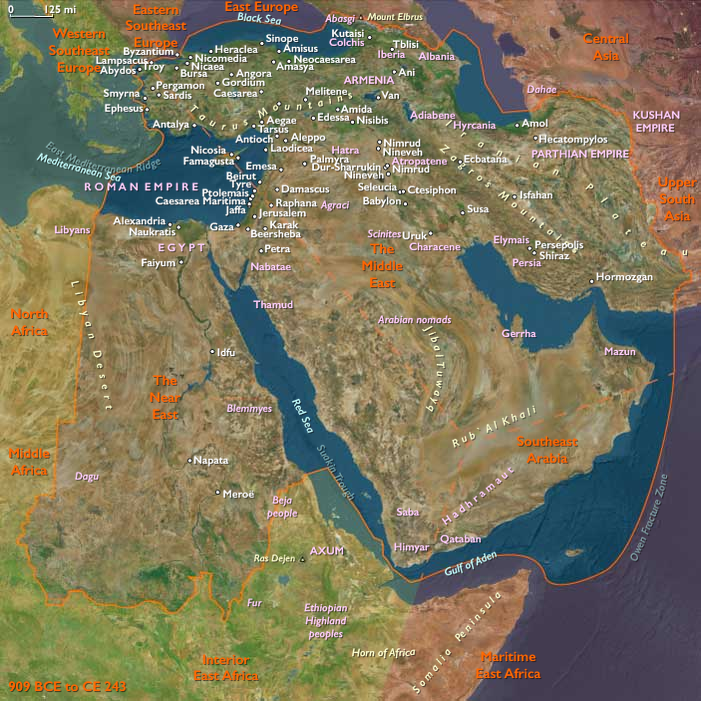
The Near and Middle East
View →Subregions
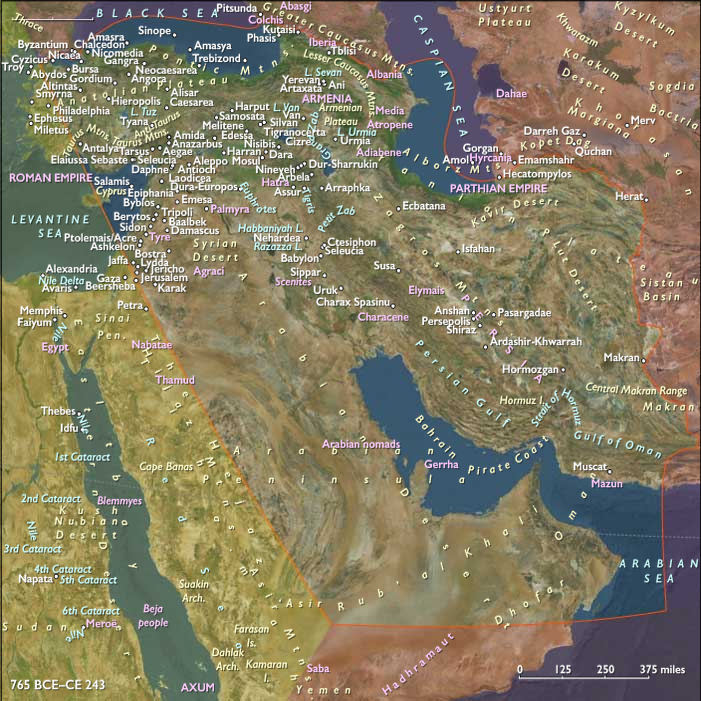
Middle East
View →Related Events
No active filters.
Showing 10 events out of 65257 total
Nehemiah, Artaxerxes' cupbearer, had begun the rebuilding of Jerusalem "in the 20th year of King Artaxerxes" (Nehemiah 2:1) or 445 BCE.
Nehemiah has apparently served as governor of the small district of Yehud (Judea) for twelve years, during which he has undertaken various religious and economic reforms, including extensive moral and liturgical reforms in rededicating the Jews to Yahweh, before returning to Persia.
He undertakes a second mission to Jerusalem in 432.
Olynthus, now the chief Greek city west of the Strymon (modern Struma) River, in 432 founds and becomes the chief city of the Chalcidian League, a confederation of the Greek cities of the Chalcidice Peninsula.
Pericles ignores Sparta's demand in 432 BCE that he revoke the recently implemented Megarian Decree, which, in a bid to stifle Megara's extensive trade, denies that city access to the harbors of the empire.
The Athenians demand that Potidaea dismantle its sea defenses and expel its Corinthian magistrates.
Phidias is also reportedly the overall supervisor of the artistic works on the Acropolis, including the (lost) “Athena Promachos.”
The Parthenon is completed in 432.
Iktinos has employed fine Pentelic marble throughout the Parthenon, incorporating every refinement developed by Greek architects over the previous two centuries to produce an unparalleled harmony of geometric proportions, optical effects, and sculptural decoration.
The acroteria (pediment plinths) feature the first known occurrence of the acanthus leaf, an architectural element based on the leaves of the acanthus plant.
Callimachus of Athens according to Vitruvius is the first to use the acanthus leaf on the new Corinthian capital design.
The frieze of the Erechtheum features acanthus leaves as a design element.
Athenian astronomer Meton, who flourishes during the later half of the fifth century BCE, discovers a nineteen-year lunisolar calendric cycle of six thousand nine hundred and forty days (nineteen solar years), finding it to be be almost equivalent to two hundred and thirty-five lunar (synodic) months.
The Greeks in 432, following the acceptance of Meton’s discovery, add a thirteenth intercalary month to their calendar, which normally consists of twelve lunar months (three hundred and fifty-four days).
The figure’s flesh is ivory and the drapery gold.
In front of the figure is a blue-black stone basin filled with oil to protect it from Olympia’s humid climate.
Potidaea revolts and an unofficial Corinthian force goes out to help.
Potidaea is laid under siege by Athens, with Phormio in command.
Alcibiades, well-born and wealthy, had been only a small boy when his father—who was in command of the Athenian army—was killed in 447 or 446 BCE, at Coronea in Boeotia, and his guardian, Pericles, a distant relation, has been too preoccupied with political leadership to provide the guidance and affection that the boy needed.
Alcibiades has grown up to be a strikingly handsome and keen-witted teenager, but he is extravagant, irresponsible, and self-centered as well.
He is, however, impressed by the moral strength and the keen mind of the philosopher Socrates, who, in turn, is strongly attracted by Alcibiades' beauty and intellectual promise.
They serve together at Potidaea, where Socrates defends Alcibiades when the latter is wounded.
None of the foregoing yet amounts to war with the Peloponnesian League as a whole, but the temperature is as high as it can be, short of this.
Athens, on the advice of Pericles, its most influential leader, refuses to back down.
A congress of Spartan allies, who accuse Athens of aggression and threaten war, is convoked to discuss grievances against Athens, and the decision is taken for war.
All known operations of the Spartan army for the past thirty years have been commanded by members of not the Eurypontid but the other royal house (the Agiads), and there is no further record of Archidamus' activities until 432, when, according to the contemporary Greek historian Thucydides, the king attempts without success to prevent the outbreak of war with Athens.
Perdiccas, after asserting his succession against various brothers, unites the Greek cities of Chalcidice in a federation centering on the city of Olynthus.
Athens enters into an alliance with King Sitalces of Odrysian Thrace in 431 BCE after Nymphodorus, an Athenian, marries Sitalces’ sister.
Nymphodorus then negotiates an agreement between Athens and Perdiccas, where Perdiccas regains Therma.
As a result of this, Athens withdraws her support for Philip, and the Thracians promise to assist Perdiccas in capturing him.
In return, Perdiccas marches on the Chalcidians, the people he had originally persuaded to revolt.
The Boeotian League has meanwhile grown into a close-knit confederacy by 431, organized in eleven districts.
Each district, comprising one or more cities, sends a general (boeotarch), several judges, and sixty counselors to a federal government; the federal council of 660 is probably divided into four panels, each in turn convening for one year.
The vote is given only to the propertied classes.
Thebes, where the council meets, dominates the league since it controls four districts and supplies the best contingent to the federal army.
The other Spartan ally seeking to involve Sparta in a private feud with an enemy is Thebes, …