
…installs Tiridates III, a Roman protégé, as…
287 CE
…installs Tiridates III, a Roman protégé, as king of Armenia, which the Persians have been forced to relinquish.
Locations
Groups
Commodities
Subjects
Regions
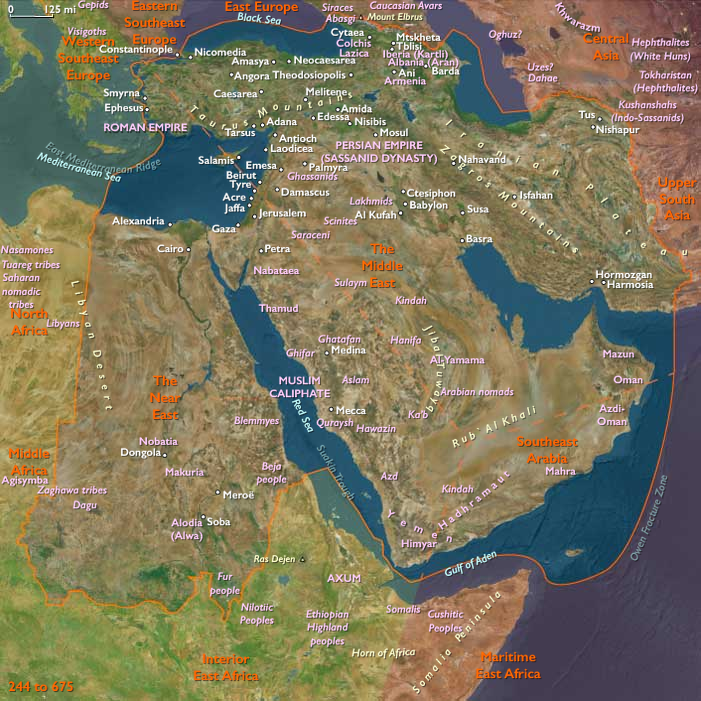
The Near and Middle East
View →Subregions
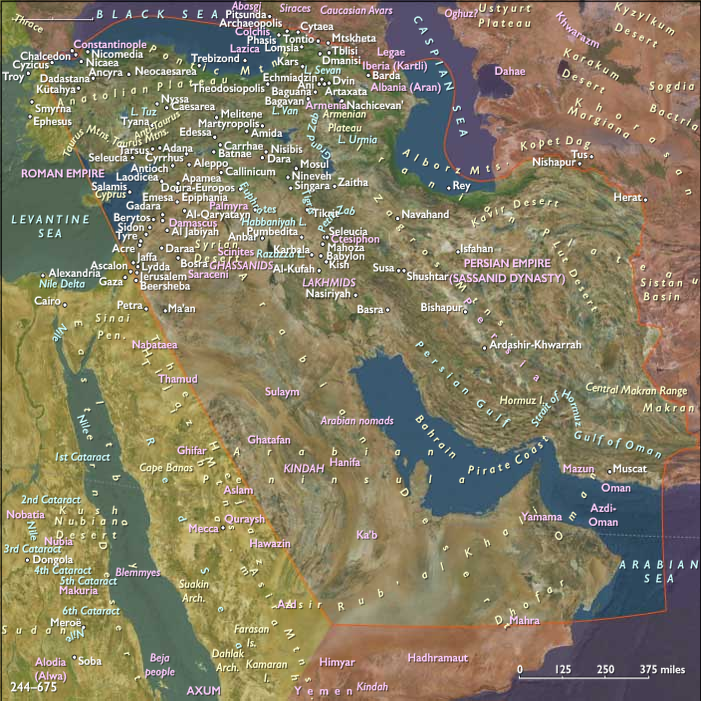
Middle East
View →Related Events
No active filters.
Showing 10 events out of 59866 total
The overthrow of Hormizd has made Bahram secure.
Diocletian signs a peace treaty with him, and …
Carausius’ Rebellion and the Creation of the Britannic Empire (286 CE)
After being entrusted by Emperor Maximian with the command of the Roman fleet at Gesoriacum (Boulogne) to combat Saxon and Frankish pirates, Mausaeus Carausius was soon accused of corruption. His alleged crime was:
- Allowing pirates to raid Roman territories first, then attacking them afterward and seizing their stolen cargoes for himself rather than returning them to the imperial treasury.
Maximian’s Response and Carausius’ Escape to Britain
- Furious at this betrayal, Maximian ordered the execution of Carausius.
- Before he could be arrested, Carausius fled with his loyal troops to Britain in 286 CE.
- Once in Britain, he declared himself ruler, taking the imperial title of Augustus, effectively seceding from the Roman Empire and forming an independent state, later known as the Britannic Empire.
The Britannic Empire: A Breakaway Roman State
- Carausius established a power base in Britain, securing support from British legions, local elites, and even some northern Gallic territories.
- He minted his own coins, emphasizing his legitimacy with the phrase "Restorer of Britain" (Restitutor Britanniae).
- His control over naval forces allowed him to dominate the English Channel, making any Roman attempt to retake Britain difficult.
Significance of Carausius’ Revolt
- His rebellion exposed the weaknesses of Roman control over Britain and the northern provinces.
- The Franks and Saxons continued their raids, taking advantage of Rome’s internal instability.
- His rule set a precedent for future breakaway states in the Western Roman Empire, showing that provincial military leaders could defy central authority and establish their own rule.
Though Carausius would eventually be assassinated by his own finance minister, Allectus, in 293 CE, his secession from Rome marked a major turning point in the empire’s struggle to maintain control over its far-flung provinces.
Empress Yang Zhi, Emperor Wu’s second wife, had borne him a son, Sima Hui, in 283, but Prince Hui had died in 284.
Empress Yang has been instrumental in keeping Crown Prince Zhong's wife Crown Princess Jia Nanfeng from being deposed, as Princess Jia is jealous and violent.
After several of the crown prince's concubines had become pregnant, Princess Jia had personally had them killed.
When Emperor Wu heard about this, he had been angry and wanted to depose the crown princess, but Empress Yang had persuaded him to remember the crown princess' father Jia Chong's contribution to the establishment of Jin.
She had also rebuked the crown princess to try to rein in her behavior—but the crown princess, not knowing that the empress had persuaded the emperor not to depose her, bears a grudge against the empress as a result.
Carausius’ Naval Dominance and Expansion into Gaul (286–293 CE)
After seizing power in Britain in 286 CE, Carausius strengthened his rule by training local barbarians as sailors, allowing him to control the western sea. His naval supremacy enabled him to extend his rule beyond Britain, securing parts of northern Gaul, including Rotomagus (modern Rouen).
1. Naval Supremacy and Control of the English Channel
- Carausius, a former pilot and naval commander, understood the strategic importance of controlling the sea.
- He trained local Britons and Germanic mercenaries as sailors, creating a powerful fleet.
- With command over the western sea, he was able to prevent Rome from launching an immediate counterattack.
- His fleet patrolled the Channel and North Sea, securing trade routes and blocking Roman military movements.
2. Expansion into Northern Gaul
- By securing maritime dominance, Carausius was able to expand into Gaul, taking control of coastal cities and river routes.
- His rule extended as far as Rotomagus (modern Rouen), a strategically important city along the Seine River.
- He maintained Roman-style governance in his territories, minting his own coins and presenting himself as a legitimate emperor.
3. A Challenge to Rome’s Authority
- By controlling Britain and northern Gaul, Carausius posed a serious threat to Roman rule in the West.
- His ability to defend his domain for nearly seven years demonstrated the effectiveness of his military and naval strategies.
- His breakaway state, often referred to as the "Britannic Empire," was the first lasting secession from Roman central authority.
4. Rome’s Response and Carausius’ Downfall
- In 293 CE, Emperor Constantius Chlorus, the western Caesar under Diocletian's Tetrarchy, launched a campaign to reclaim northern Gaul.
- He successfully recaptured Gesoriacum (Boulogne), cutting Carausius off from his continental holdings.
- Soon after, Carausius was assassinated by his finance minister, Allectus, who briefly ruled before being defeated by Roman forces in 296 CE.
Conclusion: A Temporary Maritime Empire
- Carausius' naval supremacy gave him unparalleled control over Britain and the English Channel, allowing him to rule parts of northern Gaul.
- His ability to hold power for seven years demonstrated that Rome’s control over its western provinces was weakening.
- Though ultimately defeated, Carausius' rule foreshadowed the fragmentation of the Western Roman Empire, proving that regional commanders could defy central Rome and create independent states.
His reign remains a fascinating episode in Roman history, where a rogue commander leveraged naval power to challenge the might of the empire.
Emperor Wu’s generosity and kindness have undermined his rule, as he has become overly tolerant of the noble families' corruption and wastefulness, which has drained the state’s resources.
Further, when the emperor had established the Jìn Dynasty, he had been concerned about his regime's stability, and, believing that the predecessor state, Cao Wei, had been doomed by its failure to empower the princes of the imperial clan, he has greatly empowered his uncles, his cousins, and his sons with authority including high military ranking.
This, ironically, will lead to the destabilization of the Jìn Dynasty.
In 289, as Emperor Wu nears death, he considers whom to make the regent for Crown Prince Zhong, who is developmentally disabled.
He considered both Empress Yang's father Yang Jun and his uncle Sima Liang the Prince of Ru'nan, the most respected of the imperial princes.
As a result, Yang Jun becomes fearful of Sima Liang and has him posted to …
…the key city of Xuchang (in modern Xuchang, Henan).
Maximian’s Failed Invasion of Britain (288/289 CE) and the Continued Rule of Carausius
By 288 or 289 CE, Emperor Maximian, co-ruler of the Western Roman Empire, prepared to invade Britain to reclaim the province from Carausius, the rogue naval commander who had declared himself Augustus of Britain and northern Gaul. However, the invasion failed, allowing Carausius to remain in power for several more years.
1. The Roman Invasion Attempt and Its Failure
- Maximian assembled a fleet, likely at Gesoriacum (modern Boulogne), intending to retake Britain by force.
- The invasion failed, but sources disagree on why:
- A panegyric to Constantius Chlorus blames bad weather, implying that storms or rough seas prevented the fleet from landing.
- Eutropius, a 4th-century historian, states that the failure was due to Carausius’ military skill, suggesting that his fleet successfully repelled the attack.
- Carausius himself claimed a military victory, further bolstering his legitimacy as ruler of Britain and parts of Gaul.
2. The Aftermath: Stalemate and a Peace Agreement
- Following the failed invasion, neither side could force a decisive outcome, leading to a stalemate.
- Eutropius records that hostilities were in vain, meaning that Rome was unable to dislodge Carausius, despite its military strength.
- As a result, peace was agreed, possibly recognizing de facto independence for Carausius' rule over Britain and northern Gaul.
- Carausius continued to issue coins, portraying himself as a legitimate emperor, emphasizing slogans such as "Restitutor Britanniae" (Restorer of Britain).
3. The Continued Threat of Carausius to Roman Authority
- Carausius’ control over the English Channel meant that Rome could not easily launch another invasionwithout a large naval force.
- His alliance with local Britons, Frankish and Saxon mercenaries, and Roman deserters strengthened his rule.
- However, his separatist state was not politically stable, leading to internal tensions.
4. The Road to Carausius’ Downfall (293 CE)
- In 293 CE, Emperor Diocletian’s Tetrarchy restructured the empire, and Constantius Chlorus was appointed Caesar of the West, tasked with recovering Britain.
- Constantius recaptured Boulogne, cutting Carausius off from his Gallic territories and weakening his position.
- Soon after, Carausius was assassinated by his finance minister, Allectus, who briefly ruled Britain before being defeated by Roman forces in 296 CE.
Conclusion: A Temporary British Empire
- Maximian’s failed invasion of 288/289 CE allowed Carausius to maintain his rule over Britain for several more years.
- His control of the sea and military skill prevented Rome from reclaiming the province until a more coordinated campaign under Constantius Chlorus in 296 CE.
- While Carausius' breakaway state eventually fell, his reign demonstrated the increasing instability of the Western Roman Empire and foreshadowed later provincial revolts that would contribute to Rome’s eventual decline.
Despite his defiance of Roman authority, Carausius' rule remains one of the most remarkable secessionist movements in Roman history, where a naval commander successfully held Britain against the might of the empire for nearly a decade.
Emperor Wu has resolved by 290 to let Yang Jun and Sima Liang both be regents, but after he writes his will, the will is seized by Yang Jun, who instead has another will promulgated in which Yang alone is named regent.
Emperor Wu dies soon hereafter, and Crown Prince Zhong ascends the throne as Emperor Hui.
Empress Yang is honored as empress dowager, Crown Princess Jia becomes empress, and Prince Yu becomes crown prince.
Although the Jin dynasty has provided a brief period of unity after conquering the Kingdom of Wu, the longest-lived of the Three Kingdoms competing for control of China after the fall of the Han Dynasty, in 280, a complex power struggle begins among the Sima clan following the death of Emperor Wu in 290.
The new emperor is developmentally disabled, and factions fight to control the imperial court.
Initially, the emperor's stepmother, Empress Dowager Yang, exerts the most power at the courts, and empowers her family, the Yang consort clan, with her father Yang Jun given the most power.
Yang Jun quickly shows himself to be autocratic and incompetent, drawing the ire of many other nobles and officials.
He tries to appease them by making many bestowments of titles and honors among them, but this only brings further contempt for his actions.
Knowing Empress Jia to be strong-willed and treacherous, he tries to place people loyal to him in charge of all the defense forces of the capital, Luoyang, and orders that all edicts not only be signed by the emperor but also by Empress Dowager Yang before they could be promulgated.
Empress Jia, however, wants to be involved in the government, and is angry that she is constantly rebuffed by Empress Dowager Yang and Yang Jun.
She therefore conspires with the eunuch Dong Meng and the generals Meng Guan and Li Zhao against the Yangs.
She tries to include Sima Liang into the conspiracy, but Sima Liang declines; instead, she persuades her brother-in-law, Sima Wei the Prince of Chu, to join her plan.
Sima Wei is the fifth son of Emperor Wu by his concubine Consort Shen.
Carausius had begun to entertain visions of legitimacy and official recognition by 289, minting his own coins and bringing their value in line with Roman issues as well as acknowledging and honoring Maximian and then Diocletian, who, having failed in several attempts to dislodge Carausius, acknowledge him as ruler of Britain in 290.
Diocletian and Maximian meet in Milan on the five-year anniversary of their rule, either in late December 290 or January 291, to discuss their successes and failures.
The meeting is undertaken with a sense of solemn pageantry; the Emperors spend most of their time in public appearances.
It has been surmised by David Potter that the ceremonies were arranged to demonstrate Diocletian's continuing support for his faltering colleague.
(Potter, David S. The Roman Empire at Bay: AD 180–395.
New York: Routledge, 2005) A deputation from the Roman Senate meets with the Emperors, renewing that body's infrequent contact with the Imperial office.
The choice of Milan over Rome further snubs the capital's pride, but it is already a long established practice that Rome itself is only a ceremonial capital, as the actual seat of the Imperial administration is determined by the needs of defense.
Long before Diocletian, Gallienus (r. 253–68) had already chosen Milan as the seat of his headquarters.
If the panegyric detailing the ceremony implies that the true center of the Empire is not Rome, but where the Emperor sits ("...the capital of the Empire appeared to be there, where the two emperors met"), (Panegyrici Latini 11(3)12, qtd.
in Williams, 57.)
it simply echoes what had already been stated by the historian Herodian in the early third century: "Rome is where the emperor is".
During the meeting, decisions on matters of politics and war are probably made, but they are made in secret.
The Augusti will not meet again until 303.