
Irenaeus, Bishop of Lugdunum in Gaul, writes …
Years: 181 - 181
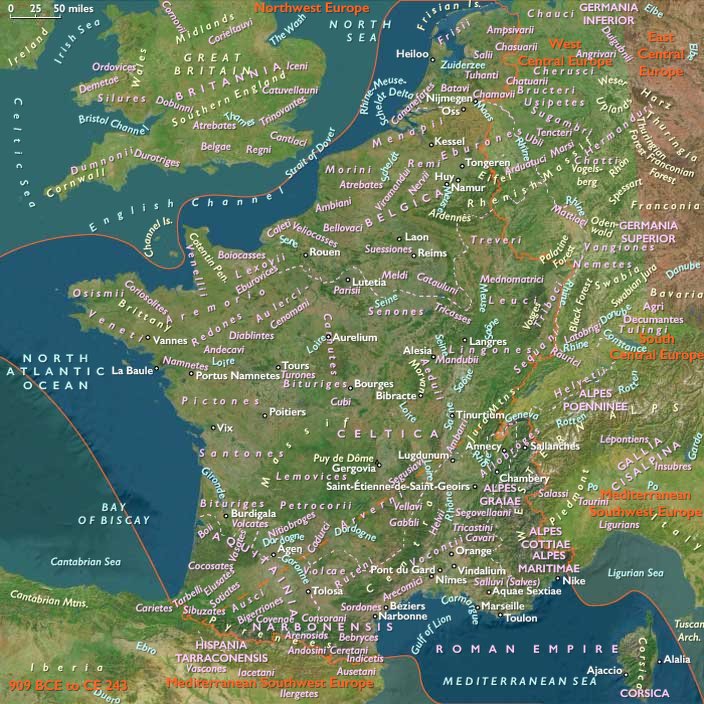
Irenaeus, Bishop of Lugdunum in Gaul, writes a five-volume work in the second century, On the Detection and Overthrow of the So-Called Gnosis, today also called On the Detection and Overthrow of Knowledge Falsely So Called (Greek: lit. "Elenchus and Overturning of the Pseudonymous Knowledge"), commonly called Against Heresies (Latin: Adversus haereses).
The final phrase "of knowledge falsely so-called" (Greek: tes pseudonymou gnoseos genitive case; or nominative case pseudonymos gnosis) is a quotation of the apostle Paul's warning against "knowledge falsely so-called" in 1 Timothy 6:20.
Due to its reference to Eleutherus as the current bishop of Rome, the work is usually dated to about 180.
In it, Irenaeus identifies and describes several schools of gnosticism and contrasts their beliefs with what he describes as catholic, orthodox Christianity.
Only fragments of the original Greek text exist, but a complete copy exists in a wooden Latin translation, made shortly after its publication in Greek, and Books IV and V are also present in a literal Armenian translation.
Irenaeus’s purpose in writing Against Heresies is to refute the teachings of various Gnostic groups; apparently, several Greek merchants had begun an oratorial campaign praising the pursuit of "gnosis" in Irenaeus' bishopric.
Another popular theory states that a group of Gnostics known as the Valentinians remained part of the early Christian church, taking part in regular church celebrations despite their radical differences.
It is also said that Gnostics would secretly meet outside of regular church activity where they would discuss their "secret knowledge" and scripture that pertains to it.
As bishop, Irenaeus felt obligated to keep a close eye on the Valentinians and to safeguard the church from them.
In order to fulfill this duty, Irenaeus educated himself and became well informed of Gnostic doctrines and traditions.
This eventually led to the compilation of his treatise.
It appears however, that the main reason Irenaeus had taken on this work was because he felt that Christians in Asia and Phrygia especially need his protection from Gnostics, for they do not have as many bishops to oversee and help keep problems like this under control (probably only one bishop was assigned to a number of communities).
Therefore, due to the issue of distance between Irenaeus (who is in the western Roman province of Gaul) and the orthodox Christian community of Asia, Irenaeus finds that writing this treatise will be the best way to offer them guidance.
Against Heresies was the best surviving contemporary description of Gnosticism until the discovery of the Library of Nag Hammadi in 1945.
This publication is historically important as the dating of the publication is irrefutable and the document is among the earliest non-controversial confirming documentation for many of the sayings attributed by early Christian writers to Jesus and to the Letters of Paul.
Locations
People
Groups
- Gallia Lugdunensis (Roman province)
- Christians, Early
- Roman Empire (Rome): Nerva-Antonine dynasty
- Valentinianism
- Gnosticism
- Marcionism
- Montanism
Topics
Commodoties
Subjects
- Commerce
- Writing
- Environment
- Labor and Service
- Conflict
- Faith
- Government
- Technology
- Movements
- Christology
Regions
Subregions

Years: 181 - 181
Locations
People
Groups
- Gallia Lugdunensis (Roman province)
- Christians, Early
- Roman Empire (Rome): Nerva-Antonine dynasty
- Valentinianism
- Gnosticism
- Marcionism
- Montanism
Topics
Commodoties
Subjects
- Commerce
- Writing
- Environment
- Labor and Service
- Conflict
- Faith
- Government
- Technology
- Movements
- Christology
Regions
Subregions