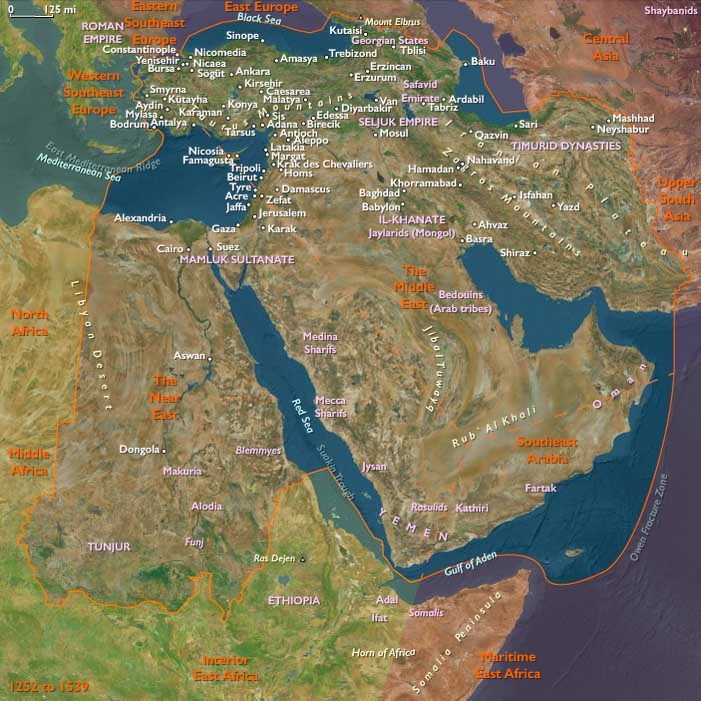
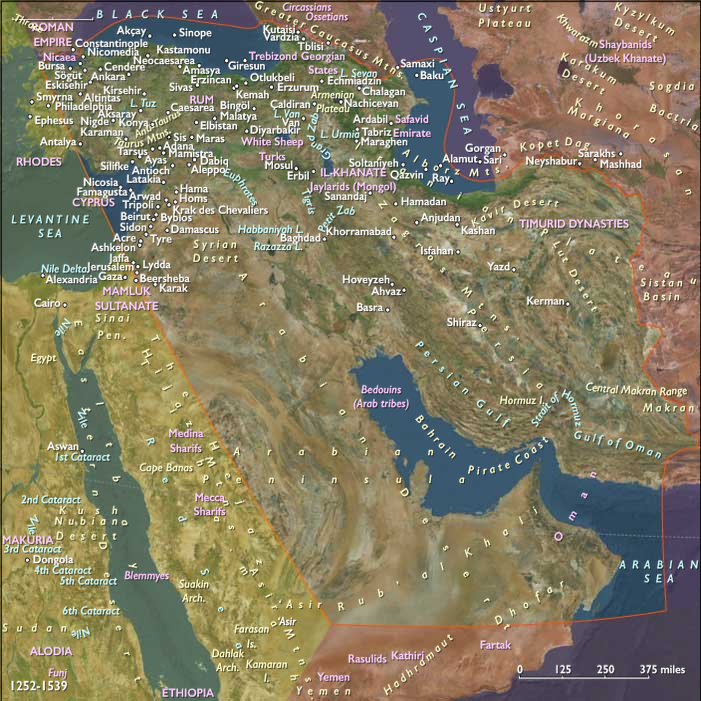
Ismail makes the rulers of Khuzestan, …
Years: 1508 - 1508
Ismail makes the rulers of Khuzestan, …
Locations
People
Groups
- Iranian peoples
- Persian people
- Muslims, Sunni
- Muslims, Shi'a
- Turkmen people
- Mongols
- Timurid Emirates
- Qizilbash or Kizilbash, (Ottoman Turkish for "Crimson/Red Heads")
- Persia, Safavid Kingdom of
Topics
Commodoties
Subjects
Regions
Subregions
Related Events
Filter results
Showing 9 events out of 9 total
Antoine Laumet de La Mothe, sieur de Cadillac, a French army lieutenant who had gone to Canada in 1683, had during the next four years explored his new country in all directions, extending his explorations to New England and New Holland, pushing on south to the Caroline (present North Carolina and South Carolina) and familiarizing himself with the native languages and habits.
He had probably entered into a business relationship with Denis Guyon, a merchant of Quebec, whose seventeen-year-old daughter Marie-Thérèse he had married on June 25, 1687.
His marriage will prove to be a fertile one, and the Lamothe-Cadillac couple is to have six daughters and seven sons.
The marriage certificate is the first document where his new identity appeared.
He calls himself "Antoine de Lamothe, écuyer, sieur de Cadillac", and signs as "De Lamothe Launay".
Lke many immigrants, he has taken advantage of his arrival in the New World to create a new identity, perhaps to conceal the reasons that had driven him from France.
This new identity "ne sort pas de son sac" ("I did not create this identity out of nowhere"), as he will write later.
The former Antoine Laumet likely remembered Sylvestre d'Esparbes de Lussan de Gout, baron of Lamothe-Bardigues, lord of Cadillac, Launay and Le Moutet; adviser to the Parliament of Toulouse.
He knew him for at least two reasons: Bardigues, Cadillac, Launay and Le Moutet all are villages and localities close to his birthplace, Saint-Nicolas-de-la-Grave, and his father Jean Laumet was a lawyer in the Parliament of Toulouse.
It is probable that the sons knew each other during their studies.
The second son in his family, Laumet identified with the second son of the baron while taking advantage of the phonic similarity between his own name and that of Launay, creating Antoine de Lamothe-Launay and taking the title of écuyer (squire), the rank held by a family's second son, followed by the title sieur (sire) of Cadillac.
This accords with the Gascon custom whereby the junior family member succeeds the elder son upon the latter's death.
Laumet has thus created a new identity as well as noble origin, while protecting himself from possible recognition by someone who had known him in his home country.
In addition, he presents his own titles of nobility as illustrated by armorial bearings that he has created by associating the shield with the three “merlettes” (birds with no legs nor bill) of the baron de Lamothe-Bardigues and that of the Virès family (of France's Languedoc region).
He receives from Denonville in 1688 the concession of the seigniory (estate) of Les Douacques (which will later become the town of Bar Harbor, Maine, well-known fishing town reputed for its lobster and surmounted by Mount Desert, later known as Cadillac Mountain).
His concession brings him no income, even from agriculture, and so he has entered into partnership with officers of Port Royal and started trading, an activity facilitated by the possibility of using a ship belonging to the Guyon brothers.
Sent in 1689 on an expedition in the vicinity of Boston, he asks, on his return, the governor of Acadia, Louis-Alexandre des Friches de Méneval, for a job as notary, to bring in a minimum income; his request is turned down.
He is then introduced to the governor Louis de Buade de Frontenac in Quebec, who sends him on an exploratory mission along the coasts of New England, aboard the frigate "L'Embuscade" (The Ambush); strong head winds force the ship to return to France.

Antoine Laumet, born to a local magistrate at Les Laumets in the hamlet of Saint-Nicolas-de-la-Grave, in Gascony, and educated in a military school, had joined the army where he was a cadet in the regiment of Dampierre-Lorraine, and in 1677 had become a lieutenant in the regiment of Clairembault.
He arrived in 1683 at Port-Royal, Acadia, where Governor Frontenac made him a lieutenant and later a captain.
Soon after disembarking the colorful Laumet had changed his name and began calling himself "Lamothe", which was the name of a nobleman of his home region (de Lamothe-Bardigues) who was a counselor to the parliament in Toulouse.
He also borrowed the latter's coat of arms that he had seen on the gates of the Bardigues estate near St. Nicolas. (It is a variation on that coat of arms that has graced the Cadillac automobile for close to one hundred years.)
He married Marie-Thérèse Guyon, niece of French-Canadian privateer, Denis Guyon, in 1687.
It is rumored that they met at the Governor's ball at Quebec's Château St. Louis and that Laumet worked for her uncle as a navigator.
He signed the marriage license de La Mothe, sieur de Cadillac.
The style "sieur" is derived from the French formal address "monsieur," and equates to the English title "sir"; it is roughly equivalent to a title between "gentleman" and "lord."
It is believed that the name Cadillac is a reference to a hamlet near the town of Montech, not far from Laumet's birthplace, or perhaps the wine-producing Cadillac, seat of the Ducs d'Épernon, which is also close to Gascony. (The couple will eventually have between seven and thirteen children.)
Cadillac in 1688 had requested and received from the Governor of New France a parcel of land in an area known as Donaquec which included part of the Donaquec River (now the Union River) and the island of Mount Desert in the present-day U.S. state of Maine.
Cadillac at that time referred to himself as Antoine de la Mothe, Sieur de Cadillac, Donaquec and Mount Desert.
He had gone to France in 1689 to consult on the war effort against New England, then moved with his family in 1691 to Quebec City, where he had been commissioned in the Troupes de la Marine.
He is named in 1694 as commander of the strategic western fort of Michilimackinac in Michigan.
Cadillac returns to France in 1699 and urges the establishment of a fortified post on the Detroit River to protect the fur trade from the English.
Cadillac, having received a land grant and trade monopoly, leads an expedition by canoe from Quebec and establishes Fort Ponchartrain du Detroit on August 4, 1701, later to become Detroit, Michigan.
The success of the late Governor Frontenac’s attacks, which again reached deep into Iroquois territory, and the inability of the English to protect them from attacks originating to their north and west, has forced the Iroquois to more seriously pursue peace.
Their demographic decline, aided by conflicts and epidemics, has put their very existence into doubt.
At the same time, commerce has become almost nonexistent because of a fall in the price of furs.
The natives prefer to trade with the merchants of New York because these merchants offer better prices than the French.
Preliminary peace negotiations had taken place in 1698 and 1699, but had been to some degree frustrated by the intervention of the English, who seek to keep the Iroquois from negotiating directly with the French.
After another successful attack into Iroquoia in early 1700, these attempts at intervention had failed.
The first conference between the French and Iroquois had been held on Iroquois territory at Onondaga in March 1700.
In September of the same year, a preliminary peace treaty had been signed in Montreal with the five Iroquois Nations.
Thirteen native symbols are on the treaty.
After this first entente, it was decided that a bigger one would be held in Montreal in the summer of 1701 and all Nations of the Great Lakes invited.
Selected French emissaries, clergy and soldiers, all well-perceived by the natives, have been assigned this diplomatic task.
The negotiations have continued during the wait for the big conference; the neutrality of the Five Nations had been discussed in Montreal in May 1701.
The Great Peace of Montreal, a peace treaty between New France and forty First Nations of North America, is signed on August 4, 1701, ending one hundred years of war between the Iroquois Confederacy and New France and its Huron and Algonquian allies.
The treaty assures that the Iroquois, formerly allied with the English, will be neutral if France and England are to ever resume hostilities.
Commerce and exploratory expeditions quietly resume in peace after the signing of the treaty.
The French explorer Cadillac leaves Montreal to explore the Great Lakes region, eventually founding the city of Detroit, which has a promising future.
Jesuit priests resume their spiritual mission-based work in the north.
The Great Peace of Montreal is a unique diplomatic event in the history of the Americas.
The treaty is still valid and recognized as such by the native tribes involved.
The French, in negotiating, have followed their traditional policy in the Americas, where the relationship with the natives is characterized by mutual respect and admiration and based on dialogue and negotiation.
Cadillac becomes commandant of Fort Ponchartrain du Detroit in 1704.
The Sieur de Cadillac had been appointed governor of Louisiana in 1710, although he had not arrived in this territory until 1713, when he supersedes Bienville in the position.
Cadillac sends Louis Juchereau de St. Denis and a company of men from Mobile in September 1713 to travel up the Red River and establish a French outpost.
St. Denis arrives in Natchitoches later this year and builds a fort, trading with the natives and freely selling them guns.
The French learn many hunting and trapping skills from the natives.
The French settlement has two purposes: to establish trade with the Spanish in Texas, and to deter Spanish advances into Louisiana.
Also, the northern terminus of the Old San Antonio Road (sometimes called El Camino Real, or Kings Highway) is at Nachitoches.
St. Denis's parents had apparently been able to send him from his native Montreal to France to further his education.
He had sailed in late 1699 from La Rochelle with the second expedition of Pierre Le Moyne, Sieur d'Iberville (a relative by marriage), arriving in Louisiana.
St. Denis had commanded a fort on the Mississippi River and another at Biloxi Bay; he has also explored to the west of the bay and upstream, where he journeyed to the lower Red River.
These expeditions have brought St. Denis into contact with the Karankawa and Caddo tribes and taught him invaluable wilderness skills specific to the area.
Cadillac has quarreled fiercely with the French colonists here, and in 1716 is recalled to France.
Years: 1508 - 1508
Locations
People
Groups
- Iranian peoples
- Persian people
- Muslims, Sunni
- Muslims, Shi'a
- Turkmen people
- Mongols
- Timurid Emirates
- Qizilbash or Kizilbash, (Ottoman Turkish for "Crimson/Red Heads")
- Persia, Safavid Kingdom of