
Isthmian America (1852–1863 CE): Gold Rush Prosperity,…
1852 CE to 1863 CE
Isthmian America (1852–1863 CE): Gold Rush Prosperity, Railroad Completion, and Cultural Conflicts
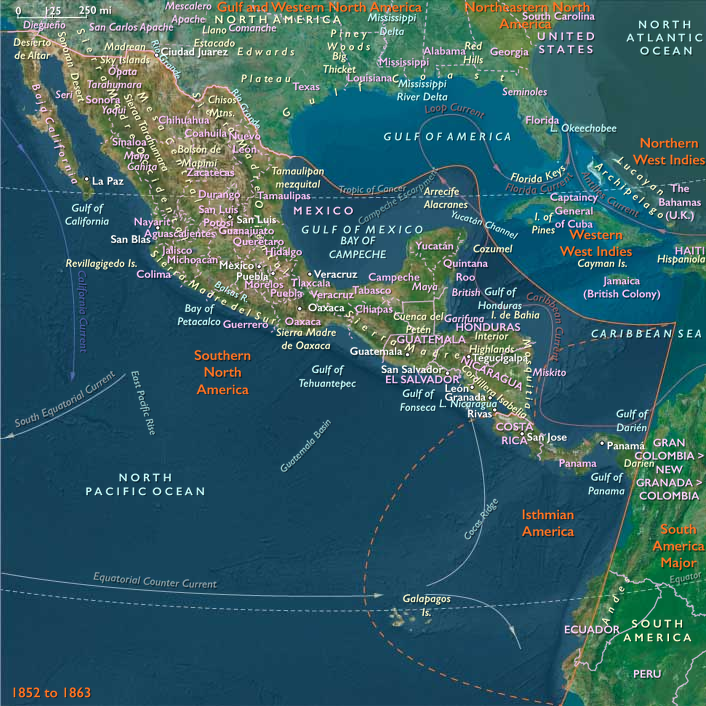
Between 1852 and 1863, Isthmian America—including Costa Rica, Panama, northwestern Colombia, western Ecuador, the Raizal Islands, and the Galápagos Islands—experiences profound economic and social changes driven primarily by the immense transit traffic associated with the California Gold Rush and the completion of the Panama Railroad in 1855. While the region prospers economically, particularly in Panama, tensions also escalate due to the influx of travelers, highlighting stark cultural conflicts and racial prejudices.
The Panama Railroad and Isthmian Prosperity
The discovery of gold in California in 1848 had already significantly increased transit across Panama. Between 1848 and 1869, approximately 375,000 people cross the isthmus from the Atlantic to the Pacific, with 225,000 making the journey in the opposite direction. Even before the completion of the railroad, Panama’s economy booms dramatically, driven by the constant flow of travelers.
On January 28, 1855, the first train traverses the newly completed Panama Railroad line, following a route that closely parallels the future Panama Canal. The railroad quickly transforms the logistics of transcontinental travel, solidifying Panama’s role as a critical global transit hub. The increased traffic creates extraordinary demand for food, lodging, and local services, resulting in inflated prices and considerable economic prosperity for merchants, hoteliers, and local entrepreneurs.
Aspinwall and Colón: Birth of a Strategic Port City
The railroad also brings urbanization and strategic development. At the railroad’s Atlantic terminus, a new port city rapidly emerges to accommodate railroad offices, docks, warehouses, workshops, and lodging for travelers and workers. American citizens name this burgeoning town Aspinwall, honoring one of the Panama Railroad Company’s founders. However, Panamanians call the town Colón, after Christopher Columbus.
The coexistence of both names initially causes considerable confusion. Local authorities, asserting their preference, refuse to deliver mail addressed to "Aspinwall," insisting no such place exists. This steadfast insistence ensures that the Panamanian-chosen name, Colón, ultimately prevails, firmly establishing the city’s lasting identity as a vital Atlantic port and urban center.
Social Tensions and the "Watermelon War" (1856)
The influx of "forty-niners" and other gold seekers dramatically alters local society. Many travelers embody the attitudes and behaviors associated with the American "Wild West," frequently becoming unruly due to boredom, alcohol consumption, and their habitual bearing of firearms. Their prejudiced attitudes—often verging on open contempt for non-Americans and indigenous cultures—lead to considerable friction with the local population.
Tensions reach a tragic climax in the infamous "Watermelon War" of 1856, triggered by an incident involving a dispute over the payment for a slice of watermelon in Panama City. The altercation rapidly escalates into violent street clashes between Panamanians and Americans. At least sixteen people are killed and many more wounded, highlighting the severe cultural and racial divisions exacerbated by rapid transit-related growth.
Regional Impact: Costa Rica, Northwestern Colombia, Ecuador, and the Islands
While Panama experiences direct and immediate benefits from the gold rush and railroad construction, other parts of Isthmian America also feel significant economic impacts. In Costa Rica, the rise in maritime traffic stimulates modest growth in trade along the Caribbean coast, prompting local commercial activity. Northwestern Colombia, particularly around the Gulf of Urabá and northern Chocó, sees increased interaction with international traders and explorers attracted by the region’s strategic and economic potential.
In western Ecuador, coastal ports such as those in Esmeraldas, Manabí, and western Guayas benefit from provisioning ships and supplying goods to the burgeoning trans-Isthmian commerce. Meanwhile, the Raizal Islands continue their strategic Caribbean role, experiencing greater international maritime engagement due to expanded regional trade networks.
Even the remote Galápagos Islands see increased visits by whalers, merchant vessels, and scientific expeditions, indirectly influenced by heightened maritime traffic throughout the eastern Pacific.
Legacy of the Era
The period 1852–1863 significantly transforms Isthmian America, consolidating Panama’s position as a vital international transit corridor and raising regional economic activity and global prominence. Yet it also exposes deep social fractures resulting from cultural tensions, prejudices, and rapid demographic shifts. These developments set the stage for ongoing economic growth, intensified geopolitical importance, and continued social complexities in subsequent decades.
Groups
Topics
Commodities
Subjects
Regions
Middle America
View →Subregions
