
The Clayton–Bulwer Treaty, signed by the United…
1849 CE
Britain has long dominated Central America, but American influence is growing, and the small countries look to the United States for protection against British imperialism.
Negotiated in by John M. Clayton and Sir Henry Lytton Bulwer, the treaty averts a clash between the two powers.
It resolves tensions over American plans to build a Nicaragua Canal that would connect the Pacific and the Atlantic.
There are three main provisions neither nation will build such a canal without the consent and cooperation of the other; neither will fortify or found new colonies in the region; when a canal is built, both powers will guarantee that it will be available on a neutral basis for all shipping.
The canal will never be built but the treaty will be in effect until 1901.
Britain has indefinite territorial claims in three regions: British Honduras (present-day Belize), the Mosquito Coast (the region along the Atlantic coast of present-day Nicaragua and Honduras) and the Bay Islands (now part of Honduras).
The United States, while not making any territorial claims, holds in reserve, ready for ratification, treaties with Nicaragua and Honduras that give the United States a certain diplomatic advantage with which to balance the de facto British dominion.
Agreement on these points being impossible and agreement on the canal question possible, the latter is put in the foreground.
By 1857, however, the British will have ended their opposition to American western expansion, while keeping a hold on their rights to a canal.
Groups
Regions
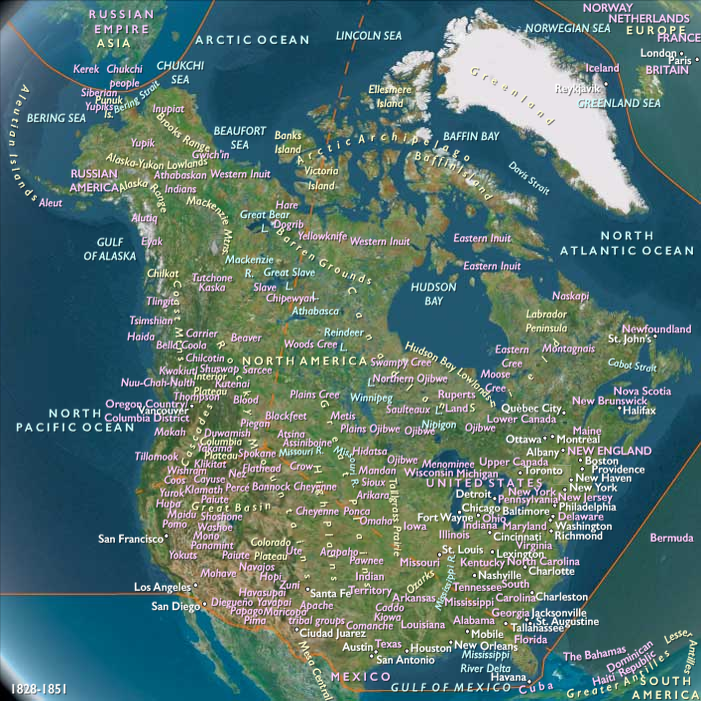
Northern North America
View →Subregions
