The Christian kingdom of Ethiopia, its political…
1540 CE to 1683 CE
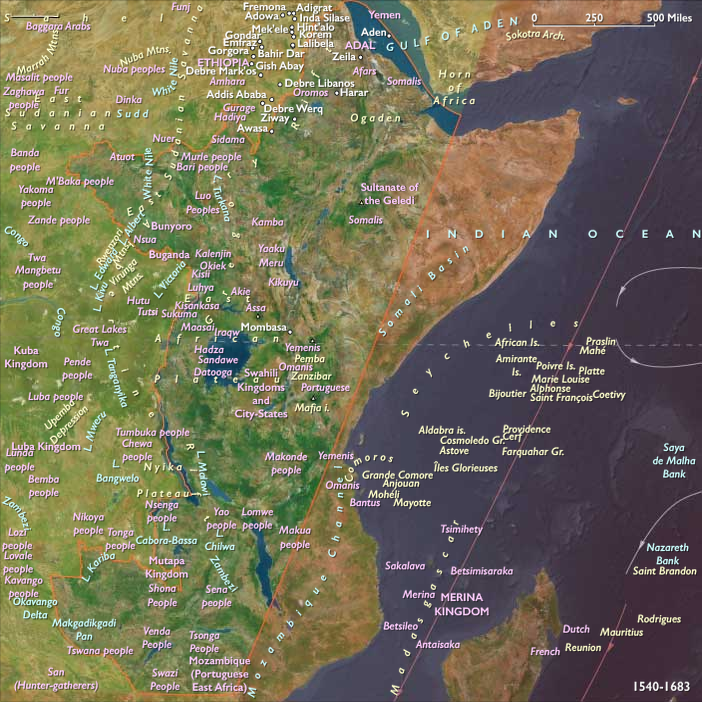
The Christian kingdom of Ethiopia, its political and military organization already weakened by the Muslim assault, begins in the mid-sixteenth century to be pressured on the south and southeast by movements of the Oromo (called Galla by the Amhara).
These migrations also affect the Sidama, Muslim pastoralists in the lowlands, and Adal.
At this time, the Oromo, settled in far southern Ethiopia, are an egalitarian pastoral people divided into a number of competing segments or groups.
They share, however, a type of age-set system of social organization called the gada system, which is ideally suited for warfare.
Their predilection toward warfare, apparently combined with an expanding population of both people and cattle, leads to a long-term predatory expansion at the expense of their neighbors after about 1550.
Unlike the highland Christians or on occasion the lowland Muslims, the Oromo are not concerned with establishing an empire or imposing a religious system.
In a series of massive but uncoordinated movements during the second half of the sixteenth century, they penetrate much of the southern and northern highlands as well as the lowlands to the east, affecting Christians and Muslims equally.
These migrations also profoundly affect the Oromo.
Disunited in the extreme, they attack and raid each other as readily as neighboring peoples in their quest for new land and pastures.
As they move farther from their homeland and encounter new physical and human environments, entire segments of the Oromo population adapt by changing their mode of economic life, their political and social organization, and their religious adherence.
Many mix with the Amhara (particularly in Shewa), become Christians, and eventually obtain a share in governing the kingdom.
In some cases, royal family members come from the union of Amhara and Oromo elements.
In other cases, Oromo, without losing their identity, become part of the nobility, but no matter how much they change, Oromo groups generally retain their language and sense of local identity.
So differentiated and dispersed will they become, however, that few foreign observers will recognize the Oromo as a distinct people until the twentieth century.
Locations
Groups
Regions
East Africa
View →Subregions