Joseph Louis Lagrange produces several papers dealing…
1768 CE to 1779 CE
Joseph Louis Lagrange produces several papers dealing with questions in algebra, including a discussion of representations of integers by quadratic forms (1769) and by more general algebraic forms (1770).
Born Giuseppe Lodovico Lagrangia, Lagrange is an Italian mathematician and astronomer serving as director of mathematics at the Prussian Academy of Sciences in Berlin.
Bachet's conjecture, now more popularly known as Lagrange's four-square theorem, states that every natural number can be represented as the sum of four integer squares.
From examples given in the Arithmetica it is clear that Diophantus was aware of the theorem.
This book had been translated in 1621 into Latin by Bachet (Claude Gaspard Bachet de Méziriac), who stated the theorem in the notes of his translation, but the theorem is not proved until 1770 by Lagrange.
Other of Lagrange's works include his tract on the Theory of Elimination, 1770; his theorem that the order of a subgroup H of a group G must divide the order of G, and his papers of 1770 and 1771 on the general process for solving an algebraic equation of any degree via the Lagrange resolvents.
This method fails to give a general formula for solutions of an equation of degree five and higher, because the auxiliary equation involved has higher degree than the original one.
The significance of this method is that it exhibits the already known formulas for solving equations of second, third, and fourth degrees as manifestations of a single principle.
The complete solution of a binomial equation of any degree is also treated in these papers.
Lagrange in 1773 considered a functional determinant of order 3, a special case of a Jacobian.
He also proved the expression for the volume of a tetrahedron with one of the vertices at the origin as the one sixth of the absolute value of the determinant formed by the coordinates of the other three vertices.
Several of Lagrange’s early papers also deal with questions of number theory.
He was, in 1769, the first to prove that Pell's equation x2 − ny2 = 1 has a nontrivial solution in the integers for any non-square natural number n. He proved the theorem, stated by Bachet without justification, that every positive integer is the sum of four squares, 1770, and proved Wilson's theorem that if n is a prime, then (n − 1)! + 1 is always a multiple of n, 1771.
His papers of 1773, 1775, and 1777 gave demonstrations of several results enunciated by Fermat, and not previously proved.
His Recherches d'Arithmétique of 1775 developed a general theory of binary quadratic forms to handle the general problem of when an integer is representable by the form ax2 + by2 + cxy.
The most important of Lagrange’s contributions to the fourth and fifth volumes, 1766–1773, of the Miscellanea Taurinensia, is the one in 1771, in which he discussed how numerous astronomical observations should be combined so as to give the most probable result.
Most of the papers sent to Paris have been on astronomical questions, notably his paper on the Jovian system in 1766, his essay on the problem of three bodies in 1772, his work on the secular equation of the Moon in 1773, and his treatise on cometary perturbations in 1778.
These have all been written on subjects proposed by the Académie française, and in each case the prize was awarded to him.
Locations
People
Groups
Regions
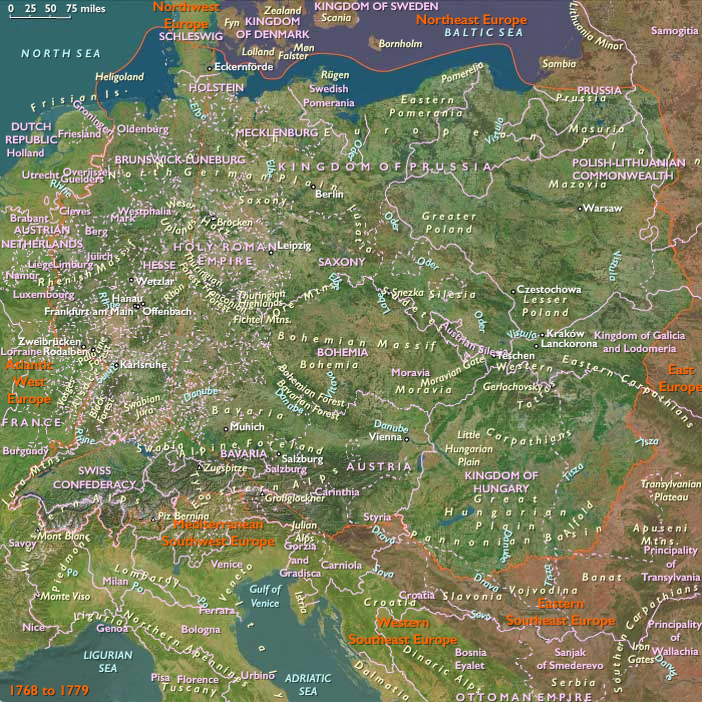
Central Europe
View →Subregions