
Italian temple construction passes through a transitional …
Years: 81BCE - 70BCE
Italian temple construction passes through a transitional phase which engenders both traditional buildings and radically new structures.
An example of the former is the Temple of Portunes (or Portunus), a god of keys, doors and livestock, who protects the warehouses where grain is stored.
Built in the Ionic order, the temple is still more familiar by its erroneous designation, the Temple of Fortuna Virilis ("manly fortune") given it by antiquaries.
Built around 75 BCE and located in the ancient Forum Boarium by the Tiber, the site overlooks the Port Tiberinus at a sharp bend in the river; from here, Portunus watches over cattle-barges as they enter the city from Ostia.
The rectangular building consists of a tetrastyle portico and cella, raised on high podium reached by a flight of steps, which it retains.
Like the Maison Carrée in Nîmes, it has a pronaos portico of four Ionic columns across and two columns deep.
The columns of the portico are free-standing, while the five columns on the long sides and the four columns at the rear are engaged along the walls of the cella.
This form is sometimes called pseudoperipteral, as distinct from a true peripteral temple like the Parthenon entirely surrounded by freestanding columns.
It is built of tuff and travertine with a stucco surface.
The temple owes its state of preservation from its being converted to use as a church in 872 and rededicated to Santa Maria Egyziaca (Saint Mary of Egypt).
Its Ionic order has been much admired, drawn and engraved and copied since the sixteenth century.
The original coating of stucco over its tufa and travertine construction has been lost.
Locations
Groups
Topics
Commodoties
Subjects
- Commerce
- Architecture
- Watercraft
- Environment
- Labor and Service
- Conflict
- Faith
- Government
- Custom and Law
- Technology
Regions
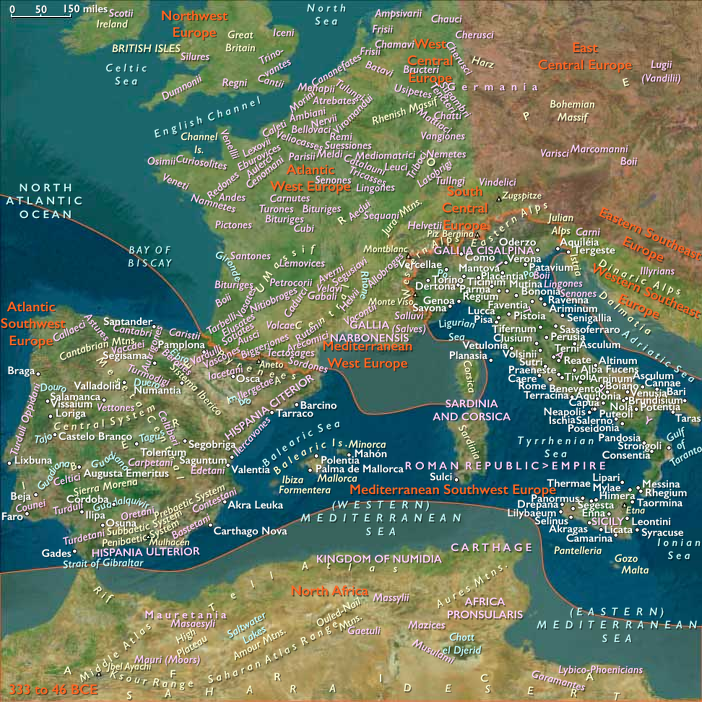
Subregions
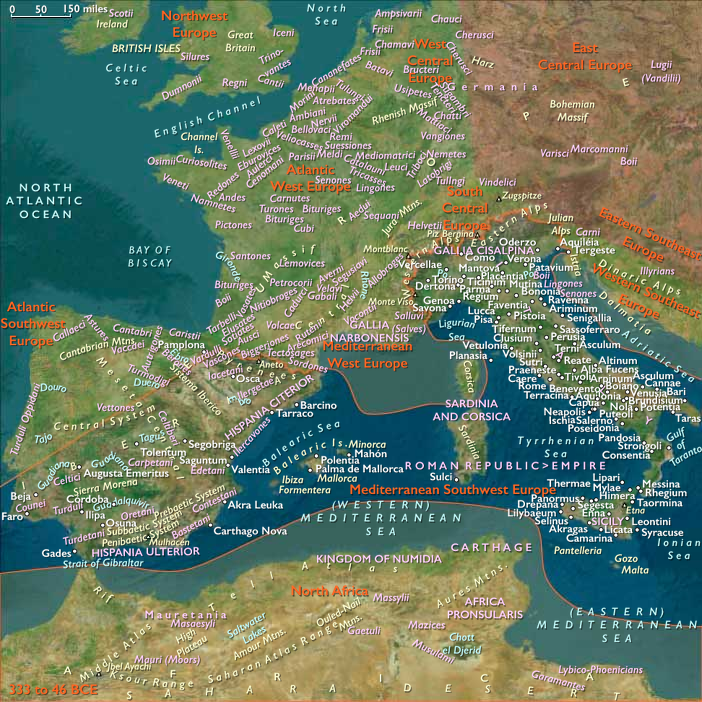
Years: 81BCE - 70BCE
Locations
Groups
Topics
Commodoties
Subjects
- Commerce
- Architecture
- Watercraft
- Environment
- Labor and Service
- Conflict
- Faith
- Government
- Custom and Law
- Technology
Regions
Subregions