Father Jacques Marquette, redeployed by his superiors…
May 1673 CE
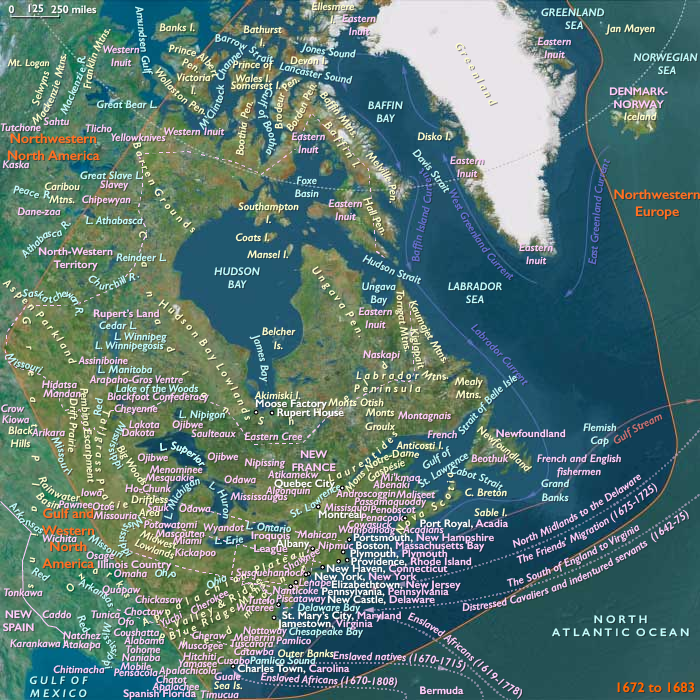
Father Jacques Marquette, redeployed by his superiors in 1668 to missions farther up the St. Lawrence River in the western Great Lakes region, had helped found a mission at Sault Ste. Marie, Michigan in present-day Michigan; and at La Pointe, on Lake Superior near the present-day city of Ashland, Wisconsin.
Here he had encountered members of the Illinois tribes, who had told him about the important route of the Mississippi River.
They had invited him to teach their people, whose settlements were mostly further south.
Because of wars between the Hurons at La Pointe and the neighboring Lakota people, Father Marquette had left the mission and gone to the Straits of Mackinac to inform his superiors about the rumored river and request permission to explore it.
Leave has been granted, and in 1673, Marquette is joined by Louis Joliet, who had previously explored the connection between Lakes Huron and Erie.
Marquette, born in Laon, France, on June 10, 1637, had joined the Society of Jesus at age seventeen.
After he worked and taught in France for several years, the Jesuits had assigned him to Quebec in 1666 as a missionary to the indigenous peoples of the Americas.
He had shown great proficiency in learning the local languages, especially Huron.
Joliet, born in 1645 in a French settlement near Quebec City, had lost his father at seven; his mother had remarried a successful merchant who owns land on the Ile d'Orleans, an island in the Saint Lawrence River in Quebec that is home to native Americans.
Joliet spent much time on Ile d'Orleans, so it was likely that he began speaking Amerind languages at a young age.
The natives are part of day-to-day life in Quebec, the center of the French fur trade, and Jollet has grown up knowing a lot about them.
A good student, Joliet had attended a Jesuit school, studying writing, mathematics, and Latin.
He is also a talented musician who plays the harpsichord, flute, and trumpet.
Departing from St. Ignace on May 17, with two canoes and five voyageurs of French-native ancestry (now recognized as the ethnic group Métis), ...
Groups
Topics
Subjects
Regions
Northern North America
View →Subregions