
A number of railroads, including the St.…
May 1879 CE
A number of railroads, including the St. Paul and Pacific Railroad (StP&P), had gone bankrupt during the Panic of 1873.
The StP&P in particular has been caught in an almost hopeless legal muddle.
For James J. Hill, it is a golden opportunity.
For three years, Hill had researched the StP&P and finally concluded that it would be possible to make a good deal of money off of the StP&P, provided that the initial capital could be found.
Hill teams up with Norman Kittson, Canadian fur trader Donald Smith, Canadian banker George Stephen, and American financier John Stewart Kennedy.
Together they not only buy the railroad, they also vastly expand it by bargaining for trackage rights with Northern Pacific Railway.
In May 1879, the St. Paul, Minneapolis, and Manitoba Railway Co. (StPM&M) forms—with James J. Hill as general manager.
His first goal is to expand and upgrade even more.
Hill was born in Eramosa Township, Wellington County, Upper Canada (now Ontario).
A childhood accident with a bow and arrow had blinded him in the right eye.
He had had nine years of formal schooling, attending the Rockwood Academy for a short while, where the head had given him free tuition, but Hill had been was forced to leave school in 1852 due to the death of his father.
By the time he had finished, he was adept at algebra, geometry, land surveying, and English.
His particular talents for English and mathematics will be critical later in his life.
After working as a clerk in Kentucky (during which time he had learned bookkeeping), Hill decided to permanently move to the United States and had settled in St. Paul, Minnesota, at the age of 18.
His first job in St. Paul was with a steamboat company, where he worked as a bookkeeper.
By 1860, he was working for wholesale grocers, for whom he handled freight transfers, especially dealing with railroads and steamboats.
Through this work, he learned all aspects of the freight and transportation business.
During this period, Hill began to work for himself for the first time.
During the winter months when the Mississippi River was frozen and steamboats could not run, Hill started bidding on other contracts and won quite a few.
Because of his previous experiences in shipping and fuel supply, Hill had been able to enter both the coal and steamboat businesses.
In 1873, he had entered the steamboat business and by 1879 he had a local monopoly by merging (with fur-trader and financier Norman Kittson).
In 1867, Hill had entered the coal business, and by 1879 it has expanded five times over, giving Hill a local monopoly in the anthracite coal business.
During this same period, Hill had also entered into banking and has quickly managed to become a member of several major banks' boards of directors.
He has also bought out bankrupt businesses, built them up again, and then resold them—often gaining a substantial profit.
Hill has undertaken to establish a monopoly of the steamboat business; he is monopolizing coal, socializing with bankers, and buying other businesses at the same time.
Hill notes that the secret to success is, "Work, hard work, intelligent work, and then more work." (Hill, James J. (2001). Highways of Progress. Minerva Group)
People
Groups
Regions
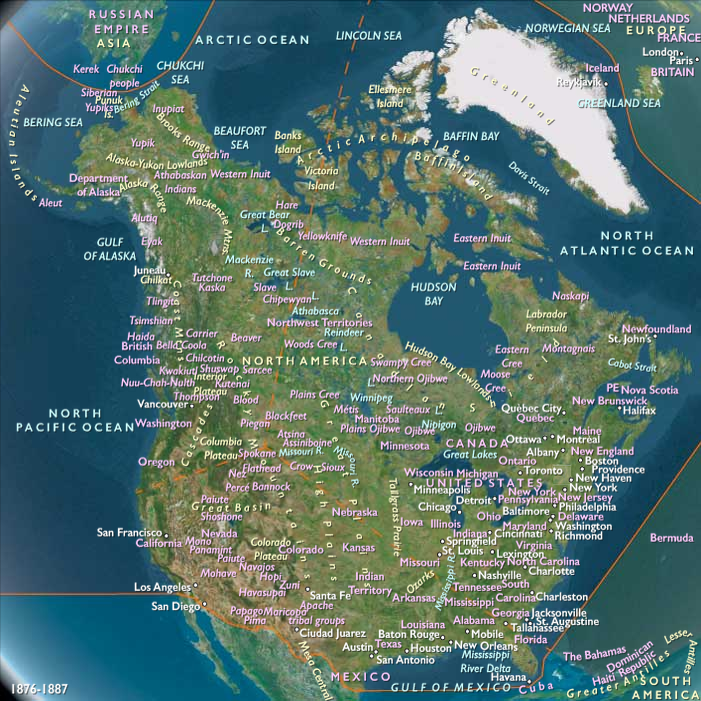
Northern North America
View →Subregions
