Jean Froissart and the Completion of Chronicles…
1405 CE
Jean Froissart and the Completion of Chronicles (c. 1405)
Jean Froissart (c. 1337–1405) was one of the most influential chroniclers of medieval France, producing a detailed, lively, and often biased account of European affairs from 1325 to 1400. His Chronicles, completed shortly before his death around 1405, remain a defining literary and historical record of 14th-century chivalric culture and the first half of the Hundred Years' War (1337–1453).
I. The Chronicles: A Masterpiece of Medieval Historiography
- The Chronicles cover the lead-up to and first half of the Hundred Years’ War, as well as political and military events across Europe.
- Divided into four books, Froissart’s work records:
- The origins of the Hundred Years' War.
- The major battles of Crécy (1346) and Poitiers (1356).
- The political intrigues of the French and English courts.
- The Flemish revolts and conflicts in the Low Countries.
- The civil wars within France, including the Orléans-Burgundy conflict.
II. A Chivalric Perspective: The Romance of War
- Froissart’s Chronicles reflect his fascination with the ideals of chivalry, portraying knights and noble warfare in romanticized terms.
- He emphasizes the valor, honor, and gallantry of noble warriors, sometimes glossing over the brutal realities of medieval conflict.
- While entertaining and rich in detail, the Chronicles are often biased in favor of the aristocracy, particularly toward England and the Burgundian factions.
III. Legacy and Historical Significance
- For centuries, Froissart’s Chronicles have been recognized as the chief expression of the chivalric revival of 14th-century France and England.
- Despite its biases and occasional inaccuracies, the Chronicles remain one of the most valuable primary sources for the Hundred Years’ War.
- The work influenced later medieval and Renaissance historians, preserving a detailed, if idealized, record of medieval knighthood and warfare.
IV. Froissart’s Death and the End of His Era
- Jean Froissart died around 1405 at the age of approximately sixty-eight.
- His death marked the end of one of the most significant chronicling careers in medieval Europe, as his work bridged literature, history, and the cultural ideals of the time.
Froissart’s Chronicles stand as one of the most enduring literary achievements of the late Middle Ages, shaping our understanding of medieval warfare, courtly life, and the evolving political landscape of 14th-century Europe.
Locations
People
Groups
Topics
Regions
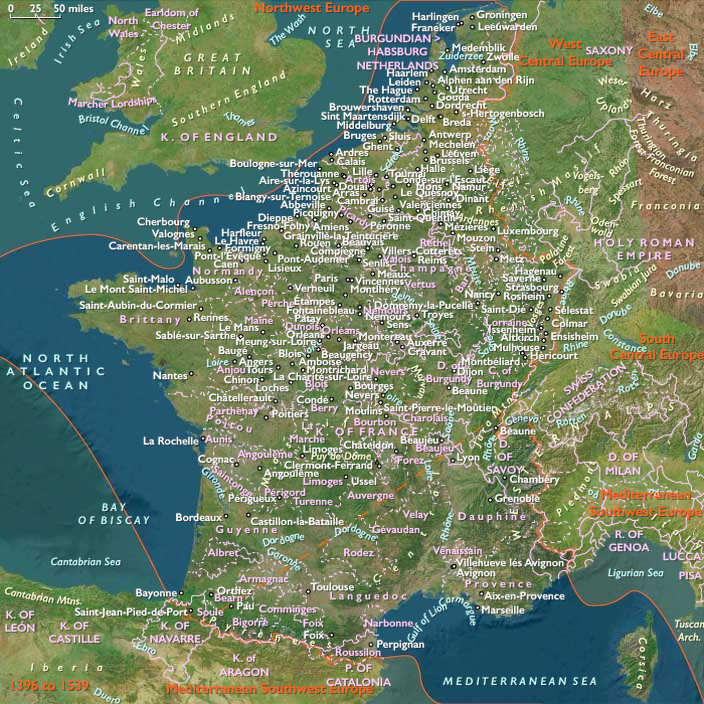
West Europe
View →Subregions