
Jewish riots and insurrections against the Herodians …
Years: 6 - 6
Jewish riots and insurrections against the Herodians and their Roman masters have characterized the dozen years since the death of Herod the Great.
Judea, nominally independent, is actually in bondage to Rome; Augustus has permitted Herod's sons less authority than he had given their father.
Glaphyra, princess of Cappadocia, had during her second marriage—to Juba II, Roman client-king of Mauretania; the first had been to Alexander of Judea, son of Herod, executed in about 7 BCE by his father—become reacquainted with Herod Archelaus (half-brother of her first husband), and now the Roman Ethnarch of Samaria, Judea, and Idumea.
Apparently, the two fell in love with each other and determined to marry.
Archelaus’s first wife is given by Josephus simply as Mariamne, perhaps his cousin Mariamne III (Mariamne bint Aristobulus), whom he has divorced to marry Glaphyra, who likewise has evidently divorced her second husband, Juba II of Mauretania.
Archelaus is half Idumaean and half Samaritan and, like his father Herod the Great, is considered an alien oppressor by his Jewish subjects.
Moreover, the marriage of a widow to her former brother-in-law violates Jewish laws of Levirate marriage.
It is considered immoral by the Jews and causes a major religious scandal in Judaea.
This violation of the Mosaic law, together with Archelaus' continued cruelty, has roused the ire of the Jews, who complain to Augustus.
Glaphyra shortly after the wedding allegedly dreamed that her first husband stood at her side and reproached her for not being faithful to him.She had not only made a second marriage but had even come back and married her brother-in-law.
Alexander in the dream said to Glaphyra he would now reclaim her as his own.
She told her friends of the dream and died two days later.
About the time of Glaphyra’s death, Augustus accedes to the delegation from Judea; he deprives Archelaus of his throne and banishes him to Vienne in Gaul.
It is uncertain if Glaphyra died before or during his exile.
Her death reputedly gratified the women of the Judaean court.
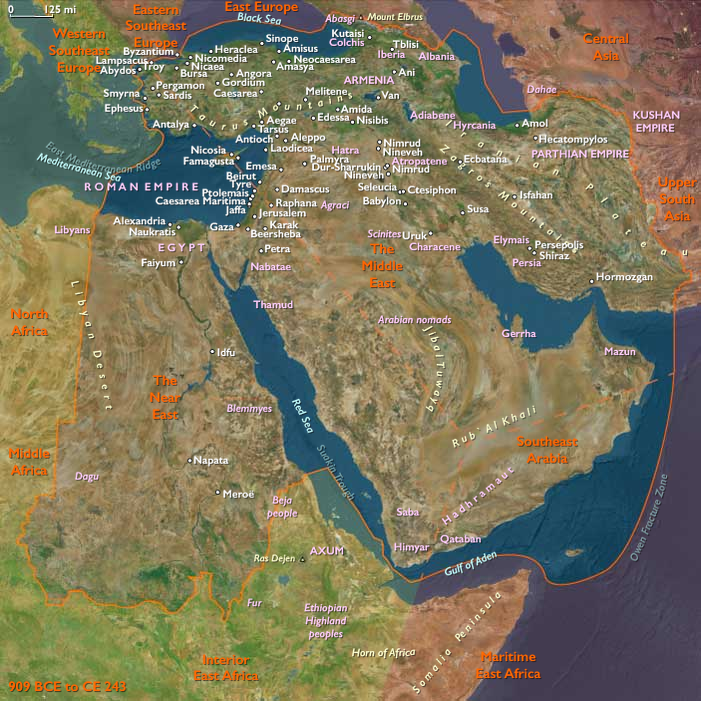
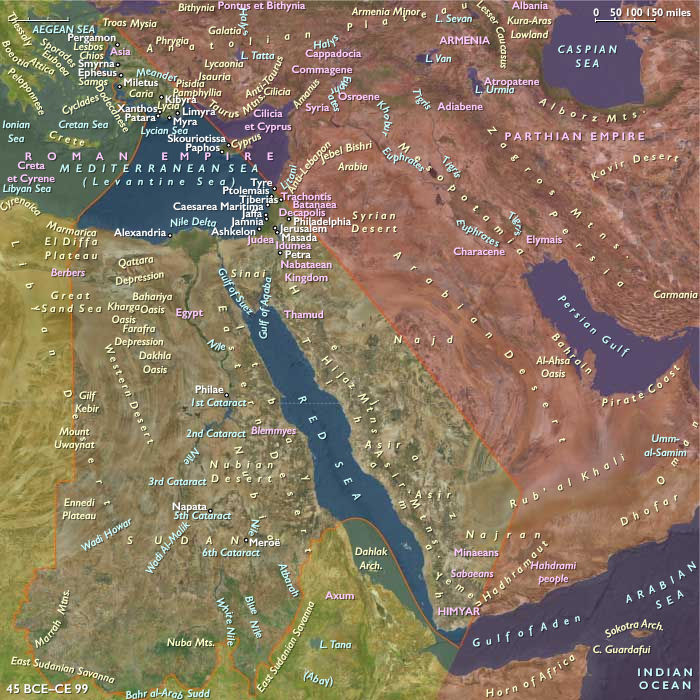
Augustus now transforms Judaea, Idumaea and Samaria from a client kingdom into the imperial province of Syria Palestina.
Accordingly, he sends a prefect to govern this province, with his seat at Caesarea Maritima.
A small Roman army of approximately three thousand men supports this minor Roman aristocrat, later called a procurator.
The soldiers, however, come not from Italy but from nearby Gentile cities, especially Caesarea and Sebaste; the officers are (presumably) from Italy.
Rome does, however, grant the Jews religious autonomy and some judicial and legislative rights through the Sanhedrin, headed by a Roman-appointed high priest.
Locations
People
Groups
- Samaritans
- Jews
- Mauretania, Kingdom of
- Roman Principate (Rome)
- Tetrarchy (Judea)
- Judea (Roman province)
Topics
Commodoties
Subjects
Regions
Subregions
Years: 6 - 6
Locations
People
Groups
- Samaritans
- Jews
- Mauretania, Kingdom of
- Roman Principate (Rome)
- Tetrarchy (Judea)
- Judea (Roman province)
Topics
Commodoties
Subjects
Regions
Subregions