
Longitude fixes the location of a place…
1720 CE to 1731 CE
It is given as an angular measurement that ranges from 0° at the prime meridian to +180° eastward and −180° westward.
A ship's east-west position is essential when approaching land.
After a long voyage, cumulative errors in dead reckoning frequently lead to shipwrecks and a great loss of life.
Avoiding such disasters has become vital in Harrison's lifetime, in an era when trade and navigation are increasing dramatically around the world.
Many ideas have been proposed for how to determine longitude during a sea voyage.
Earlier methods had attempted to compare local time with the known time at a reference place, such as Greenwich or Paris, based on a simple theory that had been first proposed by Gemma Frisius.
The methods relied on astronomical observations that were themselves reliant on the predictable nature of the motions of different heavenly bodies.
Such methods were problematic because of the difficulty in accurately estimating the time at the reference place.
Harrison sets out to solve the problem directly, by producing a reliable clock that can keep the time of the reference place.
His difficulty is in producing a clock that is not affected by variations in temperature, pressure or humidity, remains accurate over long time intervals, resists corrosion in salt air, and is able to function on board a constantly-moving ship.
Many scientists, including Isaac Newton and Christiaan Huygens, doubted that such a clock could ever be built and favored other methods for reckoning longitude, such as the method of lunar distances.
Huygens had run trials using both a pendulum and a spiral balance spring clock as methods of determining longitude, with both types producing inconsistent results.
Newton observed that "a good watch may serve to keep a reckoning at sea for some days and to know the time of a celestial observation; and for this end a good Jewel may suffice till a better sort of watch can be found out. But when longitude at sea is lost, it cannot be found again by any watch".
In the 1720s, the English clockmaker Henry Sully invents a marine clock that is designed to determine longitude: this is in the form of a clock with a large balance wheel that is vertically mounted on friction rollers and impulsed by a frictional rest Debaufre type escapement. ]
Very unconventionally, the balance oscillations are controlled by a weight at the end of a pivoted horizontal lever attached to the balance by a cord.
This solution avoids temperature error due to thermal expansion, a problem that affects steel balance springs.
Sully's clock only keeps accurate time in calm weather, because the balance oscillations are affected by the pitching and rolling of the ship.
However his clocks are among the first serious attempts to find longitude in this way.
Harrison's machines, though much larger, are of similar layout: H3 has a vertically mounted balance wheel and is linked to another wheel of the same size, an arrangement that eliminates problems arising from the ship's motion.
In 1716, Sully had presented his first Montre de la Mer to the French Académie des Sciences and in 1726 he published Une Horloge inventée et executée par M. Sulli.
Locations
Subjects
Regions
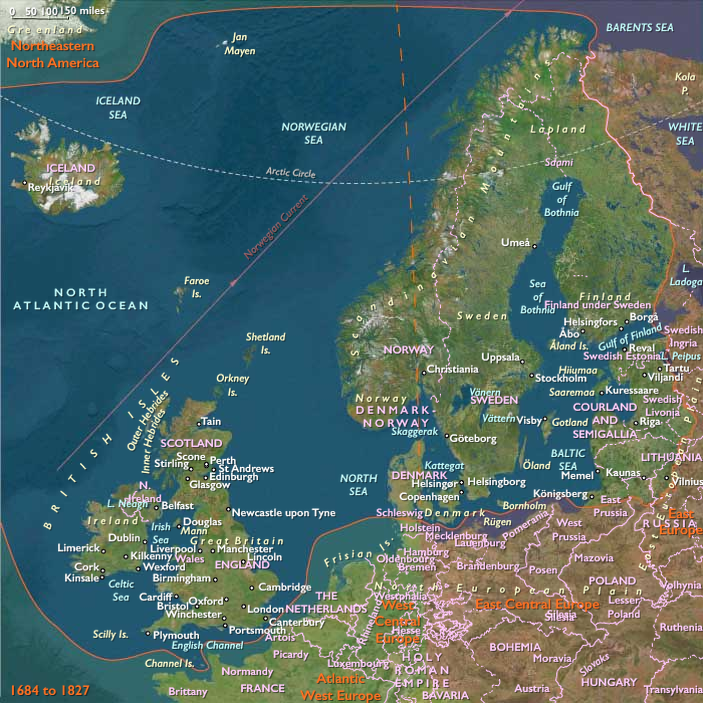
North Europe
View →Subregions
