
John has spent most of his reign …
Years: 1130 - 1130
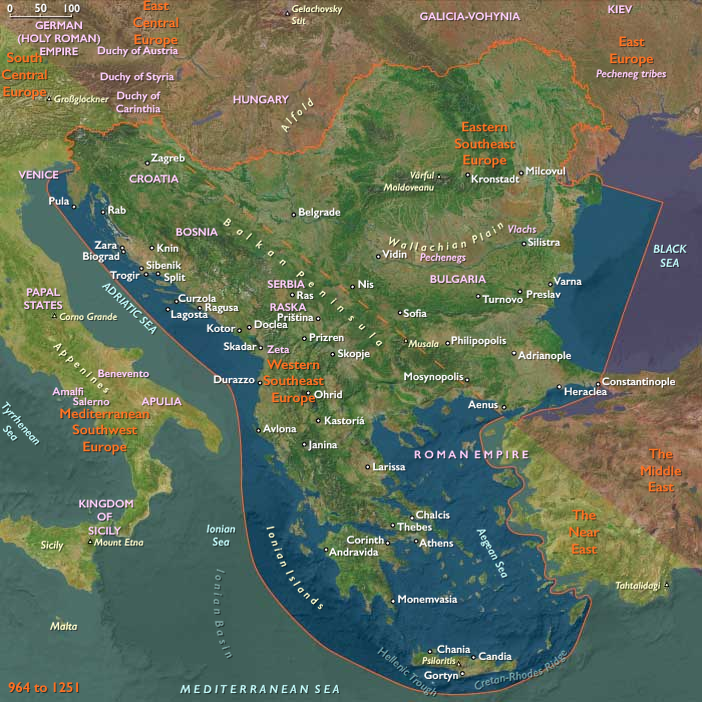
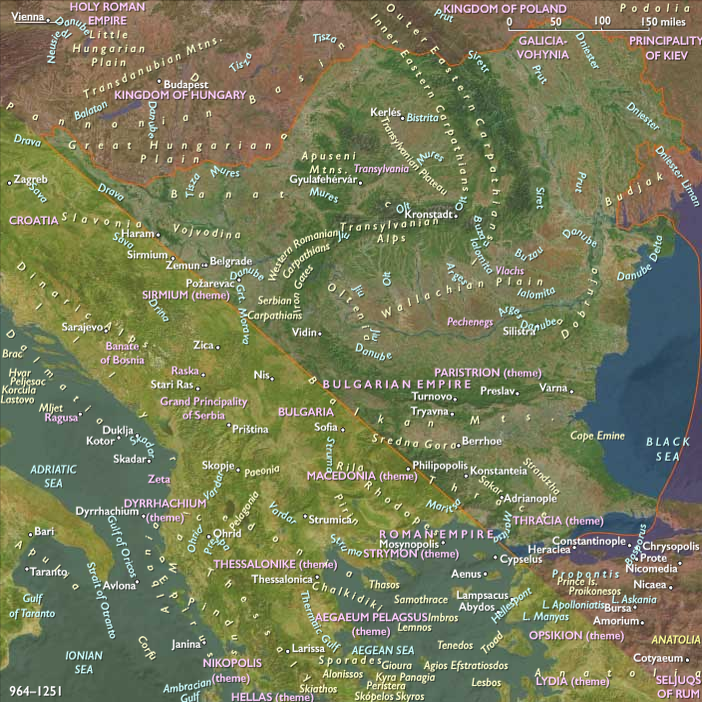
John has spent most of his reign with his troops, thwarting threats from the Pechenegs, Hungarians, and Serbs.
In 1130, he allies Constantinople with the German emperor Lothair II (III) against Roger II of Sicily.
Locations
People
Groups
- Germans
- Hungarian people
- Greeks, Medieval (Byzantines)
- Pechenegs, or Patzinaks
- Serbs (South Slavs)
- German, or Ottonian (Roman) Empire
- Roman Empire, Eastern: Komnenos dynasty, restored
- Italo-Normans
- Sicily, Hohenstaufen Kingdom of
Topics
Commodoties
Subjects
Regions
Subregions
Related Events
Filter results
Showing 10 events out of 49215 total
Li Tang has worked for most of his life as a painter at the court of Song Emperor Huizong in Kaifeng.
The highly influential Li, a pivotal figure in the transition from the monumentally scaled landscape tradition of the Northern Song period to the more intimate mode of the succeeding Southern Song period, is renowned for his so-called ax-cut brushstroke, which he employs to finely depict sharply faceted rock surfaces, as in his celebrated scroll painting “Whispering Pines in the Mountains”, executed in 1124.
After the Jurchen invasion in 1126, he had fed with the court to Hangzhou, becoming director of the imperial painting academy there until his death in 1130, at about eighty.
King Stephen, having been informed in 1129 after the death of Duke Álmos that his blind cousin was still living in Hungary, had invited Béla to his court.
Upon the king's request, Béla had married Jelena, a daughter of Serbian Duke Uroš I of Raska, and the king had granted the couple estates near Tolna.
Conferences for peace had ensued after the Cholan defeat of the Eastern Chalukyas in an important battle in 1122, followed by plans for intermarriage between the contending dynasties, and ending in 1130 with the Eastern Chalukya dynasty’s absorption into the Chola.
The Kakatiya family becomes a Cholan feudatory.
An Augustinian convent, situated in central Switzerland between Lakes Brienz and Thun in the Bernese Alps (and the nucleus of the future town of Interlaken) is founded in 1130.
Cardinal Pietro Pierleoni was born to the powerful Roman family of the Pierleoni, the son of the Consul Pier Leoni.
As a second son with ambitions, Pietro was destined for an ecclesiastical career.
He studied in Paris and entered the Benedictine Abbey of Cluny.
Later he went to Rome and occupied several important positions.
In 1130, Pope Honorius II lies dying and the cardinals decide that they willentrust the election to a commission of eight men, led by papal chancellor Haimeric, who has his candidate Cardinal Gregory Papareschi hastily elected as Pope Innocent II.
He is consecrated on February 14, the day after Honorius' death.
On the same day, the other cardinals announce that Innocent has not been canonically elected and choose, as Pope Anacletus II, Pierleoni, a Roman whose family members are the enemy of Haimeric's supporters, the Frangipani.
Anacletus' supporters are a mixture of anyone opposed to Haimeric, making him powerful enough to take control of Rome while Innocent is forced to flee North.
However, north of the Alps, Innocent gains the crucial support of St. Bernard of Clairvaux, Peter the Venerable, and other prominent reformers who personally help him to gain recognition from European rulers such as Emperor Lothar III, leaving Anacletus with few patrons.
Anacletus had been a relatively acceptable candidate for the Papacy, being well-respected, so rumors centering on his descent from a Jewish convert were spread to blacken his reputation.
Among Anacletus' supporters are duke William X of Aquitaine, who decides for Anacletus against the will of his own bishops, and the powerful Roger II of Sicily, whose title of "King of Sicily" Anacletus approves shortly after his accession.
The Introduction of Rib Vaulting in Caen: La Trinité and Saint-Étienne (c. 1130 CE)
Around 1130 CE, the original wooden roofs of the great Norman Romanesque churches of La Trinité (Abbaye aux Dames) and Saint-Étienne (Abbaye aux Hommes) in Caen were replaced with rib vaults, marking a significant architectural evolution.
This shift from timber roofs to stone vaulting reflected the growing sophistication of Norman construction techniques, particularly in vaulting systems, which would later influence the development of Gothic architecture.
Why the Transition to Rib Vaults?
- The original wooden roofs, though practical, were highly susceptible to fire and structural failure over time.
- The introduction of rib vaulting allowed for:
- Stronger, more durable ceilings capable of spanning large spaces.
- Better weight distribution, reducing the need for massive walls.
- Greater height and lightness, prefiguring the vertical emphasis of Gothic architecture.
The Architectural Significance of Rib Vaulting in Norman Churches
- Saint-Étienne, the Abbey of William the Conqueror, had originally featured barrel vaulting, but by 1130, the church’s nave was fitted with rib vaults, which enhanced its stability and grandeur.
- La Trinité, founded by Matilda of Flanders, followed a similar transition, reinforcing its role as a major religious institution.
- The use of rib vaulting in Caen would later influence the early Gothic experiments in Île-de-France, as seen in the reconstruction of Saint-Denis under Abbot Suger.
Impact on Later Architecture
- The replacement of wooden roofs with rib vaults at Caen’s great abbeys demonstrated the growing engineering capabilities of the Normans, setting a precedent for later medieval architecture.
- These innovations prefigured the structural breakthroughs that would lead to the widespread adoption of rib vaulting in Gothic cathedrals across France and England.
- The refinement of Norman vaulting techniques at La Trinité and Saint-Étienne would influence monumental church architecture throughout Europe, particularly in the great cathedrals of the 12th and 13th centuries.
The replacement of timber roofs with rib vaults in Caen around 1130 marked a defining moment in the evolution of medieval architecture, bridging the transition from Romanesque solidity to Gothic height and elegance.
Cluny III: The Apex of Romanesque Architecture (Consecrated 1130 CE)
The third and final church of the Abbey of Cluny, known as Cluny III, represented the culmination of Romanesque architectural ambition, setting new standards for scale, engineering, and design. Consecrated in 1130 CE, Cluny III remained the largest building in Europe until the Italian Renaissance, reflecting the power and influence of the Cluniac Order.
Innovations in Scale and Structure
- Unprecedented Nave Design – Unlike traditional churches with three aisles, Cluny III’s nave featured five aisles, creating an expansive and monumental interior.
- Soaring Vaults – The central barrel-vaulted aisle reached a staggering height of 96 feet (29.29 meters), making it the tallest Romanesque church ever built.
- Dual Transepts and Towered Crossings – The two lofty transepts, each crowned with towers at their crossings, emphasized the monumentality and complexity of the layout.
Architectural Innovations and Structural Challenges
- Pointed Arches – The builders employed pointed arches throughout the ground-story arcade and the side aisles, foreshadowing Gothic structural techniques that would later redefine European church architecture.
- Revolutionary Clerestory Windows – Instead of the solid masonry upper walls traditionally used to buttress barrel vaults, Cluny III incorporated three round-headed windows in each bay of the clerestory, allowing unprecedented natural light to penetrate the nave.
- This innovation, however, compromised structural stability, and some vaults collapsed in 1120, requiring urgent repairs before the church’s general consecration in 1130.
The Legacy of Cluny III
- Cluny III represented the zenith of Romanesque architecture, combining monumentality with innovative engineering.
- The church’s pointed arches and clerestory windows would directly influence the emerging Gothic style, particularly in Île-de-France.
- Though largely dismantled during the French Revolution, Cluny III’s architectural innovations paved the way for later medieval cathedrals, making it a landmark in European architectural history.
For nearly four centuries, Cluny III stood as a symbol of monastic grandeur, reflecting the Cluniac Order’s unparalleled influence in the medieval world.
Bohemond, his dispute with Edessa settled, has turned to the north to recover Anazarbus ((a former Antiochene town which had fallen into the possession of Thoros I)) and other territories lost to the Armenian Kingdom of Cilicia.
He marches with a small force up the river Jihan towards his objective.
Leo I, Prince of Armenia, is alarmed and appeals for help to the Danishmend emir, Ghazi Gümüshtigin.
As Bohemond II progresses carelessly up the river, meeting only light resistance from the Armenians, the Danishmend Turks fall on him and massacre the whole of his army in February 1130 near Mamistra.
Bohemond dies in the struggle, and his blond head is embalmed, placed in a silver box, and sent as a gift to the caliph.
However, it is due to Constantinople’s intervention that the Turks do not follow up their victory; and Anazarbus remains in Armenian hands—Michael the Syrian says that John II Komnenos at once started an offensive against the Turks.
The Turks had been pressing forward against the imperial frontier in western Asia Minor early in the reign of John Komnenos, and he is determined to drive them back.
In 1119, the Seljuqs had cut the land route to the city of Antalya on the southern coast of Anatolia.
John II, and Axouch the Grand Domestic, had recaptured Laodicea and Sozopolis, thus reopening land communication with Antalya.
This route is especially important as it also led to Cilicia and the Crusader states of Syria.
Following the end of hostilities with Hungary, John is able to concentrate on Asia Minor, which is to become the focus of his attention for most of his remaining years.
Beginning in 1130, he undertakes a campaign against the Danishmendid emirate in Malatya on the upper Euphrates.
Roger II of Sicily, having succeeded his brother Simon as Count of Sicily, is ultimately able to raise the status of the island to a kingdom in 1130, along with his other holdings, which include the Duchy of Apulia and Calabria and the Maltese Islands.
During this period, the Kingdom of Sicily is prosperous and politically powerful, having becoming one of the wealthiest states in all of Europe; even wealthier than the Kingdom of England.
Immigrants from Northern Italy and Campania have arrived in significant numbers during this era.
The island’s tongue has became Latinized and its churches Roman Catholic, in contrast to the Orthodox practices when controlled by Constantinople.
The Antipope Anacletus II, whom Roger has supported, enthrones him King of Sicily on Christmas Day 1130.
Roger's elaborate royal mantle bears the date 528 of the Islamic calendar (1133-34 CE), and therefore could not be used for his coronation.
(It will later be used as coronation cloak by the Holy Roman Emperors and is now in the Imperial Treasury (Schatzkammer) in Vienna.)
Years: 1130 - 1130
Locations
People
Groups
- Germans
- Hungarian people
- Greeks, Medieval (Byzantines)
- Pechenegs, or Patzinaks
- Serbs (South Slavs)
- German, or Ottonian (Roman) Empire
- Roman Empire, Eastern: Komnenos dynasty, restored
- Italo-Normans
- Sicily, Hohenstaufen Kingdom of
