
Filters:
John’s Failed Invasion of France and the …
Years: 1214 - 1214
February
John’s Failed Invasion of France and the Lack of Coordination with Otto IV (1214 CE)
In 1214, John of England launched his long-planned offensive to reclaim his lost Angevin territories in France. His strategy relied on a two-front assault, with:
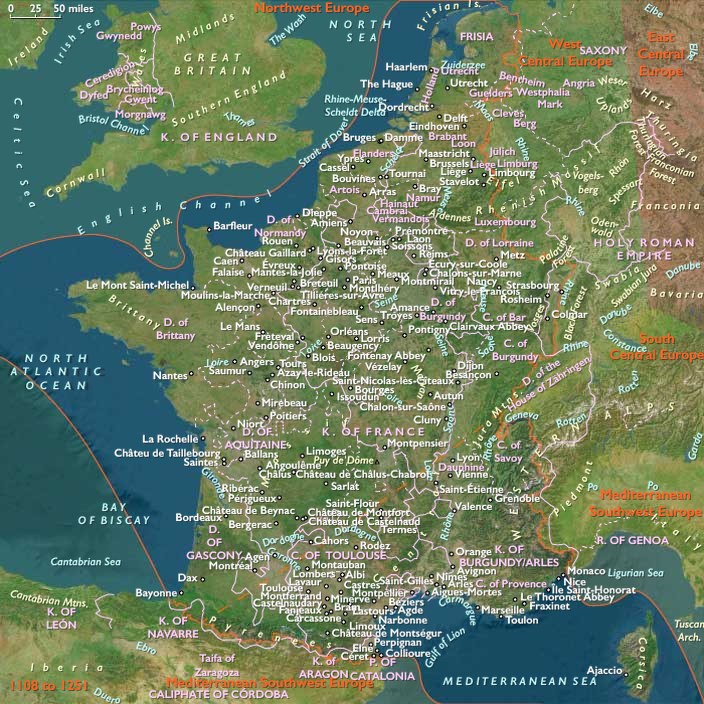
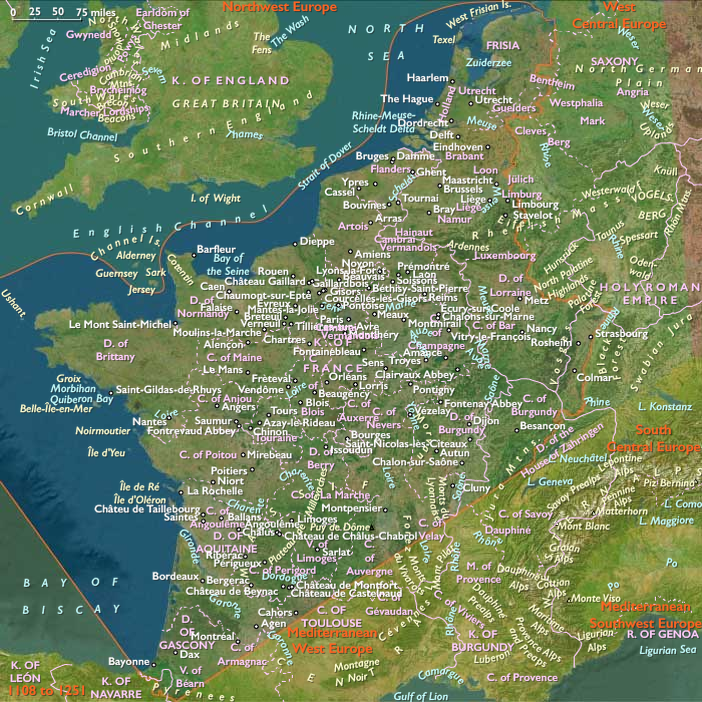
- John advancing from the Loire, having landed at La Rochelle in February 1214.
- Otto IV of Germany attacking from Flanders, supported by Count Ferdinand of Flanders and Renaud of Boulogne.
However, the campaign was plagued by poor coordination, leading to Philip II’s decisive victory at Bouvines later that year.
John’s Delayed Landing at La Rochelle (February 1214)
- John’s delayed arrival in France meant that Philip II had time to prepare defenses.
- He sought to march north from the Loire Valley, drawing Philip’s forces away from the Flemish-German offensive in the north.
Failure to Coordinate the Two-Pronged Attack
-
John’s Offensive from the Loire
- John launched successful attacks in Poitou and Anjou, defeating Prince Louis (future Louis VIII) at La Roche-aux-Moines in June 1214.
- However, his Poitevin barons refused to continue the campaign, forcing John to retreat without striking at Philip’s main army.
-
Otto IV and the Flanders Offensive
- Otto IV, Count Ferdinand of Flanders, and Renaud of Boulogne assembled their forces in northern France, planning to engage Philip’s main army.
- However, with John’s southern offensive collapsing, Philip was able to concentrate his forces in the north, leading to the decisive Battle of Bouvines on July 27, 1214.
Consequences of the Failed Coordination
- Philip II decisively defeated Otto IV and the Anglo-Flemish coalition at Bouvines, securing French dominance over northern France.
- John’s failure in the Loire meant that the campaign collapsed, forcing him to abandon hopes of regaining Normandy, Anjou, or Poitou.
- This military disaster fueled baronial discontent in England, leading to the First Barons’ War (1215–1217) and the signing of Magna Carta.
The 1214 campaign demonstrated Philip II’s superior strategic positioning, as John’s inability to coordinate with his northern allies allowed the French to achieve their greatest military triumph at Bouvines.
Locations
People
- Frederick II
- Infante Ferdinand of Portugal
- John of England
- Louis VIII of France
- Otto IV of Brunswick
- Pandulf Verraccio
- Philip II of France
- Pope Innocent III
Groups
- Papal States (Republic of St. Peter)
- Flanders, County of
- Holy Roman Empire
- France, (Capetian) Kingdom of
- Christians, Roman Catholic
- Portugal, Burgundian (Alfonsine) Kingdom of
- England, (Plantagenet, Angevin) Kingdom of
Topics
Commodoties
Subjects
Regions
Subregions
Years: 1214 - 1214
February
Locations
People
- Frederick II
- Infante Ferdinand of Portugal
- John of England
- Louis VIII of France
- Otto IV of Brunswick
- Pandulf Verraccio
- Philip II of France
- Pope Innocent III
Groups
- Papal States (Republic of St. Peter)
- Flanders, County of
- Holy Roman Empire
- France, (Capetian) Kingdom of
- Christians, Roman Catholic
- Portugal, Burgundian (Alfonsine) Kingdom of
- England, (Plantagenet, Angevin) Kingdom of
Topics
Commodoties
Subjects
Regions
Subregions