Samuel Crompton of Lancashire invents the spinning…
June 1779 CE
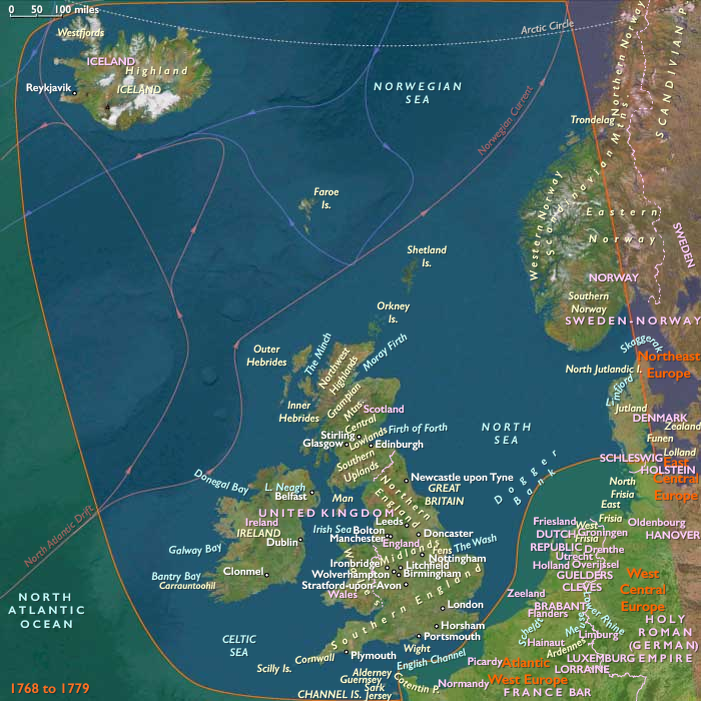
Born in 10 Firwood Fold, Bolton, Lancashire. to George and Betty Crompton (née Elizabeth Holt of Turton), his father was a caretaker at nearby Hall i' th' Wood.
Samuel has two younger sisters.
While he was a boy he lost his father and had to contribute to the family resources by spinning yarn, learning to spin on James Hargreaves's spinning jenny.
The deficiencies of the jenny had imbued him with the idea of devising something better, which he has worked on in secret for five or six years.
The result is a machine that spins yarn suitable for use in the manufacture of muslin.
The spinning mule has a fixed frame with a creel of cylindrical bobbins to hold the roving, connected through the headstock to a parallel carriage with the spindles.
On the outward motion, the rovings are paid out through attenuating rollers and twisted.
On the return, the roving is clamped and the spindles reversed to take up the newly spun thread.
Crompton has built his mule from wood.
Although he used Hargreaves' ideas of spinning multiple threads and of attenuating the roving with rollers, it is he who puts the spindles on the carriage and fixes a creel of roving bobbins on the frame.
Both the rollers and the outward motion of the carriage remove irregularities from the rove before it is wound on the spindle.
When Arkwright's patents expires, the mule will be developed by several manufacturers.
Crompton's first mule has forty-eight spindles and can produce one pound of 60s thread a day.
This demands a spindle speed of 1,700 rpm, and a power input of 1/16 hp.
The mule produces strong, thin yarn, suitable for any kind of textile, warp or weft.
It was initially used to spin cotton; other fiber will follow.
Samuel Crompton cannot afford to patent his invention.
He sells the rights to David Dale and returned to weaving.
Dale patents the mule and will profit from it.
Images

Mule Jenny: Capture from Baines 1835, Illustrations from the History of the Cotton Manufacture in Great Britain. H. Fisher, R. Fisher, and P. Jackson. Source www.handweaving.net
Locations
Commodities
Subjects
Regions
North Europe
View →Subregions