Justinian attempts to maintain peace by paying …
Years: 546 - 546
December
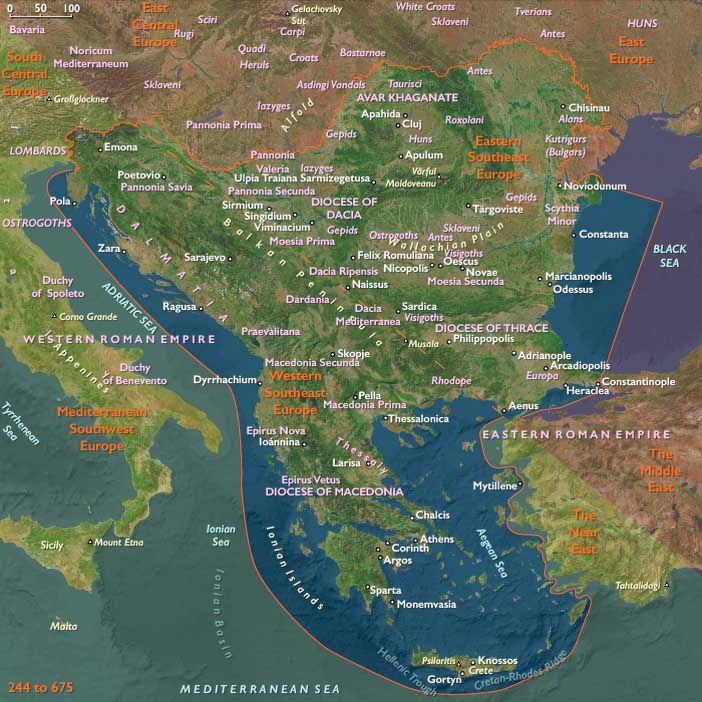
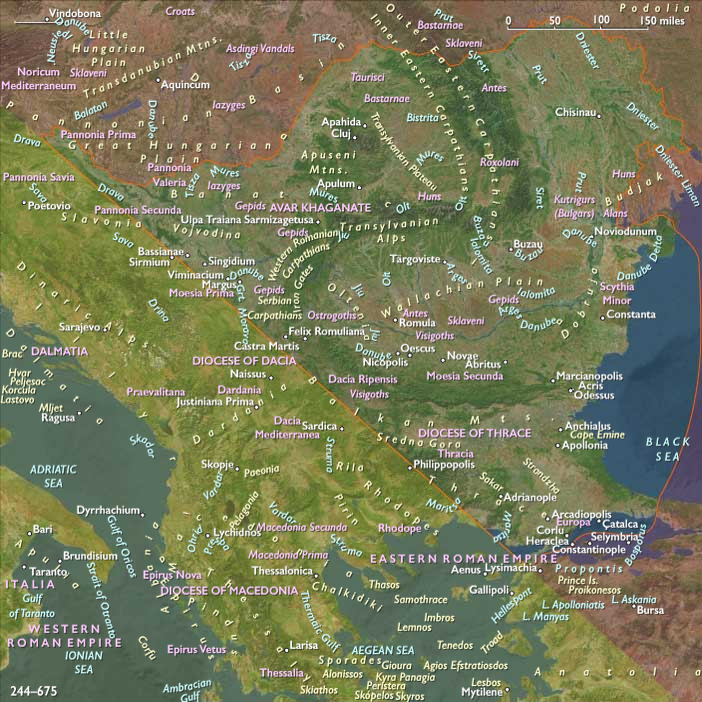
Justinian attempts to maintain peace by paying the Persians a large annual subsidy following the armistice with Persia in 545.
Pope Vigilius arrives in Constantinople to meet with emperor Justinian I.
The future pope Pelagius is sent by Totila to negotiate with Justinian.
Locations
People
Groups
- Persian people
- Goths (East Germanic tribe)
- Persian Empire, Sassanid, or Sasanid
- Christianity, Chalcedonian
- Ostrogoths, Italian Kingdom of the
- Roman Empire, Eastern: Justinian dynasty
Topics
Commodoties
Subjects
Regions
Subregions
Related Events
Filter results
Showing 10 events out of 21 total
Franz von Sickingen: Warrior, Nobleman, and Regional Powerbroker (1508–1518)
Born at Ebernburg (today Bad Münster am Stein-Ebernburg, near Bad Kreuznach), Franz von Sickingen emerged in the early sixteenth century as a prominent figure in the complex political and military landscape of the Holy Roman Empire. A nobleman and formidable soldier, Sickingen combined feudal ambition with the strategic acumen and military prowess of a mercenary captain, significantly influencing events in the Rhineland and broader imperial politics.
Early Military and Political Activities (1508–1513)
Franz von Sickingen first distinguished himself militarily by fighting alongside Emperor Maximilian I against Venicein 1508, enhancing his reputation as a capable soldier and commander. After inheriting extensive estates along the Rhine, Sickingen leveraged his newfound wealth and territorial influence to engage in private feuds and military actions that frequently placed him at odds with neighboring rulers and towns.
In 1513, Sickingen notably waged a violent conflict against the city of Worms, in retaliation for perceived slights. Despite being placed under an imperial ban, he ravaged Worms’s territory and disrupted its trade until his financial and territorial demands were met. This confrontation demonstrated his disregard for imperial authority when pursuing personal interests, establishing him as a formidable regional warlord whose power rivaled that of established princes.
Expansion of Influence and Military Ventures (1513–1518)
Following the Worms conflict, Sickingen continued to employ military force to resolve feuds and extract concessions from powerful adversaries. He compelled Philip I, Landgrave of Hesse, to pay him an extraordinary indemnity of thirty-five thousand gulden, and similarly waged a successful campaign against Antoine, Duke of Lorraine, securing substantial gains through military intimidation.
In 1518, Sickingen intervened decisively in internal conflicts within the imperial city of Metz, purportedly siding with the citizens against the ruling oligarchy. Leading an army of twenty thousand, he extracted from Metz a ransom of twenty thousand gold gulden, along with sufficient resources to pay his troops for a month, showcasing his tactical effectiveness and willingness to exploit civic unrest for profit.
Reintegration and Imperial Service (1518)
Despite his repeated defiance of imperial authority, Sickingen's military abilities and influential alliances led Emperor Maximilian I to lift the imperial ban imposed against him in 1518. Subsequently, Sickingen was employed as an imperial commander in the war waged by the Swabian League against the rebellious Ulrich, Duke of Württemberg. This reconciliation underscores the pragmatic politics of the period, highlighting how Sickingen’s capabilities as a military leader outweighed his past transgressions.
Long-term Consequences and Historical Significance
Franz von Sickingen’s actions in these formative years profoundly shaped the political and military landscape of southwestern Germany, exemplifying the fluid boundaries between private feud, noble ambition, and imperial politics. His aggressive independence, backed by military force, foreshadowed the broader political upheavals of the Reformation era, where secular authorities increasingly challenged imperial and ecclesiastical power.
By elevating the role of the noble military entrepreneur, Sickingen anticipated the shifting dynamics of power in early modern Europe. His activities demonstrated both the opportunities and dangers posed by powerful regional nobles who operated independently of central authority, thus highlighting the fragile balance between imperial unity and regional autonomy in sixteenth-century Germany.
Martin Bucer, born in Sélestat (Schlettstadt), Alsace, a free imperial city of the Holy Roman Empire.
His father and grandfather, both named Claus Butzer, were coopers (barrelmakers) by trade.
Almost nothing is known about Bucer's mother.
Bucer likely attended Sélestat's prestigious Latin school, where artisans sent their children.
Completed his studies in the summer of 1507, he had joined the Dominican Order as a novice.
Bucer later claimed his grandfather had forced him into the order.
Consecrated after a year as an acolyte in the Strasbourg church of the Williamites, he took his vows as a full Dominican friar and in 1510, had been consecrated as a deacon.
Bucer was studying theology in the Dominican monastery in Heidelberg by 1515, and the following year, he took a course in dogmatics in Mainz, where he was ordained a priest, returning to Heidelberg in January 1517 to enroll in the university.
Around this time, he becomes influenced by humanism, and he starts buying books published by Johannes Froben, some by the great humanist Erasmus.
An inventory of Bucer's books in 1518 includes the major works of Thomas Aquinas, leader of medieval scholasticism in the Dominican order.
Johannes von Staupitz, the vicar-general of the Augustinians, invited the Wittenberg reformer Martin Luther to argue his theology in 1518 at the Heidelberg Disputation, where Bucer had met Luther for the first time.
In a long letter to his mentor, Beatus Rhenanus, Bucer recounted what he had learned, and he commented on several of Luther's Ninety-Five Theses.
He largely agrees with them and perceives the ideas of Luther and Erasmus to be in concordance.
Because meeting Luther poses certain risks, he asked Rhenanus to ensure his letter does not fall into the wrong hands.
He also wrote his will, which contains the inventory of his books.
Bucer had received the baccalaureus degree in early 1519, and that summer he stated his theological views in a disputation before the faculty at Heidelberg, revealing his break with Aquinas and scholasticism.
The events that cause Bucer to leave the Dominican Order arise from his embrace of new ideas and his growing contact with other humanists and reformers.
A fellow Dominican, Jacob van Hoogstraaten, the Grand Inquisitor of Cologne, had tried to prosecute Johann Reuchlin, a humanist scholar.
Other humanists, including the nobles Ulrich von Hutten and Imperial Knight Franz von Sickingen, had taken Reuchlin's side.
Hoogstraten had been thwarted, but now planned to target Bucer.
Bucer on November 11, 1520, had told the reformer Wolfgang Capito in a letter that Hoogstraaten was threatening to make an example of him as a follower of Luther.
To escape Dominican jurisdiction, Bucer needs to be freed of his monastic vows.
Capito and others are able to expedite the annulment of his vows, and on April 29, 1521, he is formally released from the Dominican order.
Bucer for the next two year will be protected by Sickingen and Hutten.

Ulrich, Duke of Württemberg, had served the German king, Maximilian I, in the war over the succession to the duchy of Bavaria-Landshut in 1504, receiving some additions to Württemberg as a reward; he had accompanied Maximilian on his unfinished journey to Rome in 1508; and he had marched with the imperial army into France in 1513.
Ulrich had meanwhile become very unpopular in Württemberg.
His extravagance had led to a large accumulation of debt, and his subjects are irritated by his oppressive methods of raising money.
An uprising under the name of Poor Conrad had broken out in 1514 and had been suppressed only after Ulrich had made important concessions to the estates in return for financial aid.
The duke's relations with the Swabian League, moreover, are very bad, and trouble soon comes from another quarter also.
Ulrich in 151l had married Sabina, a daughter of Albert IV, Duke of Bavaria, and niece of the emperor Maximilian.
The marriage is a very unhappy one, and the duke, having formed an affection for the wife of a knight named Hans von Hutten, a kinsman of Ulrich von Hutten, had killed Hans in 1515 during an altercation.
Hutten's friends now joined the other elements of discontent.
Sabina, fleeing from her husband, had won the support of the emperor and of her brother William IV, Duke of Bavaria, and Ulrich has twice been placed under the imperial ban.
Archbishop Albert of Mainz denounces his former protégé, Ulrich von Hutten, at Rome, whereupon in 1519 Hutten becomes a supporter of Luther and his calls for religious reform.
Franz von Sickingen had become intimate with Ulrich von Hutten in about 1517, and has given his support to Hutten's schemes.
He has assisted many a creditor in procuring what was due him from a powerful debtor.
Without being a scholar, he loves science and protects men of learning.
In 1519, a threat from him frees Johann Reuchlin from his enemies, the Dominicans of Cologne.
His castles become (in Hutten's words) a refuge for righteousness.
Here many of the reformers find shelter, and a retreat is offered to Martin Luther.
The Emperor is preoccupied with the issue of Luther and his growing following.
Charles views Catholicism as a natural way of binding the diverse principalities of the Holy Roman Empire to him.
Since Pope Leo X, for his part, is unwilling to tolerate such open defiance of his own authority, he and the Emperor are forced to support one another against Luther, who is now backed by Frederick III, elector of Saxony, and Franz von Sickingen.
The Imperial Diet, the representative assembly of the German princes and cities, assembles from January to 28 to May 25, 1521 at Worms.
Luther, excommunicated by Leo X at the beginning of 1521 and summoned to appear before the emperor and the princes on April 17 and 18, has to defend his theses.
The Augustinian monk defends his reformist beliefs and refuses to recant his alleged errors unless proven wrong by the Bible or by clear reason.
Luther holds that salvation is a free gift to persons through the forgiveness of sins by God's grace alone and received by them through faith in Christ.
Luther's powerful testimony of faith at the Diet makes an indelible impression upon the mind of George, Margrave of Brandenburg-Ansbach, who turns his eyes to the new faith earlier than any other German prince or any other member of the House of Hohenzollern.
Moreover, Luther will soon enter into correspondence with him, discussing with him the most important problems of faith.
The reformer's appearance represents a first challenge to Charles, who has his own confession of faith, beginning with a sweeping invocation of his Catholic ancestors, read out to the Diet.
Although not persuaded by Luther, Charles recognizes the need for a thoroughgoing reform of the Roman Catholic church.
Nevertheless, Charles places Luther under the ban of the empire.
Luther receives the protection of Frederick of Saxony, and other German princes—partly out of intellectual and religious conviction, partly out of the desire to seize church property, and partly to assert independence of imperial control.
The first meeting of Philip of Hesse with Luther takes place in at the Diet of Worms, where he is attracted by Luther's personality, though he has at first little interest in the religious elements of the gathering.
The Emperor, simultaneously with his promulgation of the Edict of Worms against Martin Luther, promises the Pope the restoration of Parma and Piacenza to the Medici and of Milan to the Sforza.
Leo, needing the Imperial mandate for his campaign against what he views as a dangerous heresy, promises to assist in expelling the French from Lombardy, leaving Francis with only the Republic of Venice for an ally.
Imperial Invasion of Northern France: Henry of Nassau's Campaign (June 1521)
In June 1521, amid rising tensions marking the renewal of conflict between Francis I of France and Emperor Charles V, imperial armies under the command of Henry of Nassau launch an aggressive invasion into northern France, opening a decisive phase of the Italian War of 1521–1526.
The invading Imperial forces devastate strategically important French frontier towns, including Ardres and ...
...Mouzon, both razed to the ground. Subsequently, ...
...they lay siege to Tournai, which had been returned to French rule only recently in 1518, following brief English occupation after the Battle of the Spurs (1513). The choice to attack these particular cities demonstrates clear Imperial intent: Ardres holds symbolic importance as the site near the recent diplomatic pageantry of the Field of the Cloth of Gold (1520), while Tournai is a critical economic and military stronghold.
This northern invasion, initiated by Henry of Nassau, aligns strategically with Emperor Charles V's broader geopolitical ambition of weakening French influence in the Low Countries and asserting dominance along the Franco-Imperial frontier. The incursion exposes France's vulnerability in its northern territories, places substantial pressure on Francis I, and contributes significantly to destabilizing the fragile peace of Western Europe.
The immediate consequence of this invasion is a marked escalation of hostilities between Charles V and Francis I, drawing England deeper into continental affairs, as Henry VIII increasingly aligns with Imperial interests against France. Over the longer term, this aggressive opening sets the stage for further Imperial-French confrontations, prolonging and intensifying the Italian Wars, deeply influencing the geopolitical balance of Atlantic West Europe throughout the early sixteenth century.
Siege of Mézières: Imperial Advance Halted by Bayard and Montmorency (1521)
In 1521, as part of the escalating hostilities marking the Italian War of 1521–1526, an Imperial army commanded by the prominent military leader Franz von Sickingen advances aggressively into Picardy, targeting the critical fortress city of Mézières (now part of Charleville-Mézières). Sickingen's campaign aims to penetrate deep into northern France, exert pressure on King Francis I, and further destabilize the French frontier.
However, the Imperial forces meet unexpectedly fierce resistance at Mézières. The city's defense is led by the legendary knight, Pierre Terrail, Seigneur de Bayard, famed throughout Europe as the embodiment of chivalric virtue, and by the rising military commander Anne de Montmorency, who later emerges as a leading French statesman. Despite intense bombardments and sustained assaults, the French defenders stubbornly hold their ground, repelling each Imperial attempt to breach the city's walls.
The successful defense of Mézières has important strategic and symbolic consequences. Forced to withdraw by the determined resistance, Sickingen's troops retreat, leaving behind a significant Imperial setback. This defensive victory buys critical time for Francis I, allowing the king to assemble and mobilize French forces capable of effectively countering the Imperial invasion.
The siege’s significance extends beyond the immediate military outcome. By successfully resisting Imperial aggression, Bayard and Montmorency bolster the French morale at a precarious moment and reaffirm the resilience of the French frontier. For Montmorency, his prominent role in the defense solidifies his reputation, launching him into a prominent military and political career. For Bayard, already renowned for his valor, this defense further cements his legendary status.
In a broader context, the failure at Mézières disrupts Imperial momentum, preventing Emperor Charles V from exploiting initial gains in Picardy. This turning point thus shapes the ensuing phase of the war, confirming the French capacity for sustained resistance despite intense military pressure.
Years: 546 - 546
December
Locations
People
Groups
- Persian people
- Goths (East Germanic tribe)
- Persian Empire, Sassanid, or Sasanid
- Christianity, Chalcedonian
- Ostrogoths, Italian Kingdom of the
- Roman Empire, Eastern: Justinian dynasty