French and British workers had started to…
September 1864 CE
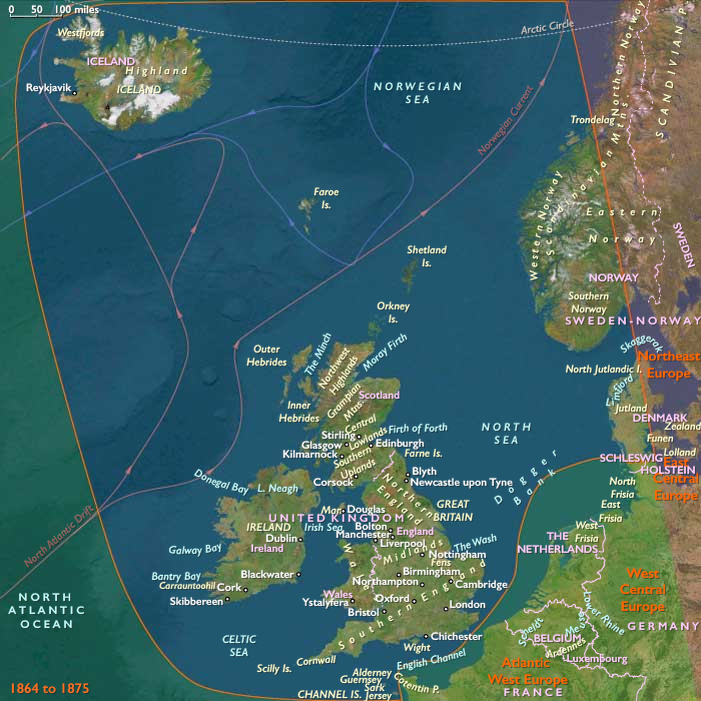
Henri Tolain, Perrachon, and Limousin had visited London in July 1863, attending a meeting held in St. James’ Hall in honor of the Polish uprising.
Here there had been discussion of the need for an international organization that would, among other things, prevent the import of foreign workers to break strikes.
In September 1864, some French delegates again visit London with the concrete aim of setting up a special committee for the exchange of information upon matters of interest to the workers of all lands.
On September 28, a great international meeting for the reception of the French delegates takes place in St. Martin’s Hall, and the positivist, Professor Edward Spencer Beesly, is in the chair.
His speech pillories the violent proceedings of the governments and refers to their flagrant breaches of international law and advocates a union of the workers of the world for the realization of justice on earth.
George Odger, Secretary of the London Trades Council, reads a speech calling for international cooperation, to which Tolain responds.
The meeting unanimously decides to found an international organization of workers.
The center is to be in London, with a committee of twenty-one elected members.
It is instructed to draft rules and constitution.
Most of the British members of the committee are drawn from the Universal League for the Material Elevation of the Industrious Classes and are noted trade-union leaders like Odger, George Howell (former secretary of the London Trades Council (LTC), which itself declines affiliation to the IWA (although remaining close to it)), Osborne, and Lucraft, and includes Owenites and Chartists.
The French members are Denoual, Victor Le Lubez, and Bosquet.
Italy is represented by Fontana.
Other members are Louis Wolff, Johann Eccarius, and at the foot of the list, Karl Marx, who participates in his individual capacity, and does not speak during the meeting.
Marx had moved from Cologne to London in May 1849, where he will remain based for the rest of his life.
It is here that he had founded the new headquarters of the Communist League, and had become heavily involved with the socialist German Workers' Educational Society, who hold their meetings in Great Windmill Street, Soho, central London's entertainment district.
Marx has devoted himself to two activities: revolutionary organizing, and an attempt to understand political economy and capitalism.
For the first few years, he and his family had lived in extreme poverty.
His main source of income was his colleague, Friedrich Engels, who derives much of his income from his family's business.
Marx had also briefly worked as correspondent for the New York Tribune in 1851.
From December 1851 to March 1852, Marx had written The Eighteenth Brumaire of Louis Napoleon, a work on the French Revolution of 1848, in which he had expanded upon his concepts of historical materialism, class struggle and the dictatorship of the proletariat, advancing the argument that victorious proletariat has to smash the bourgeois state.
The 1850s and 1860s also mark the line between what some scholars see as idealistic, Hegelian young Marx from the more scientifically minded mature Marx writings of the later period.
This distinction is usually associated with the structural Marxism school, and not all scholars agree that it exists.
Images

Karl Marx and his daughter Jenny (before May 1864)
Locations
Groups
Subjects
Regions
North Europe
View →Subregions