
Kassel was originally a Roman settlement located…
1189 CE
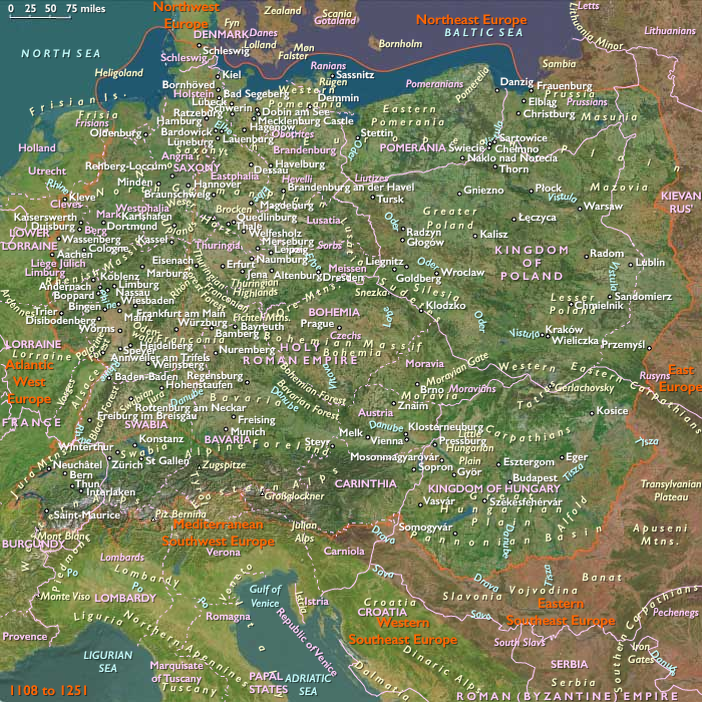
Kassel was originally a Roman settlement located on the Fulda River about ninety-three miles (one hundred and fifty kilometers) northeast of Frankfurt am Main.
The city's name is derived from the ancient Castellum Cattorum, a castle of the Chatti, a German tribe that had lived in the area since Roman times.
Kassel was first mentioned in 913 as the place where two deeds were signed by King Conrad I.
The place was called Chasella and was a fortification at a bridge crossing the Fulda river.
A deed from 1189 certifies that Kassel has city rights, but the date when they were granted is not known.
Locations
Groups
Subjects
Regions
Central Europe
View →Subregions

West Central Europe
View →Related Events
No active filters.
Showing 10 events out of 47983 total
Yoritomo, after confiscating estates in central and western Japan, appoints stewards for the estates and constables for the provinces.
As shogun, Yoritomo is both the steward and the constable general.
The Kamakura shogunate is not a national regime, however, and although it controls large tracts of land, there is strong resistance to the stewards.
The regime continues warfare against the Northern Fujiwara, but will never bring either the north or the west under complete military control.
However, the fourth leader of the Northern Fujiwara, Fujiwara no Yasuhira, is defeated by Yoritomo in 1189 and subsequently beheaded, and the one hundred-year long prosperity of the north disappears.
The old court resides in Kyoto, continuing to hold the land over which it has jurisdiction, while newly organized military families are attracted to Kamakura.
The throne of the western Chalukya dynasty, earlier usurped by Bijjala, leader of the feudatory Kalacuri family, becomes the object of a contest among Bijjala’s successors, allowing Chalukya dynasty Somesvara IV to reverse the usurpation after a decade.
The overall effort by Somesvara IV to rebuild the Chalukya empire fails and the dynasty is ended by the Seunas, who in alliance with rulers dominating the Telugu-speaking regions of the Deccan drive Somesvara IV into exile in Banavasi 1189.
The eastern Chalukya dynasty loses its three-cornered war with the Hoysala, the Seuna Yadavas of Devagiri, and the Kakatiyas.
The Hoysala take territories in the region of modern Mysore state, and the Yadavas take over areas south of the Narmada River; the truncated Chalukya realm, squeezed between the two and blocked on the east by the Kakatiyas, becomes a minor kingdom.
Following the Cholan defeat of the Chalukyas in an important battle, conferences for peace ensue, followed by plans for intermarriage between the contending dynasties, and ending with the eastern Chalukya dynasty’s absorption into the Chola.
The Kakatiya family becomes a Cholan feudatory.
The Seunas and Hoysalas continue after the fall of the Chalukyas to war over the Krishna River region in 1191, each inflicting a defeat on the other at various points in time.
This period sees the fall of two great empires, the Chalukyas of the western Deccan and the Cholas of Tamilakam.
On the ruins of these two empires are built the kingdoms of their feudatories, whose mutual antagonisms will fill the annals of Deccan history for over a hundred years, the Pandyas taking control over some regions of the erstwhile Chola empire.
The ancient Illyrian city of Skopje, situated on a major north-south route of the Balkans, about two hundred miles (three hundred and twenty kilometers) south of present Belgrade, had long been a thriving trading settlement but had fallen into decline after being hit by another devastating earthquake at the end of the eleventh century.
The Serbs take it in 1189 and make it a part of their realm.
Sancho I had become the second king of Portugal at the death of Afonso I in 1185.
Coimbra is the center of his kingdom; Sancho has terminated the exhausting and generally pointless wars against his neighbors for control of the Galician borderlands.
Instead, he turns all his attentions to the south, towards the Moorish small kingdoms (called taifas) that still thrive.
With help from Northern European Crusaders in 1189, he takes Silves, an important city of the south, an administrative and commercial town with a population estimated to be around twenty thousand people.
Sancho orders the fortification of the city and builds a castle that is today an important monument of Portuguese heritage.
However, military attention soon has to be turned again to the North, where León and Castile again threaten the Portuguese borders.
Silves will in 1191 again be lost to Almohad control.
William II of Sicily, the first ruler to respond to the papal appeal, immediately abandons his conflict with Constantinople and equips a fleet that soon leaves for the East (though William himself will die in November 1189).
Ranulf de Glanvill and the Origins of the Praecipe Writ in English Law
During the late reign of Henry II (r. 1154–1189), Ranulf de Glanvill, the King’s Chief Justiciar, compiled an early treatise on English law that included a significant legal innovation—the writ known as “Praecipe” (Latin for "command"). This writ was one of the earliest formalized legal orders in England, marking an important step toward the development of the English common law system.
The Praecipe Writ: Its Function and Importance
- The Praecipe writ was a royal written order, issued in the king’s name, requiring a defendant or local court to take specific legal action.
- It typically commanded the defendant either to perform an action (such as returning land or fulfilling a contract) or to appear in the royal court to explain why they should not do so.
- This writ was issued directly from the royal chancery, bypassing local feudal courts, strengthening the centralized royal justice system.
Glanvill’s Role in Legal Development
- As Henry II’s Chief Justiciar, Ranulf de Glanvill played a key role in formalizing English legal procedures, helping to shape early common law.
- His treatise, Tractatus de Legibus et Consuetudinibus Regni Angliae (A Treatise on the Laws and Customs of the Kingdom of England), was one of the earliest systematic accounts of English law.
- The inclusion of the Praecipe writ in his work demonstrates the increasing use of written legal orders to regulate disputes, shifting legal authority toward the king’s courts.
Impact on English Common Law
- The Praecipe writ contributed to the decline of feudal courts, as litigants increasingly sought royal justice over local baronial rulings.
- It laid the foundation for writ-based legal procedures, which would evolve into the formal common law system.
- The practice of issuing writs from the royal chancery became standard, influencing the later development of English legal administration.
Legacy
- The writ Praecipe was an early example of royal intervention in legal disputes, paving the way for future legal reforms under the Plantagenet kings.
- It became a precursor to later writs, forming the basis for medieval and modern English legal procedures.
- Glanvill’s work influenced subsequent legal scholars, including Henry de Bracton and the framers of Magna Carta (1215), further shaping the English legal tradition.
The writ of Praecipe, introduced in Glanvill’s landmark legal treatise, was a cornerstone of the transformation from feudal justice to centralized royal law, solidifying Henry II’s legacy as the architect of English common law.
Richard and Philip II’s Final Campaign Against Henry II (1189 CE)
By 1189, the conflict between Henry II of England and his son Richard, Duke of Aquitaine, had reached its breaking point. After years of tensions and betrayals, Richard openly joined forces with Philip II of France, launching a final campaign to bring his father to submission.
The 1189 Invasion: The Fall of Henry II
- Richard and Philip II launched their offensive in early summer 1189, forcing Henry into retreat across his own territories.
- The campaign saw Richard and Philip chase Henry from Le Mans to Saumur, in the heart of Angevin-controlled France.
- Along the way, Henry lost Tours, a strategically important city that had long been a center of Angevin power in the Loire Valley.