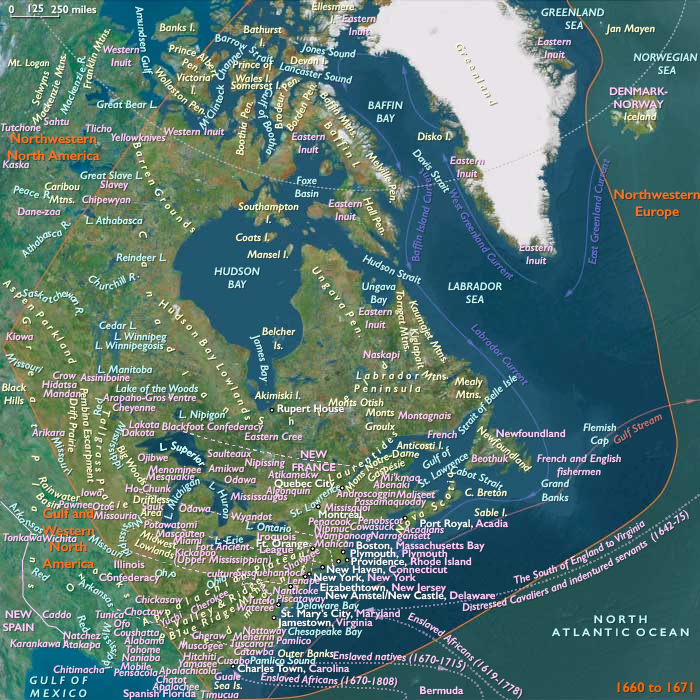
Anthony Ashley Cooper, one of the Province…
1669 CE
During the Commonwealth period he had served in the government of Oliver Cromwell and participated in reviewing English laws and drafting the nation’s first formal constitution.
Before that, English constitutional law had been based on ancient constitutional documents such as the Magna Carta and the Bill of Rights.
The experience had led Ashley Cooper to see value in adopting a formal constitution for the Province of Carolina.
Because the Fundamental Constitutions are drafted during John Locke’s service to Cooper, who is much more involved in the process than the others, it is widely accepted that Locke had a major role in the making of the Constitutions.
In the view of historian David Armitage and political scientist Vicki Hsueh, the Constitutions were co-authored by Locke and his patron Cooper, known also as 1st Earl of Shaftesbury.
The Constitutions bring right to worship and right to constitute a church to the religious dissenters to Christianity and outsiders such as Jews.
They also promised religious tolerance towards idolater natives and heathens.
The Constitutions also acknowledge aristocracy in North America and constitutionalize the practice of slavery.
The notorious article 110 of the Constitutions states that “Every freeman of Carolina shall have absolute power and authority over his negro slaves, of what opinion or religion soever.”
Pursuant to this provision slaveholders are granted absolute power of life and death over their slaves.
Additionally, the Fundamental Constitutions affirm the fact that being a Christian does not alter the civil dominion of a master over his slaves. (Article 107)
Apart from the slavery, the erection of hereditary nobility aside from the proprietors and recognition of noble titles raises controversies.
Because English Law prevents proprietors from granting titles already in use in England, such as Earl or Baron, they create two new titles, cazique and landgrave, that are to be be passed down from father to son.
Those nobles are granted privileges such as being tried only in Chief Justice’s Court and being found guilty by a jury of his peers. (Article 27)
The Constitutions introduce also a hereditary serfdom system, the members of which are called leetmen, in addition to slavery.
Like the slaves, the leetmen and leetwomen are under command and jurisdiction of noblemen to whom they serve. (Article 22)
Through the Constitutions, the Lords Proprietor and the noblemen own the four-fifths of the Colony’s vast lands.
By the same token, the freemen have the right to property for the rest of the land and among them who own more than fifty acres has the right to vote and who has more than five-hundred acres of land has the right to be a member of Parliament. (Article 72)
This requirement of land ownership has been considered as relatively favorable to the freemen in comparison to the laws in England.
Elections are to be held by secret ballot, which is not yet common practice in England.
Laws are to expire automatically after one hundred years, thus preventing outdated regulations from remaining on the books.
Commodities
Regions

Northern North America
View →Subregions