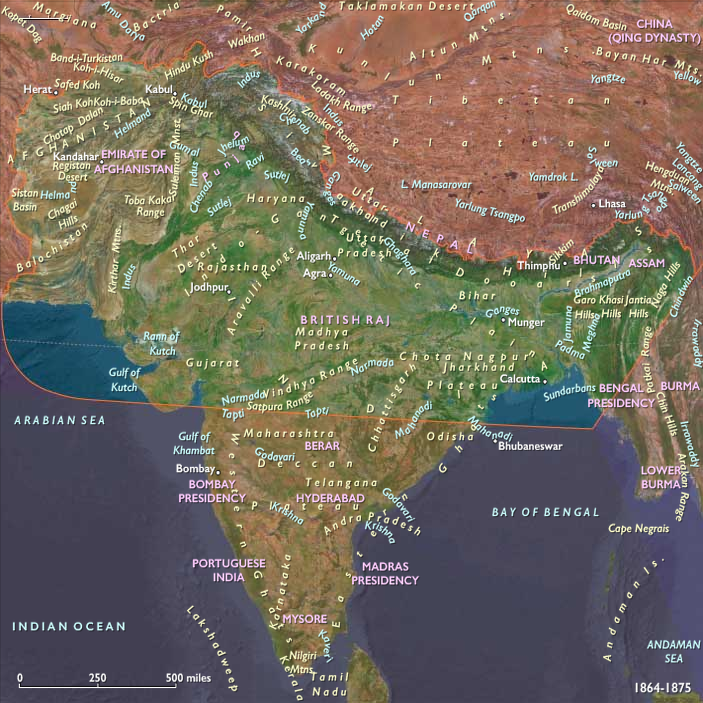
After the death of Jung Bahadur, his…
1864 CE to 1875 CE
After the death of Jung Bahadur, his eldest surviving brother, Ranoddip Singh, becomes prime minister (1877-85).
Because he is childless, his term in office is full of plots by Jung Bahadur's sons and nephews over succession.
These plots are complicated by the death of King Surendra Bikram Shah in 1881 and the royal accession of Prithvi Bir Bikram Shah (reigned 1881-1911) at the age of six.
Finally, the doddering Ranoddip Singh is assassinated, and Bir Shamsher, son of Jung Bahadur's youngest and closest brother, becomes prime minister (1885-1901).
Bir Shamsher immediately launches a purge of his opponents.
While in power, he brings piped water to the Kathmandu Valley, builds a suspension bridge at Kulekhani, and sets up a palace school where English is taught.
His successor for three months will be the progressive Dev Shamsher, who will emancipate all female slaves, establish a network of Nepali-language schools called Bhasa Pathsalas, and start the first Nepali-language newspaper, Gorkhapatra (Gorkha Newsletter).
A coalition of his brothers, upset with his radical tendencies, will force Dev Shamsher's resignation and retirement to India.
Locations
People
Groups
Topics
Regions
South Asia
View →Subregions