
Event
Kingship is said to have resumed at…
Kingship is said to have resumed at Kish after a great flood occurred in Sumer.
The earliest Dynastic name on the list known from other legendary sources is Etana, whom it calls "the shepherd, who ascended to heaven and consolidated all the foreign countries".
He was estimated by Roux to have lived approximately 3000 BCE.
Among the eleven kings who followed, a number of Semitic Akkadian names are recorded, suggesting that these people made up a sizable proportion of the population of this northern city.
The chronology of this age is particularly uncertain due to difficulties in our understanding of the text, our understanding of the material culture of the Early Dynastic period and a general lack of radiocarbon dates for sites in Iraq.
In addition, the multitude of city-states made for a confusing situation, as each had its own history.
The Sumerian king list is one record of the political history of the period.
It starts with mythological figures with improbably long reigns, but later rulers have been authenticated with archaeological evidence.
However, one complication of the Sumerian king list is that although dynasties are listed in sequential order, some of them actually ruled at the same time over different areas.
This illustrates a weakness of the Sumerian king list, as contemporaries are often placed in successive dynasties, making reconstruction difficult.
The earliest monarch on the list whose historical existence has been independently attested through archaeological inscription is En-me-barage-si of Kish, who flourishes around 2550–2450 BCE, or perhaps later.
The first historical personality of Mesopotamia, Enmebaragesi is known from inscriptions about him on fragments of vases of his own time, as well as from later traditions.
He is the next-to-last ruler of the first dynasty of Kish.
He “despoiled the weapons of the land of Elam,” one inscription asserts, and is said to have built the temple of Enlil in Nippur.
His son, Agga, is the last king of the dynasty, owing to his defeat by Gilgamesh of Uruk, the fifth king of that city, according to the Sumerian epic Gilgamesh and Agga of Kish.
From this time, for a period Uruk seems to have had some kind of hegemony in Sumer.
-
{# Image navigates to the detail page; the magnifying-glass chip is the only Fancybox lightbox trigger (kept a separate sibling — anchors can't nest). #}
 The Great Crossroads
World
-
{# Image navigates to the detail page; the magnifying-glass chip is the only Fancybox lightbox trigger (kept a separate sibling — anchors can't nest). #}
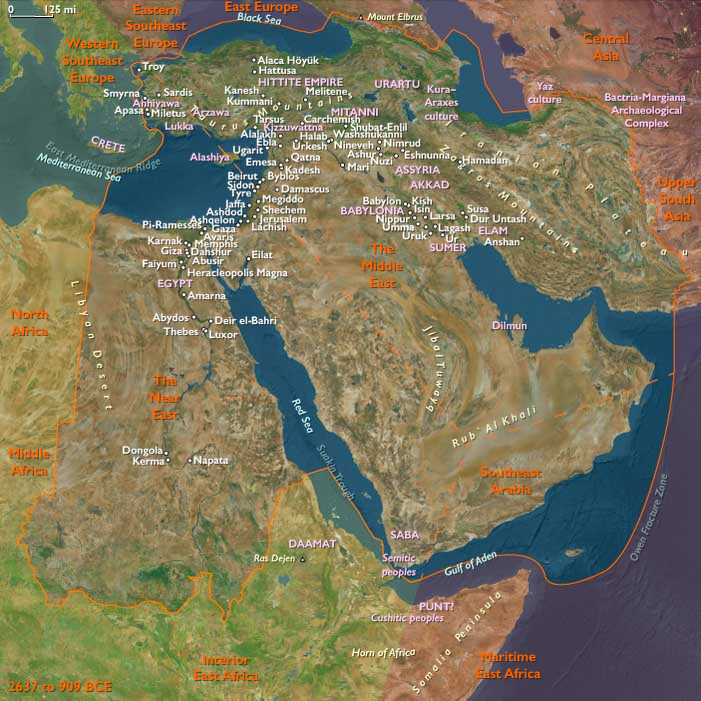 The Near and Middle East
Region
-
{# Image navigates to the detail page; the magnifying-glass chip is the only Fancybox lightbox trigger (kept a separate sibling — anchors can't nest). #}
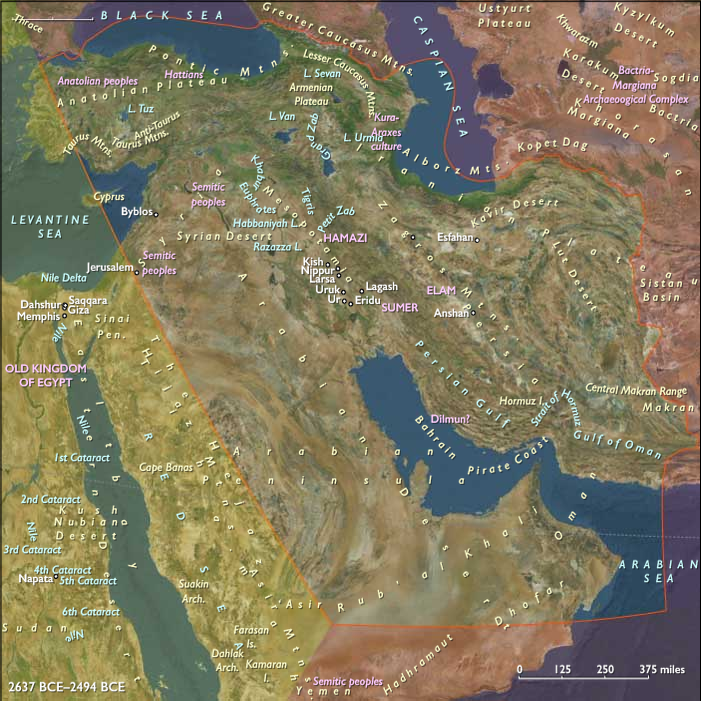 Middle East
Subregion
