
Klenová castle, a large castle located in…
1291 CE
Klenová castle, a large castle located in southwest Bohemia near the town of Klatovy, is built in 1291 as a part of the frontier defense system.
People
Groups
Subjects
Regions
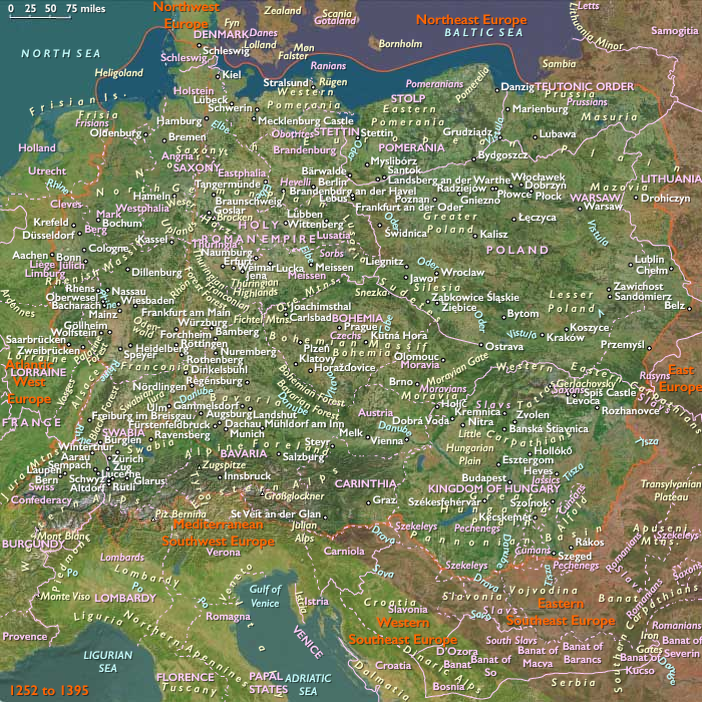
Central Europe
View →Subregions

East Central Europe
View →Related Events
No active filters.
Showing 10 events out of 45309 total
Kertanegara, knowing that the Mongol ruler will send a military expedition to punish him, tries to solidify his power.
Around 1291, the Singasari ruler launches the Pamalayu expedition to Sumatra, in order to conquer the Malay kingdom of Jambi in the south, one of successor states to Srivijaya.
Jambi is one of the first Indonesian polities where Islam had established its presence, and it already entertains cordial relationships with Yuan China.
Kublai Khan has ordered that a strong punitive naval expedition be launched against the remote equatorial islands in order to punish Kertanegara.
He sends a massive expedition of one thousand ships to Java.
Meanwhile, Kertanegara has dominated all of Java, but before the Mongol fleet arrives, a dramatic political change occurs.
Jayakatwang, prince of Kediri and one of Singhasari's most powerful vassals, rebels against his overlord.
Guo Shoujing, an engineer and astronomer, constructs the artificial Kunming Lake as a reservoir for the capital of the Yuan Dynasty in 1291.
Albert of Habsburg has ruled as a landgrave from 1290 over his father's Swabian (Further Austrian) possessions in Alsace.
In 1282, his father, the first German monarch from the House of Habsburg, had invested him and his younger brother Rudolf II with the duchies of Austria and Styria, which he had seized from late King Ottokar II of Bohemia and defended in the 1278 Battle on the Marchfeld.
By the 1283 Treaty of Rheinfelden, Albert’s father had entrusted with their sole government, while Rudolf II ought to have been compensated by the Further Austrian Habsburg home territories—which, however, never happened until his death in 1290.
Albert and his Swabian ministeriales appear to have ruled the Austrian and Styrian duchies with conspicuous success, overcoming the resistance by local nobles.
King Rudolf I had been unable to secure the succession to the German throne for his son, especially due to the objections raised by Ottokar's son King Wenceslaus II of Bohemia, and the plans to install Albert as successor of the assassinated King Ladislaus IV of Hungary in 1290 had also failed.
Upon Rudolf's death in 1291, the Prince-electors, fearing Albert's power and the implementation of a hereditary monarchy, choose Count Adolf of Nassau-Weilburg as King of the Romans.
A rising among his Styrian dependents compels Albert to recognize the sovereignty of his rival and to confine himself for a time to the government of the Habsburg lands at Vienna.
Bratislava, a town occupied by the Slovaks in the eighth century, and part of Hungary from the eleventh century, is situated on the left bank of the Danube River, where the Little Carpathian Mountains cut across the valley from Austria, and located near the point where the present borders of Slovakia, Austria, and Hungary meet.
Recognized as a city and given town privileges by Hungarian king Andrew III in 1291, it is today the capital of Slovakia.
Wladyslaw, unfortunately for his designs on Poland’s reunification, has to defer to King Wenceslaus of Bohemia, who has the support of the local lords and in 1291 is named Duke of Kraków.
However, Wladyslaw enjoys the support of Lesser Poland’s peasants, knights, and part of the clergy, who prefer a prince from the domestic Piast dynasty, as is Wladyslaw.
John of Montecorvino and his companions had moved from Persia down by sea to India, in 1291, to the Madras region or "Country of St. Thomas" where he has preached for thirteen months and baptized about one hundred persons; his companion Nicholas dies.
From here Montecorvino writes home, in December 1291 (or 1292), the earliest noteworthy account of the Coromandel coast furnished by any Western European.
The Latin Kingdom of Jerusalem is increasingly torn by conflicts between the barons and their rulers; among the Venetian, Genoese, and Pisan colonists; and between the military orders of the Hospitallers and the Templars, whose orders provide the only reliable armed force.
The Kingdom ceases to exist after the desperate and heroic defense of Acre meets a disastrous end on May 18, 1291 at the hands of the Mamluk sultan al-Ashraf Khalil, who captures the city and massacres its inhabitants and enslaves the survivors.
This is the last of the Crusader States, save for …
…the Lusignac kingdom of Cyprus, to which the expelled Hospitallers now retreat, removing their headquarters to Limassol.
The victorious Mamluks now systematically destroy every Christian fortress on the Mediterranean coast, including Tyre.
Germanic Alemannic peoples had increased their influence on the area of present day north-central Switzerlan after the fall of the Roman Empire beginning in the sixth century.
The Benedictine Monastery of St. Leodegar was founded around 750 and later acquired by Murbach Abbey in Alsace in the middle of the ninth century, by which time the area had become known as Luciaria.
In 1178, Lucerne acquired its independence from the jurisdiction of Murbach Abbey, and the founding of the city proper probably occurred that same year.
The city has gained importance as a strategically located gateway for the growing commerce from the Gotthard trade route.
By 1290, Lucerne has become a self-sufficient city of reasonable size with about three thousand inhabitants.
About this time, German King Rudolph I von Habsburg gains authority over the Monastery of St. Leodegar and its lands, including Lucerne.
The populace is not content with the increasing Habsburg influence, and Lucerne allies with neighboring towns to seek independence from their rule.